
Articles liés à Elizabethan Instrument Makers. The Origin Of The London...
Elizabethan Instrument Makers. The Origin Of The London Trade In Precision Instrument Making - Couverture rigide
Synopsis
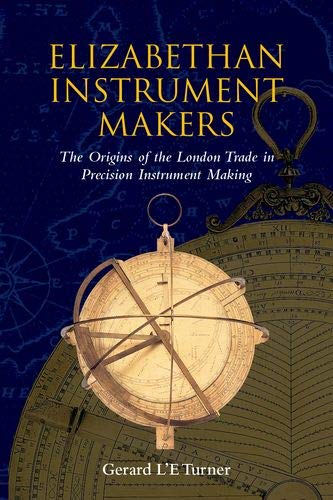
Europe in the sixteenth century experienced a period of unprecedented vitality and innovation in the spheres of science and commerce. The Americans had been discovered and the colonizing nations had au urgent need for mathematical instruments for navigation and surveying. The Elizabethan age saw the establishment of the precision instrument-making trade in London, from 1540, a trade that would become world-famous in the succeeding two centuries. The mathematical instruments and charts needed by astronomers, navigators, and surveyors owe much of their development to the work of the Flemish mathematician and astronomer, Gemma Frisius, and to the map and globe maker, Gerard Mercator, both of whom studied at Louvain. It was an immigrant from Flanders, Thomas Gemini, who is credited with starting the London trade in 1540 : his reputation came from making the plates for his own printing of the Anatomy of Vesalius, and the astrolabes he made and presented to Edward VI and Elizabeth I have survived. He was followed by Humphrey Cole, and other makers whose instruments have survived, including Ryther, Knyvyn, and Whitwell. This book first describes the context in which the Elizabethan trade began, and the influence of the instruments taken to Florence by Sir Robert Dudley in 1606.The second part catalogues in detail every surviving instrument from this period, signed and unsigned, that has been traced. The catalogue is accompanied by fine photographs which illustrate both the instruments and the techniques used to identify unsigned instruments.
Les informations fournies dans la section « Synopsis » peuvent faire référence à une autre édition de ce titre.
À propos de l'auteur
Gerard L'E Turner, Dlitt, is Visiting Professor of the History of Scientific instruments at Imperial College, London. Originally a physicist, he joined the staff of the Museum of the History of Science, Oxford University, in 1964, and became Senior Assistant Curator. He has been President of the Royal Microscopical Society, and of the British Society for the History of Science, and editor of the international journal, Annals of Science. He is a member of the Académie internationale d'Histoire des Sciences, and currently President of the Scientific Instrument Society. His two most recent books are The Practice of Science in the Nineteenth Century, and Scientific Instruments 1500-1900 : An Introduction.
Les informations fournies dans la section « A propos du livre » peuvent faire référence à une autre édition de ce titre.
Résultats de recherche pour Elizabethan Instrument Makers. The Origin Of The London...

Image d'archives
Elizabethan Instrument Makers The Origins of the London Trade in Precision Instrument Making
Edité par
Oxford University Press, 2000
ISBN 10 : 0198565666
ISBN 13 : 9780198565666
Ancien ou d'occasion
Couverture rigide
Vendeur : Powell's Bookstores Chicago, ABAA, Chicago, IL, Etats-Unis
Évaluation du vendeur 5 sur 5 étoiles

Hardcover. Etat : Very Good. Etat de la jaquette : Very Good. Cloth, dj. Minor edge wear to jacket. Else a bright, clean copy. Europe in the sixteenth century experienced a period of unprecedented vitality and innovation in the spheres of science and commerce. The Americas had been discovered and the colonizing nations had an urgent need for mathematical instruments for navigation and surveying. In 1540 the Elizabethan age saw the establishment of the precision instrument-making trade in London, a trade that would become world-famous in the succeeding two centuries. The mathematical instruments needed by astronomers, navigators, and surveyors owe much of their development to the work of the Flemish mathematician and astronomer, Gemma Frisius, and to the map and globe maker, Gerard Mercator, both of whom studied at Louvain. However it was Thomas Gemini who is credited with starting the London trade in 1540: his reputation came from making the plates for his own printing of the Anatomy of Vesalius, and the astrolabes he made and presented to Edward VI and Elizabeth I, which survive today. He was followed by Humphrey Cole, and other makers whose instruments have survived, including Ryther, Knyvyn, and Whitwell. This book first describes the context in which the Elizabethan trade began, and the influence of the instruments taken to Florence by Sir Robert Dudley in 1606. The second part catalogues in detail every surviving instrument from this period, signed and unsigned, that has been traced. The catalogue is accompanied by fine photographs which illustrate both the instruments and the techniques used to identify unsigned instruments. N° de réf. du vendeur 2041823
Acheter D'occasion
EUR 61,49
Expédition à EUR 4,39
Expédition nationale : Etats-Unis
Expédition nationale : Etats-Unis
Quantité disponible : 1 disponible(s)
Image d'archives
Elizabethan Instrument Makers: The Origins of the London Trade in Precision Instrument Making (eng)
Edité par
Oxford University Press, 2001
ISBN 10 : 0198565666
ISBN 13 : 9780198565666
Neuf
Couverture rigide
Vendeur : Brook Bookstore On Demand, Napoli, NA, Italie
Évaluation du vendeur 5 sur 5 étoiles
Etat : new. Questo è un articolo print on demand. N° de réf. du vendeur 7d145be343d6715a84946140d0ba8103
Acheter neuf
EUR 74,82
Expédition à EUR 8
Expédition depuis Italie vers Etats-Unis
Expédition depuis Italie vers Etats-Unis
Quantité disponible : Plus de 20 disponibles
Image fournie par le vendeur
Elizabethan Instrument Makers: The Origins of the London Trade in Precision Instrument Making - signed
Edité par
OUP OXFORD, 2001
ISBN 10 : 0198565666
ISBN 13 : 9780198565666
Ancien ou d'occasion
Couverture rigide
Vendeur : Optimon Books, Gravesend, KENT, Royaume-Uni
Évaluation du vendeur 5 sur 5 étoiles
Hardcover. Etat : Good. Europe in the sixteenth century experienced a period of unprecedented vitality and innovation in the spheres of science and commerce. The Americas had been discovered and the colonizing nations had an urgent need for mathematical instruments for navigation and surveying. The Elizabethan age saw the establishment of the precision instrument-making trade in London, from 1540, a trade that would become world-famous in the succeeding two centuries.The first of a group of London makers was an immigrant from Flanders, Thomas Gemini, succeeded by the Englishman, Humfrey Cole.It has proved possible to find over 100 surviving mathematical instruments, signed and unsigned, made by a group of London makers during the reign of Queen Elizabeth I. This book describes these instruments in detail, together with the methods by which unsigned instruments are attributed. It tells how the skills of dividing and engraving on brass developed in parallel with the map-making and printing for which the Low Countries were the most important centre. There was already a demand in Elizabethan England for these skills, since accurate measurement was crucial to the professions of navigation, surveying, fortification, and gunnery. England, at war with Spain, eager to exploit the riches of the New World, and, at home, experiencing the re-distribution of monastic property to individual landowners, urgently needed these new professions. unclipped d/j, minimal shelf wear, text clean and unmarked. Copyright © OUP OXFORD. N° de réf. du vendeur 465050
Acheter D'occasion
EUR 62,27
Expédition à EUR 20,93
Expédition depuis Royaume-Uni vers Etats-Unis
Expédition depuis Royaume-Uni vers Etats-Unis
Quantité disponible : 1 disponible(s)
Image fournie par le vendeur
Elizabethan Instrument Makers The Origins of the London Trade in Precision Instrument Making
Edité par
Oxford Oxford University Press 2000, 2001
ISBN 10 : 0198565666
ISBN 13 : 9780198565666
Ancien ou d'occasion
Couverture rigide
Edition originale
Vendeur : Chaucer Bookshop ABA ILAB, Canterbury, Royaume-Uni
Évaluation du vendeur 4 sur 5 étoiles

FIRST EDITION Large 8vo. navy clothboud hardback, gilt, with dust jacket. 305pp. with b/w illustrations and colour frontispiece. Dust Jacket has not been price-clipped. A clean copy with no previous owners' markings or inscriptions. VG/VG. (Shelf 30) ISBN: 0198565666 NOTE: Heavy Book (1 kg +) Postage outside the UK might incur a surcharge. Buyer is responsible for any additional duties, taxes, or fees required by recipient's country.** Pictures available upon request.** Visit our homepage for our shop opening hours. Over 20,000 books in stock - come and browse. PayPal, credit and most debit cards welcome. Books posted worldwide. For any queries please contact us direct. N° de réf. du vendeur 46012
Acheter D'occasion
EUR 55,09
Expédition à EUR 29,07
Expédition depuis Royaume-Uni vers Etats-Unis
Expédition depuis Royaume-Uni vers Etats-Unis
Quantité disponible : 1 disponible(s)
Image fournie par le vendeur
Elizabethan Instrument Makers: The Origins of the London Trade in Precision Instrument Making
Edité par
Oxford University Press, 2000
ISBN 10 : 0198565666
ISBN 13 : 9780198565666
Ancien ou d'occasion
Couverture rigide
Edition originale
Vendeur : Moroccobound Fine Books, IOBA, Lewis Center, OH, Etats-Unis
Évaluation du vendeur 5 sur 5 étoiles
Hardcover. Etat : Fine. Etat de la jaquette : Fine. 1st Edition. 303 pp. Hardcover, bound in boards with dust jacket. Unmarked copy. N° de réf. du vendeur Bx116-E
Acheter D'occasion
EUR 81,38
Expédition à EUR 5,04
Expédition nationale : Etats-Unis
Expédition nationale : Etats-Unis
Quantité disponible : 1 disponible(s)
Image fournie par le vendeur
Elizabethan Instrument Makers : The Origins of the London Trade in Precision Instrument Making
Edité par
Oxford University Press, Oxford, 2000
ISBN 10 : 0198565666
ISBN 13 : 9780198565666
Ancien ou d'occasion
Couverture rigide
Edition originale
Vendeur : Trinders' Fine Tools, Clare, Sudbury, Royaume-Uni
Évaluation du vendeur 4 sur 5 étoiles
Hardcover. Etat : Fine. Etat de la jaquette : Fine. First Edition. 305 pages, colour frontispiece and 14 colour plates, black and white illustrations. First describes the context in which the Elizabethan trade began and the known craftsmen; the second part catalogues in detail every surviving instrument from this period, signed and unsigned, that has been traced. Appendix on the attribution of unsigned instruments; Bibliography. An important recent reference work. N° de réf. du vendeur 000938
Acheter D'occasion
EUR 77,85
Expédition à EUR 12,15
Expédition depuis Royaume-Uni vers Etats-Unis
Expédition depuis Royaume-Uni vers Etats-Unis
Quantité disponible : 1 disponible(s)
Image d'archives
Elizabethan Instrument Makers: The Origins of the London Trade in Precision Instrument Making
Edité par
Oxford University Press, 2001
ISBN 10 : 0198565666
ISBN 13 : 9780198565666
Neuf
Couverture rigide
Vendeur : THE SAINT BOOKSTORE, Southport, Royaume-Uni
Évaluation du vendeur 5 sur 5 étoiles
Hardback. Etat : New. New copy - Usually dispatched within 4 working days. N° de réf. du vendeur B9780198565666
Acheter neuf
EUR 100,89
Expédition à EUR 23,28
Expédition depuis Royaume-Uni vers Etats-Unis
Expédition depuis Royaume-Uni vers Etats-Unis
Quantité disponible : Plus de 20 disponibles
Image d'archives
Elizabethan Instrument Makers. The Origins of the London Trade in Precision Instrument Making.
Edité par
-Oxford University Press -, 2000
ISBN 10 : 0198565666
ISBN 13 : 9780198565666
Ancien ou d'occasion
Couverture rigide
Vendeur : Paul Brown, Ramsgate, Royaume-Uni
Évaluation du vendeur 4 sur 5 étoiles
First edition. xiv+305 pages with index. Illustrated black and white and color. Cloth. As new. Fine in fine dustjacket. Europe in the sixteenth century experienced a period of unprecedented vitality and innovation in the spheres of science and commerce. The Americas had been discovered and the colonizing nations had an urgent need for mathematical instruments for navigation and surveying. The Elizabethan age saw the establishment of the precision instrument-making trade in London, from 1540, a trade that would become world-famous in the succeeding two centuries.The first of a group of London makers was an immigrant from Flanders, Thomas Gemini, succeeded by the Englishman, Humfrey Cole.It has proved possible to find over 100 surviving mathematical instruments, signed and unsigned, made by a group of London makers during the reign of Queen Elizabeth I. This book describes these instruments in detail, together with the methods by which unsigned instruments are attributed. It tells how the skills of dividing and engraving on brass developed in parallel with the map-making and printing for which the Low Countries were the most important centre. There was already a demand in Elizabethan England for these skills, since accurate measurement was crucial to the professions of navigation, surveying, fortification, and gunnery. England, at war with Spain, eager to exploit the riches of the New World, and, at home, experiencing the re-distribution of monastic property to individual landowners, urgently needed these new professions. N° de réf. du vendeur 10386
Acheter D'occasion
EUR 95,81
Expédition à EUR 29,48
Expédition depuis Royaume-Uni vers Etats-Unis
Expédition depuis Royaume-Uni vers Etats-Unis
Quantité disponible : 1 disponible(s)