
Articles liés à Narrative of Sojourner Truth (Dover Thrift Editions)
Synopsis
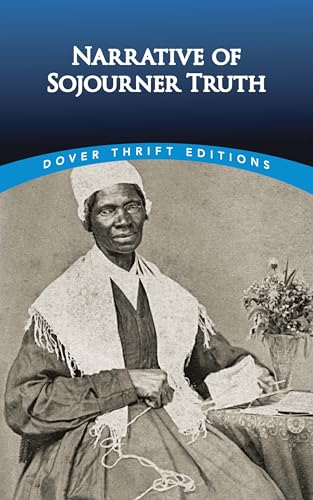
One of the most famous and admired African-American women in U.S. history, Sojourner Truth sang, preached, and debated at camp meetings across the country, led by her devotion to the antislavery movement and her ardent pursuit of women's rights. Born into slavery in 1797, Truth fled from bondage some 30 years later to become a powerful figure in the progressive movements reshaping American society. This remarkable narrative, first published in 1850, offers a rare glimpse into the little-documented world of Northern slavery. Truth recounts her life as a slave in rural New York, her separation from her family, her religious conversion, and her life as a traveling preacher during the 1840s. She also describes her work as a social reformer, counselor of former slaves, and sponsor of a black migration to the West. A spellbinding orator and implacable prophet, Truth mesmerized audiences with her tales of life in bondage and with her moving renditions of Methodist hymns and her own songs. Frederick Douglass described her message as a "strange compound of wit and wisdom, of wild enthusiasm, and flint-like common sense." This inspiring account of a black woman's struggles for racial and sexual equality is essential reading for students of American history, as well as for those interested in the continuing quest for equality of opportunity.
Les informations fournies dans la section « Synopsis » peuvent faire référence à une autre édition de ce titre.
Présentation de l'éditeur
One of the most famous and admired African-American women in U.S. history, Sojourner Truth sang, preached, and debated at camp meetings across the country, led by her devotion to the antislavery movement and her ardent pursuit of women's rights. Born into slavery in 1797, Truth fled from bondage some 30 years later to become a powerful figure in the progressive movements reshaping American society. This remarkable narrative, first published in 1850, offers a rare glimpse into the little-documented world of Northern slavery. Truth recounts her life as a slave in rural New York, her separation from her family, her religious conversion, and her life as a traveling preacher during the 1840s. She also describes her work as a social reformer, counselor of former slaves, and sponsor of a black migration to the West. A spellbinding orator and implacable prophet, Truth mesmerized audiences with her tales of life in bondage and with her moving renditions of Methodist hymns and her own songs. Frederick Douglass described her message as a "strange compound of wit and wisdom, of wild enthusiasm, and flint-like common sense." This inspiring account of a black woman's struggles for racial and sexual equality is essential reading for students of American history, as well as for those interested in the continuing quest for equality of opportunity.
Présentation de l'éditeur
Narrative of Sojourner Truth
Written by Olive Gilbert
Based on information provided by Sojourner Truth
1850
A CLASSIC SLAVE NARRATIVE
Complete New Edition
Sojourner Truth (c. 1797 – November 26, 1883) was an African-American abolitionist and women's rights activist. Truth was born into slavery in Swartekill, Ulster County, New York, but escaped with her infant daughter to freedom in 1826. After going to court to recover her son, she became the first black woman to win such a case against a white man. Sojourner Truth was named Isabella ("Bell") Baumfree when she was born. She gave herself the name Sojourner Truth in 1843. Her best-known speech was delivered extemporaneously, in 1851, at the Ohio Women's Rights Convention in Akron, Ohio. The speech became widely known as "Ain't I a Woman?" (a title taken from a version of the speech rewritten by a white writer using a stereotypical Southern dialect.) During the Civil War, Truth helped recruit black troops for the Union Army; after the war, she tried unsuccessfully to secure land grants from the federal government for former slaves.
Les informations fournies dans la section « A propos du livre » peuvent faire référence à une autre édition de ce titre.
Résultats de recherche pour Narrative of Sojourner Truth (Dover Thrift Editions)

Image d'archives
Narrative of Sojourner Truth D
Edité par
Dover Publications, Incorporated, 2016
ISBN 10 : 048629899X
ISBN 13 : 9780486298993
Ancien ou d'occasion
Couverture souple
Vendeur : World of Books (was SecondSale), Montgomery, IL, Etats-Unis
Évaluation du vendeur 5 sur 5 étoiles

Etat : Good. Item in good condition. Textbooks may not include supplemental items i.e. CDs, access codes etc. N° de réf. du vendeur 00065102710
Acheter D'occasion
EUR 3,68
Livraison gratuite
Expédition nationale : Etats-Unis
Expédition nationale : Etats-Unis
Quantité disponible : 10 disponible(s)
Image d'archives
Narrative of Sojourner Truth D
Edité par
Dover Publications, Incorporated, 2016
ISBN 10 : 048629899X
ISBN 13 : 9780486298993
Ancien ou d'occasion
Couverture souple
Vendeur : World of Books (was SecondSale), Montgomery, IL, Etats-Unis
Évaluation du vendeur 5 sur 5 étoiles
Etat : Acceptable. Item in acceptable condition! Textbooks may not include supplemental items i.e. CDs, access codes etc. N° de réf. du vendeur 00102883269
Acheter D'occasion
EUR 3,68
Livraison gratuite
Expédition nationale : Etats-Unis
Expédition nationale : Etats-Unis
Quantité disponible : 1 disponible(s)
Image d'archives
The Narrative of Sojourner Truth (Dover Thrift Editions)
Edité par
Dover Publications, Incorporated, 2016
ISBN 10 : 048629899X
ISBN 13 : 9780486298993
Ancien ou d'occasion
Paperback
Vendeur : Gulf Coast Books, Cypress, TX, Etats-Unis
Évaluation du vendeur 5 sur 5 étoiles
Paperback. Etat : Good. N° de réf. du vendeur 048629899X-3-19404203
Acheter D'occasion
EUR 3,69
Livraison gratuite
Expédition nationale : Etats-Unis
Expédition nationale : Etats-Unis
Quantité disponible : 1 disponible(s)
Image d'archives
The Narrative of Sojourner Truth (Dover Thrift Editions: Black History)
Edité par
Dover Publications, Incorporated, 2016
ISBN 10 : 048629899X
ISBN 13 : 9780486298993
Ancien ou d'occasion
paperback
Vendeur : Your Online Bookstore, Houston, TX, Etats-Unis
Évaluation du vendeur 5 sur 5 étoiles
paperback. Etat : Fair. N° de réf. du vendeur 048629899X-4-28206944
Acheter D'occasion
EUR 3,69
Livraison gratuite
Expédition nationale : Etats-Unis
Expédition nationale : Etats-Unis
Quantité disponible : 2 disponible(s)
Image fournie par le vendeur
The Narrative of Sojourner Truth
Edité par
Dover Publications, Incorporated, 2016
ISBN 10 : 048629899X
ISBN 13 : 9780486298993
Ancien ou d'occasion
Couverture souple
Vendeur : Zoom Books East, Glendale Heights, IL, Etats-Unis
Évaluation du vendeur 5 sur 5 étoiles
Etat : good. Book is in good condition and may include underlining highlighting and minimal wear. The book can also include "From the library of" labels. May not contain miscellaneous items toys, dvds, etc. . We offer 100% money back guarantee and 24 7 customer service. N° de réf. du vendeur ZEV.048629899X.G
Acheter D'occasion
EUR 4,02
Livraison gratuite
Expédition nationale : Etats-Unis
Expédition nationale : Etats-Unis
Quantité disponible : 1 disponible(s)
Image fournie par le vendeur
The Narrative of Sojourner Truth
Edité par
Dover Publications, Incorporated, 2016
ISBN 10 : 048629899X
ISBN 13 : 9780486298993
Ancien ou d'occasion
Couverture souple
Vendeur : Greenworld Books, Arlington, TX, Etats-Unis
Évaluation du vendeur 5 sur 5 étoiles
Etat : good. Fast Free Shipping â" Good condition. It may show normal signs of use, such as light writing, highlighting, or library markings, but all pages are intact and the book is fully readable. A solid, complete copy that's ready to enjoy. N° de réf. du vendeur GWV.048629899X.G
Acheter D'occasion
EUR 4,48
Livraison gratuite
Expédition nationale : Etats-Unis
Expédition nationale : Etats-Unis
Quantité disponible : 1 disponible(s)
Image d'archives
The Narrative of Sojourner Truth (Dover Thrift Editions: Black History)
Edité par
Dover Publications, Incorporated, 2016
ISBN 10 : 048629899X
ISBN 13 : 9780486298993
Ancien ou d'occasion
Soft cover
Vendeur : Orchard Bookshop, Houston, TX, Etats-Unis
Évaluation du vendeur 5 sur 5 étoiles
Soft cover. Etat : Fair. N° de réf. du vendeur ABE-1740774324418
Acheter D'occasion
EUR 1,37
Expédition à EUR 3,52
Expédition nationale : Etats-Unis
Expédition nationale : Etats-Unis
Quantité disponible : 1 disponible(s)
Image d'archives
The Narrative of Sojourner Truth
Edité par
Dover Publications, Incorporated, 2016
ISBN 10 : 048629899X
ISBN 13 : 9780486298993
Ancien ou d'occasion
paperback
Vendeur : Evergreen Goodwill, Seattle, WA, Etats-Unis
Évaluation du vendeur 5 sur 5 étoiles
paperback. Etat : Good. N° de réf. du vendeur mon0000772588
Acheter D'occasion
EUR 1,37
Expédition à EUR 3,52
Expédition nationale : Etats-Unis
Expédition nationale : Etats-Unis
Quantité disponible : 1 disponible(s)
Image d'archives
Narrative of Sojourner Truth
Edité par
Dover Publications July 1997, 1997
ISBN 10 : 048629899X
ISBN 13 : 9780486298993
Ancien ou d'occasion
Paper Back
Vendeur : Eagle Eye Books, Decatur, GA, Etats-Unis
Évaluation du vendeur 4 sur 5 étoiles

Paper Back. Etat : Used. N° de réf. du vendeur 857021
Acheter D'occasion
EUR 1,81
Expédition à EUR 3,52
Expédition nationale : Etats-Unis
Expédition nationale : Etats-Unis
Quantité disponible : 1 disponible(s)
Image fournie par le vendeur
Narrative of Sojourner Truth
Edité par
Dover Publications, Incorporated, 2016
ISBN 10 : 048629899X
ISBN 13 : 9780486298993
Ancien ou d'occasion
Couverture souple
Vendeur : GreatBookPrices, Columbia, MD, Etats-Unis
Évaluation du vendeur 5 sur 5 étoiles
Etat : good. May show signs of wear, highlighting, writing, and previous use. This item may be a former library book with typical markings. No guarantee on products that contain supplements Your satisfaction is 100% guaranteed. Twenty-five year bookseller with shipments to over fifty million happy customers. N° de réf. du vendeur 440749-5
Acheter D'occasion
EUR 3,03
Expédition à EUR 2,33
Expédition nationale : Etats-Unis
Expédition nationale : Etats-Unis
Quantité disponible : 2 disponible(s)