
Articles liés à Application Of Muscle/Nerve Stimulation In Health And...
Synopsis
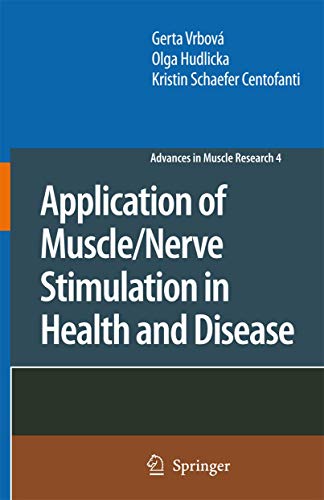
The first evidence that electrical changes can cause muscles to contract was p- vided by Galvani (1791). Galvani's ideas about 'animal electricity' were explored during the 19th and 20th century when it was firmly established that 'electricity' is one of the most important mechanisms used for communication by the nervous system and muscle. These researches lead to the development of ever more soph- ticated equipment that could either record the electrical changes in nerves and muscles, or elicit functional changes by electrically stimulating these structures. It was indeed the combination of these two methods that elucidated many of the basic principles about the function of the nervous system. Following these exciting findings, it was discovered that electrical stimulation and the functions elicited by it also lead to long-term changes in the properties of nerves and particularly muscles. Recent findings help us to understand the mec- nisms by which activity induced by electrical stimulation can influence mature, fully differentiated cells, in particular muscles, blood vessels and nerves. Electrically elicited activity determines the properties of muscle fibres by activating a sequence of signalling pathways that change the gene expression of the muscle. Thus, elect- cal activity graduated from a simple mechanism that is used to elicit muscle c- traction, to a system that could induce permanent changes in muscles and modify most of its characteristic properties.
Les informations fournies dans la section « Synopsis » peuvent faire référence à une autre édition de ce titre.
Résultats de recherche pour Application Of Muscle/Nerve Stimulation In Health And...

Image d'archives
Application of Muscle/Nerve Stimulation in Health and Disease
Edité par
Springer, 2008
ISBN 10 : 1402082320
ISBN 13 : 9781402082320
Ancien ou d'occasion
Couverture rigide
Vendeur : ThriftBooks-Atlanta, AUSTELL, GA, Etats-Unis
Évaluation du vendeur 5 sur 5 étoiles

Hardcover. Etat : Very Good. No Jacket. Former library book; May have limited writing in cover pages. Pages are unmarked. ~ ThriftBooks: Read More, Spend Less. N° de réf. du vendeur G1402082320I4N10
Acheter D'occasion
EUR 77,05
Livraison gratuite
Expédition nationale : Etats-Unis
Expédition nationale : Etats-Unis
Quantité disponible : 1 disponible(s)
Image fournie par le vendeur
Application of Muscle/Nerve Stimulation in Health and Disease
Edité par
SPRINGER NATURE Mai 2008, 2008
ISBN 10 : 1402082320
ISBN 13 : 9781402082320
Neuf
Couverture rigide
Vendeur : BuchWeltWeit Ludwig Meier e.K., Bergisch Gladbach, Allemagne
Évaluation du vendeur 5 sur 5 étoiles
Buch. Etat : Neu. This item is printed on demand - it takes 3-4 days longer - Neuware -The first evidence that electrical changes can cause muscles to contract was p- vided by Galvani (1791). Galvani's ideas about 'animal electricity' were explored during the 19th and 20th century when it was firmly established that 'electricity' is one of the most important mechanisms used for communication by the nervous system and muscle. These researches lead to the development of ever more soph- ticated equipment that could either record the electrical changes in nerves and muscles, or elicit functional changes by electrically stimulating these structures. It was indeed the combination of these two methods that elucidated many of the basic principles about the function of the nervous system. Following these exciting findings, it was discovered that electrical stimulation and the functions elicited by it also lead to long-term changes in the properties of nerves and particularly muscles. Recent findings help us to understand the mec- nisms by which activity induced by electrical stimulation can influence mature, fully differentiated cells, in particular muscles, blood vessels and nerves. Electrically elicited activity determines the properties of muscle fibres by activating a sequence of signalling pathways that change the gene expression of the muscle. Thus, elect- cal activity graduated from a simple mechanism that is used to elicit muscle c- traction, to a system that could induce permanent changes in muscles and modify most of its characteristic properties. 118 pp. Englisch. N° de réf. du vendeur 9781402082320
Acheter neuf
EUR 149,79
Expédition à EUR 23
Expédition depuis Allemagne vers Etats-Unis
Expédition depuis Allemagne vers Etats-Unis
Quantité disponible : 2 disponible(s)
Image d'archives
Application of Muscle/Nerve Stimulation in Health and Disease (Advances in Muscle Research, 4)
Vendeur : Ria Christie Collections, Uxbridge, Royaume-Uni
Évaluation du vendeur 5 sur 5 étoiles
Etat : New. In English. N° de réf. du vendeur ria9781402082320_new
Acheter neuf
EUR 172,86
Expédition à EUR 11,19
Expédition depuis Royaume-Uni vers Etats-Unis
Expédition depuis Royaume-Uni vers Etats-Unis
Quantité disponible : Plus de 20 disponibles
Image fournie par le vendeur
Application of Muscle/Nerve Stimulation in Health and Disease
Vendeur : AHA-BUCH GmbH, Einbeck, Allemagne
Évaluation du vendeur 5 sur 5 étoiles
Buch. Etat : Neu. Druck auf Anfrage Neuware - Printed after ordering - The first evidence that electrical changes can cause muscles to contract was p- vided by Galvani (1791). Galvani's ideas about 'animal electricity' were explored during the 19th and 20th century when it was firmly established that 'electricity' is one of the most important mechanisms used for communication by the nervous system and muscle. These researches lead to the development of ever more soph- ticated equipment that could either record the electrical changes in nerves and muscles, or elicit functional changes by electrically stimulating these structures. It was indeed the combination of these two methods that elucidated many of the basic principles about the function of the nervous system. Following these exciting findings, it was discovered that electrical stimulation and the functions elicited by it also lead to long-term changes in the properties of nerves and particularly muscles. Recent findings help us to understand the mec- nisms by which activity induced by electrical stimulation can influence mature, fully differentiated cells, in particular muscles, blood vessels and nerves. Electrically elicited activity determines the properties of muscle fibres by activating a sequence of signalling pathways that change the gene expression of the muscle. Thus, elect- cal activity graduated from a simple mechanism that is used to elicit muscle c- traction, to a system that could induce permanent changes in muscles and modify most of its characteristic properties. N° de réf. du vendeur 9781402082320
Acheter neuf
EUR 171,61
Expédition à EUR 35
Expédition depuis Allemagne vers Etats-Unis
Expédition depuis Allemagne vers Etats-Unis
Quantité disponible : 2 disponible(s)
Image fournie par le vendeur
Application of Muscle/Nerve Stimulation in Health and Disease
Edité par
Springer Netherlands, 2008
ISBN 10 : 1402082320
ISBN 13 : 9781402082320
Neuf
Couverture rigide
Vendeur : moluna, Greven, Allemagne
Évaluation du vendeur 5 sur 5 étoiles
Etat : New. Explains in comprehensible terms how the neuromuscular system worksLists the effects of muscle activity on the properties of muscle and its blood supplyCompares the effects of activity elicited by exercise or electrical stimulationDi. N° de réf. du vendeur 4095427
Acheter neuf
EUR 167,77
Expédition à EUR 48,99
Expédition depuis Allemagne vers Etats-Unis
Expédition depuis Allemagne vers Etats-Unis
Quantité disponible : Plus de 20 disponibles