
Articles liés à The Criminal Brain: Understanding Biological Theories...
Synopsis
A lively, up-to-date overview of the newest research in biosocial criminology
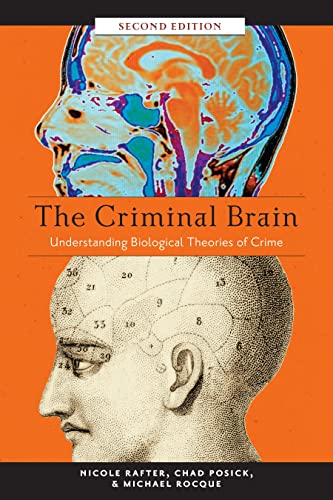
What is the relationship between criminality and biology? Nineteenth-century phrenologists insisted that criminality was innate, inherent in the offender's brain matter. While they were eventually repudiated as pseudo-scientists, today the pendulum has swung back. Both criminologists and biologists have begun to speak of a tantalizing but disturbing possibility: that criminality may be inherited as a set of genetic deficits that place one at risk to commit theft, violence, or acts of sexual deviance. But what do these new theories really assert? Are they as dangerous as their forerunners, which the Nazis and other eugenicists used to sterilize, incarcerate, and even execute thousands of supposed "born" criminals? How can we prepare for a future in which leaders may propose crime-control programs based on biology?In this second edition of The Criminal Brain, Nicole Rafter, Chad Posick, and Michael Rocque describe early biological theories of crime and provide a lively, up-to-date overview of the newest research in biosocial criminology. New chapters introduce the theories of the latter part of the 20th century; apply and critically assess current biosocial and evolutionary theories, the developments in neuro-imaging, and recent progressions in fields such as epigenetics; and finally, provide a vision for the future of criminology and crime policy from a biosocial perspective. The book is a careful, critical examination of each research approach and conclusion. Both compiling and analyzing the body of scholarship devoted to understanding the criminal brain, this volume serves as a condensed, accessible, and contemporary exploration of biological theories of crime and their everyday relevance.
Les informations fournies dans la section « Synopsis » peuvent faire référence à une autre édition de ce titre.
À propos des auteurs
Nicole Rafter was Professor Emeritus of Criminology at Northeastern University. Her publications include The Crime of All Crimes: Toward a Criminology of Genocide, The Criminal Brain: Understanding Biological Theories of Crime, and, with Michelle Brown, Criminology Goes to the Movies. In 2009, Rafter was awarded the Sutherland Award by the American Society of Criminology
for outstanding contributions to the discipline.
Chad Posick is Associate Professor in the Department of Criminal Justice and Criminology at Georgia Southern University.
Michael Rocque is Assistant Professor in the Bates Department of Sociology and the Senior Research Advisor for the Maine Department of Corrections.
Les informations fournies dans la section « A propos du livre » peuvent faire référence à une autre édition de ce titre.
Résultats de recherche pour The Criminal Brain: Understanding Biological Theories...

Image d'archives
The Criminal Brain, Second Edition: Understanding Biological Theories of Crime
Vendeur : Kennys Bookshop and Art Galleries Ltd., Galway, GY, Irlande
Évaluation du vendeur 5 sur 5 étoiles

Etat : New. Num Pages: 416 pages, black & white illustrations. BIC Classification: JHB; JKV. Category: (G) General (US: Trade). Dimension: 155 x 230 x 28. Weight in Grams: 626. . 2016. paperback. . . . . N° de réf. du vendeur 9781479894697
Acheter neuf
EUR 5,84
Expédition à EUR 9,50
Expédition depuis Irlande vers Etats-Unis
Expédition depuis Irlande vers Etats-Unis
Quantité disponible : 1 disponible(s)
Image d'archives
The Criminal Brain, Second Edition: Understanding Biological Theories of Crime
Vendeur : Kennys Bookstore, Olney, MD, Etats-Unis
Évaluation du vendeur 5 sur 5 étoiles
Etat : New. Num Pages: 416 pages, black & white illustrations. BIC Classification: JHB; JKV. Category: (G) General (US: Trade). Dimension: 155 x 230 x 28. Weight in Grams: 626. . 2016. paperback. . . . . Books ship from the US and Ireland. N° de réf. du vendeur 9781479894697
Acheter neuf
EUR 6,04
Expédition à EUR 9,36
Expédition nationale : Etats-Unis
Expédition nationale : Etats-Unis
Quantité disponible : 1 disponible(s)
Image fournie par le vendeur
The Criminal Brain, Second Edition: Understanding Biological Theories of Crime
Edité par
NYU Press, 2016
ISBN 10 : 1479894699
ISBN 13 : 9781479894697
Ancien ou d'occasion
Couverture souple
Vendeur : Goodwill of Central and Coastal Virginia, Richmond, VA, Etats-Unis
Évaluation du vendeur 4 sur 5 étoiles

Etat : acceptable. N° de réf. du vendeur CCVV.1479894699.A
Acheter D'occasion
EUR 11,79
Expédition à EUR 5,12
Expédition nationale : Etats-Unis
Expédition nationale : Etats-Unis
Quantité disponible : 1 disponible(s)
Image d'archives
The Criminal Brain, Second Edition Understanding Biological Theories of Crime
Vendeur : Powell's Bookstores Chicago, ABAA, Chicago, IL, Etats-Unis
Évaluation du vendeur 5 sur 5 étoiles
Paperback. Etat : NEW. 2nd ed. N° de réf. du vendeur 2035708
Acheter neuf
EUR 13,77
Expédition à EUR 4,46
Expédition nationale : Etats-Unis
Expédition nationale : Etats-Unis
Quantité disponible : Plus de 20 disponibles
Image d'archives
The Criminal Brain: Understanding Biological Theories of Crime
Edité par
New York University Press, 2016
ISBN 10 : 1479894699
ISBN 13 : 9781479894697
Ancien ou d'occasion
Couverture souple
Vendeur : Anybook.com, Lincoln, Royaume-Uni
Évaluation du vendeur 5 sur 5 étoiles
Etat : Good. This is an ex-library book and may have the usual library/used-book markings inside.This book has soft covers. Clean from markings. In good all round condition. Please note the Image in this listing is a stock photo and may not match the covers of the actual item,700grams, ISBN:9781479894697. N° de réf. du vendeur 9823310
Acheter D'occasion
EUR 26,16
Expédition à EUR 15,37
Expédition depuis Royaume-Uni vers Etats-Unis
Expédition depuis Royaume-Uni vers Etats-Unis
Quantité disponible : 1 disponible(s)
Image d'archives
The Criminal Brain, Second Edition: Understanding Biological Theories of Crime
Vendeur : Chiron Media, Wallingford, Royaume-Uni
Évaluation du vendeur 5 sur 5 étoiles
Paperback. Etat : New. Brand new book, sourced directly from publisher. Dispatch time is 24-48 hours from our warehouse. Book will be sent in robust, secure packaging to ensure it reaches you securely. N° de réf. du vendeur 6666-GRD-9781479894697
Acheter neuf
EUR 35,25
Expédition à EUR 7,65
Expédition depuis Royaume-Uni vers Etats-Unis
Expédition depuis Royaume-Uni vers Etats-Unis
Quantité disponible : 1 disponible(s)
Image fournie par le vendeur
The Criminal Brain, Second Edition
Edité par
New York University Press, US, 2016
ISBN 10 : 1479894699
ISBN 13 : 9781479894697
Neuf
Paperback
Vendeur : Rarewaves USA, HEBRON, KY, Etats-Unis
Évaluation du vendeur 5 sur 5 étoiles
Paperback. Etat : New. A lively, up-to-date overview of the newest research in biosocial criminology What is the relationship between criminality and biology? Nineteenth-century phrenologists insisted that criminality was innate, inherent in the offender's brain matter. While they were eventually repudiated as pseudo-scientists, today the pendulum has swung back. Both criminologists and biologists have begun to speak of a tantalizing but disturbing possibility: that criminality may be inherited as a set of genetic deficits that place one at risk to commit theft, violence, or acts of sexual deviance. But what do these new theories really assert? Are they as dangerous as their forerunners, which the Nazis and other eugenicists used to sterilize, incarcerate, and even execute thousands of supposed "born" criminals? How can we prepare for a future in which leaders may propose crime-control programs based on biology? In this second edition of The Criminal Brain, Nicole Rafter, Chad Posick, and Michael Rocque describe early biological theories of crime and provide a lively, up-to-date overview of the newest research in biosocial criminology. New chapters introduce the theories of the latter part of the 20th century; apply and critically assess current biosocial and evolutionary theories, the developments in neuro-imaging, and recent progressions in fields such as epigenetics; and finally, provide a vision for the future of criminology and crime policy from a biosocial perspective. The book is a careful, critical examination of each research approach and conclusion. Both compiling and analyzing the body of scholarship devoted to understanding the criminal brain, this volume serves as a condensed, accessible, and contemporary exploration of biological theories of crime and their everyday relevance. N° de réf. du vendeur LU-9781479894697
Acheter neuf
EUR 43,92
Livraison gratuite
Expédition nationale : Etats-Unis
Expédition nationale : Etats-Unis
Quantité disponible : Plus de 20 disponibles
Image d'archives
The Criminal Brain, Second Edition: Understanding Biological Theories of Crime
Edité par
NYU Press, 2016
ISBN 10 : 1479894699
ISBN 13 : 9781479894697
Ancien ou d'occasion
Paperback
Vendeur : WorldofBooks, Goring-By-Sea, WS, Royaume-Uni
Évaluation du vendeur 5 sur 5 étoiles
Paperback. Etat : Very Good. The book has been read, but is in excellent condition. Pages are intact and not marred by notes or highlighting. The spine remains undamaged. N° de réf. du vendeur GOR013614818
Acheter D'occasion
EUR 38,24
Expédition à EUR 6,60
Expédition depuis Royaume-Uni vers Etats-Unis
Expédition depuis Royaume-Uni vers Etats-Unis
Quantité disponible : 1 disponible(s)
Image fournie par le vendeur
The Criminal Brain, Second Edition
Edité par
New York University Press, US, 2016
ISBN 10 : 1479894699
ISBN 13 : 9781479894697
Neuf
Paperback
Vendeur : Rarewaves.com USA, London, LONDO, Royaume-Uni
Évaluation du vendeur 5 sur 5 étoiles
Paperback. Etat : New. A lively, up-to-date overview of the newest research in biosocial criminology What is the relationship between criminality and biology? Nineteenth-century phrenologists insisted that criminality was innate, inherent in the offender's brain matter. While they were eventually repudiated as pseudo-scientists, today the pendulum has swung back. Both criminologists and biologists have begun to speak of a tantalizing but disturbing possibility: that criminality may be inherited as a set of genetic deficits that place one at risk to commit theft, violence, or acts of sexual deviance. But what do these new theories really assert? Are they as dangerous as their forerunners, which the Nazis and other eugenicists used to sterilize, incarcerate, and even execute thousands of supposed "born" criminals? How can we prepare for a future in which leaders may propose crime-control programs based on biology? In this second edition of The Criminal Brain, Nicole Rafter, Chad Posick, and Michael Rocque describe early biological theories of crime and provide a lively, up-to-date overview of the newest research in biosocial criminology. New chapters introduce the theories of the latter part of the 20th century; apply and critically assess current biosocial and evolutionary theories, the developments in neuro-imaging, and recent progressions in fields such as epigenetics; and finally, provide a vision for the future of criminology and crime policy from a biosocial perspective. The book is a careful, critical examination of each research approach and conclusion. Both compiling and analyzing the body of scholarship devoted to understanding the criminal brain, this volume serves as a condensed, accessible, and contemporary exploration of biological theories of crime and their everyday relevance. N° de réf. du vendeur LU-9781479894697
Acheter neuf
EUR 46,14
Livraison gratuite
Expédition depuis Royaume-Uni vers Etats-Unis
Expédition depuis Royaume-Uni vers Etats-Unis
Quantité disponible : 1 disponible(s)
Image d'archives
The Criminal Brain, Second Edition
Vendeur : PBShop.store UK, Fairford, GLOS, Royaume-Uni
Évaluation du vendeur 5 sur 5 étoiles
PAP. Etat : New. New Book. Shipped from UK. Established seller since 2000. N° de réf. du vendeur FW-9781479894697
Acheter neuf
EUR 40,58
Expédition à EUR 5,92
Expédition depuis Royaume-Uni vers Etats-Unis
Expédition depuis Royaume-Uni vers Etats-Unis
Quantité disponible : 15 disponible(s)