
Articles liés à Bad Samaritans: The Myth of Free Trade and the Secret...
Synopsis
"Lucid, deeply informed, and enlivened with striking illustrations." -Noam Chomsky
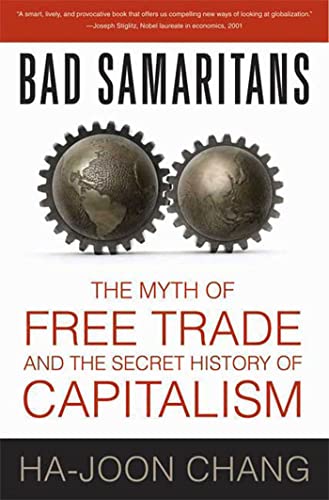
One economist has called Ha-Joon Chang "the most exciting thinker our profession has turned out in the past fifteen years." With Bad Samaritans, this provocative scholar bursts into the debate on globalization and economic justice. Using irreverent wit, an engagingly personal style, and a battery of examples, Chang blasts holes in the "World Is Flat" orthodoxy of Thomas Friedman and other liberal economists who argue that only unfettered capitalism and wide-open international trade can lift struggling nations out of poverty. On the contrary, Chang shows, today's economic superpowers-from the U.S. to Britain to his native Korea-all attained prosperity by shameless protectionism and government intervention in industry. We have conveniently forgotten this fact, telling ourselves a fairy tale about the magic of free trade and-via our proxies such as the World Bank, International Monetary Fund, and World Trade Organization-ramming policies that suit ourselves down the throat of the developing world. Unlike typical economists who construct models of how the marketplace should work, Chang examines the past: what has actually happened. His pungently contrarian history demolishes one pillar after another of free-market mythology. We treat patents and copyrights as sacrosanct-but developed our own industries by studiously copying others' technologies. We insist that centrally planned economies stifle growth-but many developing countries had higher GDP growth before they were pressured into deregulating their economies. Both justice and common sense, Chang argues, demand that we reevaluate the policies we force on nations that are struggling to follow in our footsteps.Les informations fournies dans la section « Synopsis » peuvent faire référence à une autre édition de ce titre.
À propos de l'auteur
Ha-Joon Chang, a Korean native, has taught at the Faculty of Economics, University of Cambridge, since 1990. He has worked as a consultant for numerous international organizations, including various UN agencies, the World Bank, and the Asian Development Bank. He has published 11 books, including Kicking Away the Ladder, winner of the 2003 Myrdal Prize. In 2005, Ha-Joon Chang was awarded the 2005 Leontief Prize for Advancing the Frontiers of Economic Thought.
Ha-Joon Chang teaches economics at Cambridge University. His books include Reclaiming Development (Zed 2004) and 23 Things They Don't Tell You about Capitalism (2010).Les informations fournies dans la section « A propos du livre » peuvent faire référence à une autre édition de ce titre.
Résultats de recherche pour Bad Samaritans: The Myth of Free Trade and the Secret...

Image d'archives
Bad Samaritans: The Myth of Free Trade and the Secret History of Capitalism
Edité par
Bloomsbury Publishing Plc, 2009
ISBN 10 : 1596915986
ISBN 13 : 9781596915985
Ancien ou d'occasion
Paperback
Vendeur : World of Books (was SecondSale), Montgomery, IL, Etats-Unis
Évaluation du vendeur 5 sur 5 étoiles

Paperback. Etat : Good. "Lucid, deeply informed, and enlivened with striking illustrations." -Noam Chomsky One economist has called Ha-Joon Chang "the most exciting thinker our profession has turned out in the past fifteen years." With Bad Samaritans, this provocative scholar bursts into the debate on globalization and economic justice. Using irreverent wit, an engagingly personal style, and a battery of examples, Chang blasts holes in the "World Is Flat" orthodoxy of Thomas Friedman and other liberal economists who argue that only unfettered capitalism and wide-open international trade can lift struggling nations out of poverty. On the contrary, Chang shows, today's economic superpowers-from the U.S. to Britain to his native Korea-all attained prosperity by shameless protectionism and government intervention in industry. We have conveniently forgotten this fact, telling ourselves a fairy tale about the magic of free trade and-via our proxies such as the World Bank, International Monetary Fund, and World Trade Organization-ramming policies that suit ourselves down the throat of the developing world. Unlike typical economists who construct models of how the marketplace should work, Chang examines the past: what has actually happened. His pungently contrarian history demolishes one pillar after another of free-market mythology. We treat patents and copyrights as sacrosanct-but developed our own industries by studiously copying others' technologies. We insist that centrally planned economies stifle growth-but many developing countries had higher GDP growth before they were pressured into deregulating their economies. Both justice and common sense, Chang argues, demand that we reevaluate the policies we force on nations that are struggling to follow in our footsteps. N° de réf. du vendeur 00106837386
Acheter D'occasion
EUR 5,81
Livraison gratuite
Expédition nationale : Etats-Unis
Expédition nationale : Etats-Unis
Quantité disponible : 4 disponible(s)
Image d'archives
Bad Samaritans: The Myth of Free Trade and the Secret History of Capitalism
Edité par
Bloomsbury Publishing Plc, 2009
ISBN 10 : 1596915986
ISBN 13 : 9781596915985
Ancien ou d'occasion
Paperback
Vendeur : World of Books (was SecondSale), Montgomery, IL, Etats-Unis
Évaluation du vendeur 5 sur 5 étoiles
Paperback. Etat : Fair. "Lucid, deeply informed, and enlivened with striking illustrations." -Noam Chomsky One economist has called Ha-Joon Chang "the most exciting thinker our profession has turned out in the past fifteen years." With Bad Samaritans, this provocative scholar bursts into the debate on globalization and economic justice. Using irreverent wit, an engagingly personal style, and a battery of examples, Chang blasts holes in the "World Is Flat" orthodoxy of Thomas Friedman and other liberal economists who argue that only unfettered capitalism and wide-open international trade can lift struggling nations out of poverty. On the contrary, Chang shows, today's economic superpowers-from the U.S. to Britain to his native Korea-all attained prosperity by shameless protectionism and government intervention in industry. We have conveniently forgotten this fact, telling ourselves a fairy tale about the magic of free trade and-via our proxies such as the World Bank, International Monetary Fund, and World Trade Organization-ramming policies that suit ourselves down the throat of the developing world. Unlike typical economists who construct models of how the marketplace should work, Chang examines the past: what has actually happened. His pungently contrarian history demolishes one pillar after another of free-market mythology. We treat patents and copyrights as sacrosanct-but developed our own industries by studiously copying others' technologies. We insist that centrally planned economies stifle growth-but many developing countries had higher GDP growth before they were pressured into deregulating their economies. Both justice and common sense, Chang argues, demand that we reevaluate the policies we force on nations that are struggling to follow in our footsteps. N° de réf. du vendeur 00106810328
Acheter D'occasion
EUR 5,81
Livraison gratuite
Expédition nationale : Etats-Unis
Expédition nationale : Etats-Unis
Quantité disponible : 1 disponible(s)
Image fournie par le vendeur
Bad Samaritans: The Myth of Free Trade and the Secret History of Capitalism
Edité par
Bloomsbury Publishing, 2009
ISBN 10 : 1596915986
ISBN 13 : 9781596915985
Ancien ou d'occasion
Couverture souple
Vendeur : Zoom Books East, Glendale Heights, IL, Etats-Unis
Évaluation du vendeur 5 sur 5 étoiles
Etat : good. Book is in good condition and may include underlining highlighting and minimal wear. The book can also include "From the library of" labels. May not contain miscellaneous items toys, dvds, etc. . We offer 100% money back guarantee and 24 7 customer service. N° de réf. du vendeur ZEV.1596915986.G
Acheter D'occasion
EUR 5,82
Livraison gratuite
Expédition nationale : Etats-Unis
Expédition nationale : Etats-Unis
Quantité disponible : 1 disponible(s)
Image fournie par le vendeur
Bad Samaritans: The Myth of Free Trade and the Secret History of Capitalism
Edité par
Bloomsbury Publishing, 2009
ISBN 10 : 1596915986
ISBN 13 : 9781596915985
Ancien ou d'occasion
Couverture souple
Vendeur : Zoom Books Company, Lynden, WA, Etats-Unis
Évaluation du vendeur 5 sur 5 étoiles
Etat : very_good. Book is in very good condition and may include minimal underlining highlighting. The book can also include "From the library of" labels. May not contain miscellaneous items toys, dvds, etc. . We offer 100% money back guarantee and 24 7 customer service. N° de réf. du vendeur ZBV.1596915986.VG
Acheter D'occasion
EUR 6,76
Livraison gratuite
Expédition nationale : Etats-Unis
Expédition nationale : Etats-Unis
Quantité disponible : 2 disponible(s)
Image fournie par le vendeur
Bad Samaritans: The Myth of Free Trade and the Secret History of Capitalism
Edité par
Bloomsbury Publishing, 2009
ISBN 10 : 1596915986
ISBN 13 : 9781596915985
Ancien ou d'occasion
Couverture souple
Vendeur : clickgoodwillbooks, Indianapolis, IN, Etats-Unis
Évaluation du vendeur 4 sur 5 étoiles

Etat : acceptable. Used - Acceptable: All pages and the cover are intact, but shrink wrap, dust covers, or boxed set case may be missing. Pages may include limited notes, highlighting, or minor water damage but the text is readable. Item may be missing bundled media. N° de réf. du vendeur 3O6JUN001A1P_ns
Acheter D'occasion
EUR 3,82
Expédition à EUR 3,56
Expédition nationale : Etats-Unis
Expédition nationale : Etats-Unis
Quantité disponible : 1 disponible(s)
Image d'archives
Bad Samaritans: The Myth of Free Trade and the Secret History of Capitalism
Edité par
Bloomsbury Publishing, 2009
ISBN 10 : 1596915986
ISBN 13 : 9781596915985
Ancien ou d'occasion
Paperback
Vendeur : ThriftBooks-Atlanta, AUSTELL, GA, Etats-Unis
Évaluation du vendeur 5 sur 5 étoiles
Paperback. Etat : Fair. No Jacket. Readable copy. Pages may have considerable notes/highlighting. ~ ThriftBooks: Read More, Spend Less. N° de réf. du vendeur G1596915986I5N00
Acheter D'occasion
EUR 7,42
Livraison gratuite
Expédition nationale : Etats-Unis
Expédition nationale : Etats-Unis
Quantité disponible : 1 disponible(s)
Image d'archives
Bad Samaritans: The Myth of Free Trade and the Secret History of Capitalism
Edité par
Bloomsbury Press, 2008
ISBN 10 : 1596915986
ISBN 13 : 9781596915985
Ancien ou d'occasion
Paperback
Vendeur : HPB Inc., Dallas, TX, Etats-Unis
Évaluation du vendeur 5 sur 5 étoiles
Paperback. Etat : Very Good. Connecting readers with great books since 1972! Used books may not include companion materials, and may have some shelf wear or limited writing. We ship orders daily and Customer Service is our top priority! N° de réf. du vendeur S_455684888
Acheter D'occasion
EUR 4,14
Expédition à EUR 3,34
Expédition nationale : Etats-Unis
Expédition nationale : Etats-Unis
Quantité disponible : 1 disponible(s)
Image d'archives
Bad Samaritans: The Myth of Free Trade and the Secret History of Capitalism
Edité par
Bloomsbury Press, 2008
ISBN 10 : 1596915986
ISBN 13 : 9781596915985
Ancien ou d'occasion
Paperback
Vendeur : HPB-Emerald, Dallas, TX, Etats-Unis
Évaluation du vendeur 5 sur 5 étoiles
Paperback. Etat : Very Good. Connecting readers with great books since 1972! Used books may not include companion materials, and may have some shelf wear or limited writing. We ship orders daily and Customer Service is our top priority! N° de réf. du vendeur S_473189164
Acheter D'occasion
EUR 4,14
Expédition à EUR 3,34
Expédition nationale : Etats-Unis
Expédition nationale : Etats-Unis
Quantité disponible : 1 disponible(s)
Image fournie par le vendeur
Bad Samaritans: The Myth of Free Trade and the Secret History of Capitalism
Edité par
Bloomsbury Publishing, 2009
ISBN 10 : 1596915986
ISBN 13 : 9781596915985
Ancien ou d'occasion
Couverture souple
Vendeur : Goodwill Books, Hillsboro, OR, Etats-Unis
Évaluation du vendeur 5 sur 5 étoiles
Etat : good. Signs of wear and consistent use. N° de réf. du vendeur GICWV.1596915986.G
Acheter D'occasion
EUR 4,09
Expédition à EUR 3,56
Expédition nationale : Etats-Unis
Expédition nationale : Etats-Unis
Quantité disponible : 1 disponible(s)
Image d'archives
Bad Samaritans: The Myth of Free Trade and the Secret History of Capitalism
Edité par
Bloomsbury Publishing Plc, 2009
ISBN 10 : 1596915986
ISBN 13 : 9781596915985
Ancien ou d'occasion
Paperback
Vendeur : World of Books Inc, Montgomery, IL, Etats-Unis
Évaluation du vendeur 4 sur 5 étoiles
Paperback. Etat : Fair. "Lucid, deeply informed, and enlivened with striking illustrations." -Noam Chomsky One economist has called Ha-Joon Chang "the most exciting thinker our profession has turned out in the past fifteen years." With Bad Samaritans, this provocative scholar bursts into the debate on globalization and economic justice. Using irreverent wit, an engagingly personal style, and a battery of examples, Chang blasts holes in the "World Is Flat" orthodoxy of Thomas Friedman and other liberal economists who argue that only unfettered capitalism and wide-open international trade can lift struggling nations out of poverty. On the contrary, Chang shows, today's economic superpowers-from the U.S. to Britain to his native Korea-all attained prosperity by shameless protectionism and government intervention in industry. We have conveniently forgotten this fact, telling ourselves a fairy tale about the magic of free trade and-via our proxies such as the World Bank, International Monetary Fund, and World Trade Organization-ramming policies that suit ourselves down the throat of the developing world. Unlike typical economists who construct models of how the marketplace should work, Chang examines the past: what has actually happened. His pungently contrarian history demolishes one pillar after another of free-market mythology. We treat patents and copyrights as sacrosanct-but developed our own industries by studiously copying others' technologies. We insist that centrally planned economies stifle growth-but many developing countries had higher GDP growth before they were pressured into deregulating their economies. Both justice and common sense, Chang argues, demand that we reevaluate the policies we force on nations that are struggling to follow in our footsteps. N° de réf. du vendeur CIN1596915986A
Acheter D'occasion
EUR 7,65
Livraison gratuite
Expédition nationale : Etats-Unis
Expédition nationale : Etats-Unis
Quantité disponible : 1 disponible(s)