
Articles liés à The Art of Stone Skipping and Other Fun Old-Time Games:...
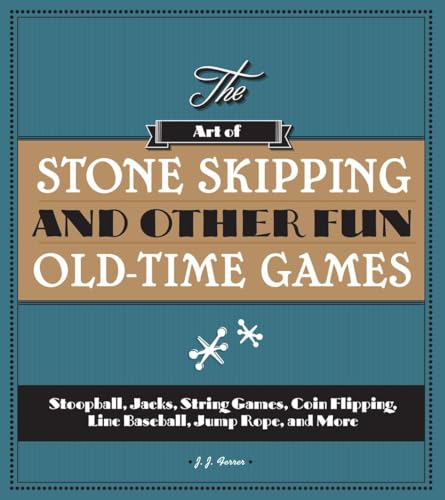
The Art of Stone Skipping and Other Fun Old-Time Games: Stoopball, Jacks, String Games, Coin Flipping, Line Baseball, Jump Rope, and More - Couverture souple
Synopsis
It’s an old-time playtime—nothing electronic, just games that have stood the test of time! They help children build skills like hand-eye coordination, problem solving, and simply learning how to be a good team player and work well with others. But most of all, they’re lots of fun. This collection of timeless games guarantees kids a great time—by themselves, with a group of friends, or with their family. And best of all, no batteries are required . . . and very little equipment, too.
There’s Hopscotch and Dodgeball, Four Square and Stoopball, Horse and One Old Cat (a ball game similar to baseball, but with only one base). All you need is your brain—and occasionally a paper and pen—to play games like Association, the Minister’s Cat, and Dumb Crambo (which is similar to Charades, but has a rhyming twist). A rainy day with no pals around would be just right to make Hand Shadows, walk on Can Stilts, or practice Jacks. Don’t forget card games like Crazy Eights and Rummy, Crab and Sack Races, and old favorites like Duck, Duck, Goose and Red Rover. And because no parent likes to hear the whine of "Are we there yet?" there’s a whole chapter of games for the car!
Black-and-white illustrations keep the old-timey feel while getting kids excited to play. Simple instructions explain how many people can play, what you need, the object of the game, and the basic rules. For extra entertainment, there are also lots of fun facts about the history of the games sprinkled throughout. This book is so packed with activities that kids will want to turn off their computers, shut down their PlayStations and Xboxes, and get playing the old-fashioned way!
Les informations fournies dans la section « Synopsis » peuvent faire référence à une autre édition de ce titre.
À propos de l'auteur
J. J. Ferrer is the mother of three sons and the author of four books, A NEW MOTHER'S PRAYERS, I AM A MOTHER OF SONS, DANCING WITH MY DAUGHTER, and SHE OF THE RIB. She has fond memories of playing "Red Rover, Red Rover" at school in Wauchula, Florida. Today, she lives in Greenville, South Carolina and plays Spades and Musical Miles as often as possible.
Extrait. © Reproduit sur autorisation. Tous droits réservés.
Archaeologists have found enough carved wooden game pieces, leather balls, and clay dice to prove that playing games has been a part of every civilization since the beginning of time. Even in cultures where children were expected to work alongside adults rather than play freely, kids have always turned to games for fun and recreation, whether competing against friends or simply challenging themselves. We know from artifacts that children were playing board games in China as early as 2000 BC, marbles in Greece by 400 BC, and ball in Egypt by 2 BC.
Balls may well be the oldest of all toys. Early ones were made from strips of leather, cloth, or papyrus sewn together, then stuffed with hair, feathers, or straw. Balls were also made from animal skulls and bladders and, in some cultures, even the heads of enemies! Simple games of catch, in which one child threw a ball up in the air and caught it or two children tossed a ball back and forth to each other, probably happened as soon as Cain and Abel were old enough to walk. But history tells us that the first “organized” ball games happened in Mexico nearly four thousand years ago, with teams of two to six players trying to get a really heavy ball across their opponents’ goal line. Ball games weren’t always just for fun, though: Sometimes they had religious purposes, and sometimes the losing team lost their heads as well as the game!
Les informations fournies dans la section « A propos du livre » peuvent faire référence à une autre édition de ce titre.
Résultats de recherche pour The Art of Stone Skipping and Other Fun Old-Time Games:...

Image d'archives
The Art of Stone Skipping and Other Fun Old-Time Games: Stoopball, Jacks, String Games, Coin Flipping, Line Baseball, Jump Rope, and More
Edité par
Charlesbridge Publishing,U.S., 2013
ISBN 10 : 1936140748
ISBN 13 : 9781936140749
Ancien ou d'occasion
Paperback
Vendeur : World of Books (was SecondSale), Montgomery, IL, Etats-Unis
Évaluation du vendeur 5 sur 5 étoiles

Paperback. Etat : Very Good. ItP#8217;s an old-time playtimeP#8212;nothing electronic, just games that have stood the test of time! They help children build skills like hand-eye coordination, problem solving, and simply learning how to be a good team player and work well with others. But most of all, theyP#8217;re lots of fun. This collection of timeless games guarantees kids a great timeP#8212;by themselves, with a group of friends, or with their family. And best of all, no batteries are required . . . and very little equipment, too.Plt;brPgt;Plt;brPgt;ThereP#8217;s Hopscotch and Dodgeball, Four Square and Stoopball, Horse and One Old Cat (a ball game similar to baseball, but with only one base). All you need is your brainP#8212;and occasionally a paper and penP#8212;to play games like Association, the MinisterP#8217;s Cat, and Dumb Crambo (which is similar to Charades, but has a rhyming twist). A rainy day with no pals around would be just right to make Hand Shadows, walk on Can Stilts, or practice Jacks. DonP#8217;t forget card games like Crazy Eights and Rummy, Crab and Sack Races, and old favorites like Duck, Duck, Goose and Red Rover. And because no parent likes to hear the whine of Pquot;Are we there yet?Pquot; thereP#8217;s a whole chapter of games for the car!Plt;brPgt;Plt;brPgt;Black-and-white illustrations keep the old-timey feel while getting kids excited to play. Simple instructions explain how many people can play, what you need, the object of the game, and the basic rules. For extra entertainment, there are also lots of fun facts about the history of the games sprinkled throughout. This book is so packed with activities that kids will want to turn off their computers, shut down their PlayStations and Xboxes, and get playing the old-fashioned way! N° de réf. du vendeur 00099468643
Acheter D'occasion
EUR 6,71
Livraison gratuite
Expédition nationale : Etats-Unis
Expédition nationale : Etats-Unis
Quantité disponible : 2 disponible(s)
Image d'archives
The Art of Stone Skipping and Other Fun Old-Time Games: Stoopball, Jacks, String Games, Coin Flipping, Line Baseball, Jump Rope, and More
Edité par
Charlesbridge Publishing,U.S., 2013
ISBN 10 : 1936140748
ISBN 13 : 9781936140749
Ancien ou d'occasion
Paperback
Vendeur : World of Books (was SecondSale), Montgomery, IL, Etats-Unis
Évaluation du vendeur 5 sur 5 étoiles
Paperback. Etat : Good. ItP#8217;s an old-time playtimeP#8212;nothing electronic, just games that have stood the test of time! They help children build skills like hand-eye coordination, problem solving, and simply learning how to be a good team player and work well with others. But most of all, theyP#8217;re lots of fun. This collection of timeless games guarantees kids a great timeP#8212;by themselves, with a group of friends, or with their family. And best of all, no batteries are required . . . and very little equipment, too.Plt;brPgt;Plt;brPgt;ThereP#8217;s Hopscotch and Dodgeball, Four Square and Stoopball, Horse and One Old Cat (a ball game similar to baseball, but with only one base). All you need is your brainP#8212;and occasionally a paper and penP#8212;to play games like Association, the MinisterP#8217;s Cat, and Dumb Crambo (which is similar to Charades, but has a rhyming twist). A rainy day with no pals around would be just right to make Hand Shadows, walk on Can Stilts, or practice Jacks. DonP#8217;t forget card games like Crazy Eights and Rummy, Crab and Sack Races, and old favorites like Duck, Duck, Goose and Red Rover. And because no parent likes to hear the whine of Pquot;Are we there yet?Pquot; thereP#8217;s a whole chapter of games for the car!Plt;brPgt;Plt;brPgt;Black-and-white illustrations keep the old-timey feel while getting kids excited to play. Simple instructions explain how many people can play, what you need, the object of the game, and the basic rules. For extra entertainment, there are also lots of fun facts about the history of the games sprinkled throughout. This book is so packed with activities that kids will want to turn off their computers, shut down their PlayStations and Xboxes, and get playing the old-fashioned way! N° de réf. du vendeur 00103272056
Acheter D'occasion
EUR 6,71
Livraison gratuite
Expédition nationale : Etats-Unis
Expédition nationale : Etats-Unis
Quantité disponible : 3 disponible(s)
Image d'archives
The Art of Stone Skipping and Other Fun Old-Time Games: Stoopball, Jacks, String Games, Coin Flipping, Line Baseball, Jump Rope, and More
Vendeur : Gulf Coast Books, Cypress, TX, Etats-Unis
Évaluation du vendeur 5 sur 5 étoiles
paperback. Etat : Good. N° de réf. du vendeur 1936140748-3-36005701
Acheter D'occasion
EUR 6,71
Livraison gratuite
Expédition nationale : Etats-Unis
Expédition nationale : Etats-Unis
Quantité disponible : 1 disponible(s)
Image d'archives
The Art of Stone Skipping and Other Fun Old-Time Games: Stoopball, Jacks, String Games, Coin Flipping, Line Baseball, Jump Rope, and More
Vendeur : Orion Tech, Kingwood, TX, Etats-Unis
Évaluation du vendeur 5 sur 5 étoiles
Paperback. Etat : Good. N° de réf. du vendeur 1936140748-3-27619100
Acheter D'occasion
EUR 6,71
Livraison gratuite
Expédition nationale : Etats-Unis
Expédition nationale : Etats-Unis
Quantité disponible : 1 disponible(s)
Image d'archives
The Art of Stone Skipping and Other Fun Old-Time Games : Stoopball, Jacks, String Games, Coin Flipping, Line Baseball, Jump Rope, and More
Edité par
Charlesbridge Publishing, Incorporated, 2013
ISBN 10 : 1936140748
ISBN 13 : 9781936140749
Ancien ou d'occasion
Couverture souple
Vendeur : Better World Books, Mishawaka, IN, Etats-Unis
Évaluation du vendeur 5 sur 5 étoiles
Etat : Very Good. Former library copy. Pages intact with possible writing/highlighting. Binding strong with minor wear. Dust jackets/supplements may not be included. Includes library markings. Stock photo provided. Product includes identifying sticker. Better World Books: Buy Books. Do Good. N° de réf. du vendeur 1659115-75
Acheter D'occasion
EUR 6,72
Livraison gratuite
Expédition nationale : Etats-Unis
Expédition nationale : Etats-Unis
Quantité disponible : 2 disponible(s)
Image d'archives
The Art of Stone Skipping and Other Fun Old-Time Games : Stoopball, Jacks, String Games, Coin Flipping, Line Baseball, Jump Rope, and More
Edité par
Charlesbridge Publishing, Incorporated, 2013
ISBN 10 : 1936140748
ISBN 13 : 9781936140749
Ancien ou d'occasion
Couverture souple
Vendeur : Better World Books, Mishawaka, IN, Etats-Unis
Évaluation du vendeur 5 sur 5 étoiles
Etat : Good. Former library copy. Pages intact with minimal writing/highlighting. The binding may be loose and creased. Dust jackets/supplements are not included. Includes library markings. Stock photo provided. Product includes identifying sticker. Better World Books: Buy Books. Do Good. N° de réf. du vendeur 4472606-6
Acheter D'occasion
EUR 6,72
Livraison gratuite
Expédition nationale : Etats-Unis
Expédition nationale : Etats-Unis
Quantité disponible : 1 disponible(s)
Image d'archives
The Art of Stone Skipping and Other Fun Old-Time Games : Stoopball, Jacks, String Games, Coin Flipping, Line Baseball, Jump Rope, and More
Edité par
Charlesbridge Publishing, Incorporated, 2013
ISBN 10 : 1936140748
ISBN 13 : 9781936140749
Ancien ou d'occasion
Couverture souple
Vendeur : Better World Books: West, Reno, NV, Etats-Unis
Évaluation du vendeur 5 sur 5 étoiles
Etat : Very Good. Pages intact with possible writing/highlighting. Binding strong with minor wear. Dust jackets/supplements may not be included. Stock photo provided. Product includes identifying sticker. Better World Books: Buy Books. Do Good. N° de réf. du vendeur 9705956-20
Acheter D'occasion
EUR 6,72
Livraison gratuite
Expédition nationale : Etats-Unis
Expédition nationale : Etats-Unis
Quantité disponible : 1 disponible(s)
Image d'archives
The Art of Stone Skipping and Other Fun Old-Time Games: Stoopball, Jacks, String Games, Coin Flipping, Line Baseball, Jump Rope, and More
Edité par
Charlesbridge Publishing,U.S., 2013
ISBN 10 : 1936140748
ISBN 13 : 9781936140749
Ancien ou d'occasion
Paperback
Vendeur : World of Books Inc, Montgomery, IL, Etats-Unis
Évaluation du vendeur 4 sur 5 étoiles

Paperback. Etat : Very Good. ItP#8217;s an old-time playtimeP#8212;nothing electronic, just games that have stood the test of time! They help children build skills like hand-eye coordination, problem solving, and simply learning how to be a good team player and work well with others. But most of all, theyP#8217;re lots of fun. This collection of timeless games guarantees kids a great timeP#8212;by themselves, with a group of friends, or with their family. And best of all, no batteries are required . . . and very little equipment, too.Plt;brPgt;Plt;brPgt;ThereP#8217;s Hopscotch and Dodgeball, Four Square and Stoopball, Horse and One Old Cat (a ball game similar to baseball, but with only one base). All you need is your brainP#8212;and occasionally a paper and penP#8212;to play games like Association, the MinisterP#8217;s Cat, and Dumb Crambo (which is similar to Charades, but has a rhyming twist). A rainy day with no pals around would be just right to make Hand Shadows, walk on Can Stilts, or practice Jacks. DonP#8217;t forget card games like Crazy Eights and Rummy, Crab and Sack Races, and old favorites like Duck, Duck, Goose and Red Rover. And because no parent likes to hear the whine of Pquot;Are we there yet?Pquot; thereP#8217;s a whole chapter of games for the car!Plt;brPgt;Plt;brPgt;Black-and-white illustrations keep the old-timey feel while getting kids excited to play. Simple instructions explain how many people can play, what you need, the object of the game, and the basic rules. For extra entertainment, there are also lots of fun facts about the history of the games sprinkled throughout. This book is so packed with activities that kids will want to turn off their computers, shut down their PlayStations and Xboxes, and get playing the old-fashioned way! N° de réf. du vendeur CIN1936140748VG
Acheter D'occasion
EUR 8,54
Livraison gratuite
Expédition nationale : Etats-Unis
Expédition nationale : Etats-Unis
Quantité disponible : 2 disponible(s)
Image d'archives
The Art of Stone Skipping and Other Fun Old-Time Games: Stoopball, Jacks, String Games, Coin Flipping, Line Baseball, Jump Rope, and More
Edité par
Charlesbridge Publishing,U.S., 2013
ISBN 10 : 1936140748
ISBN 13 : 9781936140749
Ancien ou d'occasion
Paperback
Vendeur : World of Books Inc, Montgomery, IL, Etats-Unis
Évaluation du vendeur 4 sur 5 étoiles
Paperback. Etat : Good. ItP#8217;s an old-time playtimeP#8212;nothing electronic, just games that have stood the test of time! They help children build skills like hand-eye coordination, problem solving, and simply learning how to be a good team player and work well with others. But most of all, theyP#8217;re lots of fun. This collection of timeless games guarantees kids a great timeP#8212;by themselves, with a group of friends, or with their family. And best of all, no batteries are required . . . and very little equipment, too.Plt;brPgt;Plt;brPgt;ThereP#8217;s Hopscotch and Dodgeball, Four Square and Stoopball, Horse and One Old Cat (a ball game similar to baseball, but with only one base). All you need is your brainP#8212;and occasionally a paper and penP#8212;to play games like Association, the MinisterP#8217;s Cat, and Dumb Crambo (which is similar to Charades, but has a rhyming twist). A rainy day with no pals around would be just right to make Hand Shadows, walk on Can Stilts, or practice Jacks. DonP#8217;t forget card games like Crazy Eights and Rummy, Crab and Sack Races, and old favorites like Duck, Duck, Goose and Red Rover. And because no parent likes to hear the whine of Pquot;Are we there yet?Pquot; thereP#8217;s a whole chapter of games for the car!Plt;brPgt;Plt;brPgt;Black-and-white illustrations keep the old-timey feel while getting kids excited to play. Simple instructions explain how many people can play, what you need, the object of the game, and the basic rules. For extra entertainment, there are also lots of fun facts about the history of the games sprinkled throughout. This book is so packed with activities that kids will want to turn off their computers, shut down their PlayStations and Xboxes, and get playing the old-fashioned way! N° de réf. du vendeur CIN1936140748G
Acheter D'occasion
EUR 8,54
Livraison gratuite
Expédition nationale : Etats-Unis
Expédition nationale : Etats-Unis
Quantité disponible : 3 disponible(s)
Image d'archives
The Art of Stone Skipping and Other Fun Old-Time Games: Stoopball, Jacks, String Games, Coin Flipping, Line Baseball, Jump Rope, and More
Vendeur : ThriftBooks-Dallas, Dallas, TX, Etats-Unis
Évaluation du vendeur 5 sur 5 étoiles
Paperback. Etat : Good. No Jacket. Pages can have notes/highlighting. Spine may show signs of wear. ~ ThriftBooks: Read More, Spend Less. N° de réf. du vendeur G1936140748I3N00
Acheter D'occasion
EUR 10,04
Livraison gratuite
Expédition nationale : Etats-Unis
Expédition nationale : Etats-Unis
Quantité disponible : 1 disponible(s)