
Montant total (1 article articles) :
Destination de la commande :

people computers xii proceedings (6 résultats)
Passer aux résultats principaux de la recherche
Filtres de recherche
Type d'article
- Tous les types de produits
- Livres (6)
- Magazines & Périodiques (Aucun autre résultat ne correspond à ces critères)
- Bandes dessinées (Aucun autre résultat ne correspond à ces critères)
- Partitions de musique (Aucun autre résultat ne correspond à ces critères)
- Art, Affiches et Gravures (Aucun autre résultat ne correspond à ces critères)
- Photographies (Aucun autre résultat ne correspond à ces critères)
- Cartes (Aucun autre résultat ne correspond à ces critères)
- Manuscrits & Papiers anciens (Aucun autre résultat ne correspond à ces critères)
Etat En savoir plus
- Neuf (5)
- Comme neuf, Très bon ou Bon (1)
- Assez bon ou satisfaisant (Aucun autre résultat ne correspond à ces critères)
- Moyen ou mauvais (Aucun autre résultat ne correspond à ces critères)
- Conformément à la description (Aucun autre résultat ne correspond à ces critères)
Reliure
- Toutes
- Couverture rigide (Aucun autre résultat ne correspond à ces critères)
- Couverture souple (6)
Particularités
- Ed. originale (Aucun autre résultat ne correspond à ces critères)
- Signé (Aucun autre résultat ne correspond à ces critères)
- Jaquette (Aucun autre résultat ne correspond à ces critères)
- Avec images (2)
- Sans impressions à la demande (6)
Langue (1)
Prix
- Tous les prix
- Moins de EUR 20 (Aucun autre résultat ne correspond à ces critères)
- EUR 20 à EUR 45 (Aucun autre résultat ne correspond à ces critères)
- Plus de EUR 45
Livraison gratuite
Pays
Evaluation du vendeur
-
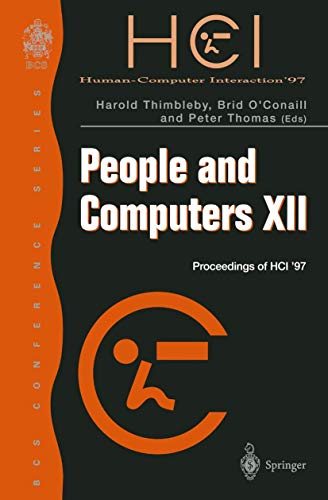
People and Computers XII: Proceedings of HCI '97 (BCS Conference Series)
Vendeur : Lucky's Textbooks, Dallas, TX, Etats-Unis
Évaluation du vendeur 5 sur 5 étoiles

EUR 53,09
EUR 3,43 shipping
Ships within Etats-UnisQuantité disponible : Plus de 20 disponibles
Ajouter au panierEtat : New.
-
People and Computers XII: Proceedings of HCI '97 (BCS Conference Series)
Vendeur : Bookmonger.Ltd, HILLSIDE, NJ, Etats-Unis
Évaluation du vendeur 4 sur 5 étoiles

EUR 61,14
EUR 3,44 shipping
Ships within Etats-UnisQuantité disponible : 2 disponible(s)
Ajouter au panierPaperback. Etat : Fine.
-
People and Computers XII: Proceedings of HCI '97 (BCS Conference Series)
Vendeur : California Books, Miami, FL, Etats-Unis
Évaluation du vendeur 5 sur 5 étoiles
EUR 65,48
Livraison gratuite
Ships within Etats-UnisQuantité disponible : Plus de 20 disponibles
Ajouter au panierEtat : New.
-
People and Computers XII: Proceedings of HCI'97 (BCS Conference Series)
Vendeur : Revaluation Books, Exeter, Royaume-Uni
Évaluation du vendeur 5 sur 5 étoiles
EUR 80,65
EUR 14,31 shipping
Ships from Royaume-Uni to Etats-UnisQuantité disponible : 2 disponible(s)
Ajouter au panierPaperback. Etat : Brand New. 436 pages. 9.21x6.14x0.99 inches. In Stock.
-

People and Computers XII : Proceedings of HCI ¿97
Vendeur : AHA-BUCH GmbH, Einbeck, Allemagne
Évaluation du vendeur 5 sur 5 étoiles
EUR 53,49
EUR 63,29 shipping
Ships from Allemagne to Etats-UnisQuantité disponible : 1 disponible(s)
Ajouter au panierTaschenbuch. Etat : Neu. Druck auf Anfrage Neuware - Printed after ordering - Most organisations try to protect their systems from unauthorised access, usually through passwords. Considerable resources are spent designing secure authentication mechanisms, but the number of security breaches and problems is still increasing (DeAlvare, 1990; Gordon, 1995; Hitchings, 1995). Unauthorised access to systems, and resulting theft of information or misuse of the system, is usually due to hackers 'cracking' user passwords, or obtaining them through social engineering. System security, unlike other fields of system development, has to date been regarded as an entirely technical issue - little research has been done on usability or human factors related to use of security mechanisms. Hitchings (1995) concludes that this narrow perspective has produced security mechanisms which are much less effective than they are generally thought to be. Davis & Price (1987) point out that, since security is designed, implemented, used and breached by people, human factors should be considered in the design of security mechanism. It seems that currently hackers pay more attention to human factors than security designers do. The technique of social engineering, for instanc- obtaining passwords by deception and persuasion- exploits users' lack of security awareness. Hitchings (1995) also suggests that organisational factors ought to be considered when assessing security systems. The aim of the study described in this paper was to identify usability and organisational factors which affect the use of passwords. The following section provides a brief overview of authentication systems along with usability and organisational issues which have been identified to date. 1.
-
EUR 50,35
EUR 70 shipping
Ships from Allemagne to Etats-UnisQuantité disponible : 5 disponible(s)
Ajouter au panierTaschenbuch. Etat : Neu. People and Computers XII | Proceedings of HCI '97 | Harold Thimbleby (u. a.) | Taschenbuch | xi | Englisch | 1997 | Springer | EAN 9783540761723 | Verantwortliche Person für die EU: Springer Verlag GmbH, Tiergartenstr. 17, 69121 Heidelberg, juergen[dot]hartmann[at]springer[dot]com | Anbieter: preigu.


