
Articles liés à Celtic Art: The Methods of Construction
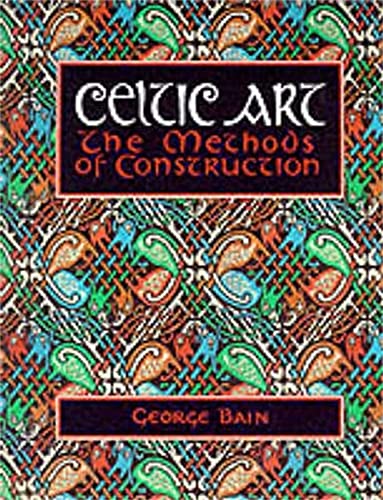
Synopsis
Celtic Art is the only indigenous British art form of world significance and this book is a graphically eloquent plea for the establishment of this great national art to its rightful place in schools and colleges where the history of ornament is being taught.
Until recently, the classical orientated art-world has regarded the abstract, iconographic and symbolic style of the Celtic artist as something of an enigma, a mysterious archaic survival largely ignored in histories of art. The modern trends away from realism and the interest of the younger generation in psychedelic and art nouveau styles provides favourable ground for the Celtic art revival which the widespread interest in this new edition seems to indicate is possible.
When this book first appeared, it was hailed as a 'veritable grammar of ornament'. It is certainly an indispensable reference book and practical textbook for the art student and craftsman seeking simple constructional methods for laying out complex ornamental schemes.
The entire chronology of symbols is embrace from spirals through chevrons, step patterns and keys to knotwork interlacings, which are unique to this particular Celtic school. There are also sections dealing with zoomorphics, authentic Celtic knitwear, ceramics and other areas in which the author pioneered in his day.
This book deals with the Pictish School of artist-craftsman, who cut pagan symbols like the Burghead Bull, and in the early Christian era designed such superb examples of monumental sculpture as the Aberlemno Cross, the Ardagh Chalice and the counter-parts in the Books of Kells and Lindisfarne.
Knotwork Interlacings, owing much of their perfection and beauty to the use of mathematical formulae, are unique to Pictish Art and are found nowhere else than the areas occupied by the Picts. The outstanding achievement of their art was the subtle manner in which they combined artistic, geometric and mathematical methods with magic, imagination and logic, the function being both to teach and adorn.
Although incidental to the main educational purpose of this book, there is also an implicit challenge to the art historian and archaeologist. The author frankly admits that the evidence such researches into the art have revealed of a hitherto unsuspected culture of much sophistication in pre-Roman Britain, pose as many questions as are answered.
Who were the Picts? Whence the Asiatic origins of the Celtic Art?
The instinct to ornament is one of the most basic human impulses that seems to have atavistic roots in the primeval creative and imaginative characteristic that separates man from beast.
Les informations fournies dans la section « Synopsis » peuvent faire référence à une autre édition de ce titre.
À propos de l'auteur
George Bain clearly demonstrated in his classrooms, to judge from pupils' work here illustrated, hat through practice and application in his methods of constructing decoration, anyone with the initial interest can release this innate interest to beautiful and mark out the impress of their individuality that has been a quality in man since the Neolithic times of the cave artist and still finds expression through the subconscious outlines of the phone-pad doodler.
Les informations fournies dans la section « A propos du livre » peuvent faire référence à une autre édition de ce titre.
Résultats de recherche pour Celtic Art: The Methods of Construction

Image d'archives
Celtic Art: The Methods of Construction
Edité par
Little, Brown, 1996
ISBN 10 : 0094769001
ISBN 13 : 9780094769007
Ancien ou d'occasion
Couverture souple
Vendeur : St Vincent de Paul of Lane County, Eugene, OR, Etats-Unis
Évaluation du vendeur 5 sur 5 étoiles

Etat : Acceptable. paperback 100% of proceeds go to charity! Acceptable reading copy with obvious signs of use, wear, and/or cosmetic issues. Item is complete and remains readable despite notable condition issues. N° de réf. du vendeur F-06-5341
Acheter D'occasion
EUR 3,98
Expédition à EUR 3,44
Expédition nationale : Etats-Unis
Expédition nationale : Etats-Unis
Quantité disponible : 1 disponible(s)
Image d'archives
Celtic Art: The Methods of Construction
Edité par
Little, Brown Book Group, 1996
ISBN 10 : 0094769001
ISBN 13 : 9780094769007
Ancien ou d'occasion
Paperback
Vendeur : World of Books Inc, Montgomery, IL, Etats-Unis
Évaluation du vendeur 2 sur 5 étoiles

Paperback. Etat : Good. The Pictish School of Celtic art from pagan symbols to monumental sculptures, thoroughly covered and illustrated. N° de réf. du vendeur CIN0094769001G
Acheter D'occasion
EUR 7,42
Livraison gratuite
Expédition nationale : Etats-Unis
Expédition nationale : Etats-Unis
Quantité disponible : 1 disponible(s)
Image d'archives
Celtic Art: The Methods of Construction
Edité par
Constable and Company Ltd, 1996
ISBN 10 : 0094769001
ISBN 13 : 9780094769007
Ancien ou d'occasion
paperback
Vendeur : HPB Inc., Dallas, TX, Etats-Unis
Évaluation du vendeur 5 sur 5 étoiles
paperback. Etat : Very Good. Connecting readers with great books since 1972! Used books may not include companion materials, and may have some shelf wear or limited writing. We ship orders daily and Customer Service is our top priority! N° de réf. du vendeur S_479763319
Acheter D'occasion
EUR 4,24
Expédition à EUR 3,23
Expédition nationale : Etats-Unis
Expédition nationale : Etats-Unis
Quantité disponible : 1 disponible(s)
Image d'archives
Celtic Art: The Methods of Construction
Edité par
Little, Brown, 1996
ISBN 10 : 0094769001
ISBN 13 : 9780094769007
Ancien ou d'occasion
Couverture souple
Vendeur : World of Books (was SecondSale), Montgomery, IL, Etats-Unis
Évaluation du vendeur 5 sur 5 étoiles
Etat : Good. Item in good condition and has highlighting/writing on text. Used texts may not contain supplemental items such as CDs, info-trac etc. N° de réf. du vendeur 00105695299
Acheter D'occasion
EUR 7,51
Livraison gratuite
Expédition nationale : Etats-Unis
Expédition nationale : Etats-Unis
Quantité disponible : 1 disponible(s)
Image d'archives
Celtic Art (Celtic Interest)
Edité par
Little, Brown Book Group, 1996
ISBN 10 : 0094769001
ISBN 13 : 9780094769007
Ancien ou d'occasion
Paperback
Vendeur : HPB-Emerald, Dallas, TX, Etats-Unis
Évaluation du vendeur 5 sur 5 étoiles
Paperback. Etat : Very Good. Connecting readers with great books since 1972! Used books may not include companion materials, and may have some shelf wear or limited writing. We ship orders daily and Customer Service is our top priority! N° de réf. du vendeur S_483196951
Acheter D'occasion
EUR 5,31
Expédition à EUR 3,23
Expédition nationale : Etats-Unis
Expédition nationale : Etats-Unis
Quantité disponible : 1 disponible(s)
Image fournie par le vendeur
Celtic Art: The Methods of Construction
Edité par
Constable, London, 1977
ISBN 10 : 0094769001
ISBN 13 : 9780094769007
Ancien ou d'occasion
Soft cover
Vendeur : Newbury Books, Atlanta, GA, Etats-Unis
Évaluation du vendeur 5 sur 5 étoiles
Soft cover. Etat : Fine. 28th impression, 2013. Illustrations on black and white plates. Contents: Knotwork Borders (18 plates); Knotwork Panels (22 plates); Spirals (15 plates); Key Patterns (15 plates); Lettering (15 plates); Zoomorphics (23 plates); Plant Forms (7 plates); Human Figures (4 plates); Applications of Celtic Art (40 plates). 163pp 1.01lb 11.2x8.9x0.4in. N° de réf. du vendeur 31694
Acheter D'occasion
EUR 8,87
Expédition à EUR 5,60
Expédition nationale : Etats-Unis
Expédition nationale : Etats-Unis
Quantité disponible : 1 disponible(s)
Image d'archives
Celtic Art: The Methods of Construction (Celtic Interest)
Edité par
Constable, 1996
ISBN 10 : 0094769001
ISBN 13 : 9780094769007
Ancien ou d'occasion
Paperback
Vendeur : AwesomeBooks, Wallingford, Royaume-Uni
Évaluation du vendeur 5 sur 5 étoiles
Paperback. Etat : Very Good. Celtic Art: The Methods of Construction (Celtic Interest) This book is in very good condition and will be shipped within 24 hours of ordering. The cover may have some limited signs of wear but the pages are clean, intact and the spine remains undamaged. This book has clearly been well maintained and looked after thus far. Money back guarantee if you are not satisfied. See all our books here, order more than 1 book and get discounted shipping. . N° de réf. du vendeur 7719-9780094769007
Acheter D'occasion
EUR 13,37
Expédition à EUR 4,79
Expédition depuis Royaume-Uni vers Etats-Unis
Expédition depuis Royaume-Uni vers Etats-Unis
Quantité disponible : 1 disponible(s)
Image fournie par le vendeur
Celtic Art : The Methods of Construction
Edité par
Constable and Company Ltd, 1996
ISBN 10 : 0094769001
ISBN 13 : 9780094769007
Neuf
Couverture souple
Vendeur : GreatBookPrices, Columbia, MD, Etats-Unis
Évaluation du vendeur 5 sur 5 étoiles
Etat : New. N° de réf. du vendeur 1374966-n
Acheter neuf
EUR 18,87
Expédition à EUR 2,27
Expédition nationale : Etats-Unis
Expédition nationale : Etats-Unis
Quantité disponible : 7 disponible(s)
Image fournie par le vendeur
Celtic Art (Paperback)
Edité par
Little, Brown Book Group, London, 1996
ISBN 10 : 0094769001
ISBN 13 : 9780094769007
Neuf
Paperback
Vendeur : Grand Eagle Retail, Bensenville, IL, Etats-Unis
Évaluation du vendeur 5 sur 5 étoiles
Paperback. Etat : new. Paperback. Celtic Art is the only indigenous British art form of world significance and this book is a graphically eloquent plea for the establishment of this great national art to its rightful place in schools and colleges where the history of ornament is being taught.Until recently, the classical orientated art-world has regarded the abstract, iconographic and symbolic style of the Celtic artist as something of an enigma, a mysterious archaic survival largely ignored in histories of art. The modern trends away from realism and the interest of the younger generation in psychedelic and art nouveau styles provides favourable ground for the Celtic art revival which the widespread interest in this new edition seems to indicate is possible.When this book first appeared, it was hailed as a 'veritable grammar of ornament'. It is certainly an indispensable reference book and practical textbook for the art student and craftsman seeking simple constructional methods for laying out complex ornamental schemes.The entire chronology of symbols is embrace from spirals through chevrons, step patterns and keys to knotwork interlacings, which are unique to this particular Celtic school. There are also sections dealing with zoomorphics, authentic Celtic knitwear, ceramics and other areas in which the author pioneered in his day.This book deals with the Pictish School of artist-craftsman, who cut pagan symbols like the Burghead Bull, and in the early Christian era designed such superb examples of monumental sculpture as the Aberlemno Cross, the Ardagh Chalice and the counter-parts in the Books of Kells and Lindisfarne.Knotwork Interlacings, owing much of their perfection and beauty to the use of mathematical formulae, are unique to Pictish Art and are found nowhere else than the areas occupied by the Picts. The outstanding achievement of their art was the subtle manner in which they combined artistic, geometric and mathematical methods with magic, imagination and logic, the function being both to teach and adorn.Although incidental to the main educational purpose of this book, there is also an implicit challenge to the art historian and archaeologist. The author frankly admits that the evidence such researches into the art have revealed of a hitherto unsuspected culture of much sophistication in pre-Roman Britain, pose as many questions as are answered.Who were the Picts? Whence the Asiatic origins of the Celtic Art?The instinct to ornament is one of the most basic human impulses that seems to have atavistic roots in the primeval creative and imaginative characteristic that separates man from beast. The Pictish School of Celtic art from pagan symbols to monumental sculptures, thoroughly covered and illustrated. Shipping may be from multiple locations in the US or from the UK, depending on stock availability. N° de réf. du vendeur 9780094769007
Acheter neuf
EUR 21,22
Livraison gratuite
Expédition nationale : Etats-Unis
Expédition nationale : Etats-Unis
Quantité disponible : 1 disponible(s)
Image d'archives
Celtic Art
Vendeur : PBShop.store US, Wood Dale, IL, Etats-Unis
Évaluation du vendeur 5 sur 5 étoiles
PAP. Etat : New. New Book. Shipped from UK. Established seller since 2000. N° de réf. du vendeur GB-9780094769007
Acheter neuf
EUR 21,24
Livraison gratuite
Expédition nationale : Etats-Unis
Expédition nationale : Etats-Unis
Quantité disponible : 15 disponible(s)