
Articles liés à The Man from Beijing
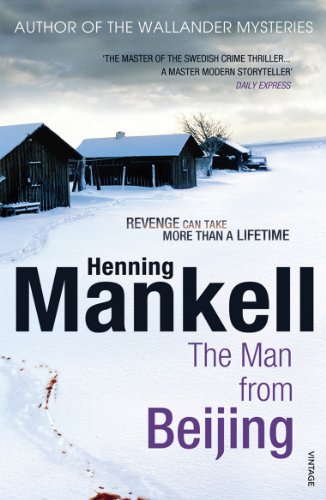
Synopsis
A brutal revenge story that is both a gripping police procedural and a chilling political thriller. One cold January day the police are called to a sleepy little hamlet in the north of Sweden where they discover a savagely murdered man lying in the snow. As they begin their investigation they notice that the village seems eerily quiet and deserted. Going from house to house, looking for witnesses, they uncover a crime unprecedented in Swedish history.
Les informations fournies dans la section « Synopsis » peuvent faire référence à une autre édition de ce titre.
Extrait
The Epitaph
1
Frozen snow, severe frost. Midwinter.
Early in January 2006 a lone wolf crosses the unmarked border and enters Sweden from Vauldalen in Norway. A man on a snowmobile thinks he might have glimpsed it just outside Fjällnäs, but the wolf vanishes into the trees heading east before he is able to pinpoint it. In the remote Norwegian Österdalarna Mountains it had discovered a lump of frozen moose carcass, with remnants of meat still clinging to the bones. But that was more than two days ago. It is beginning to feel the pain of hunger and is desperately searching for food.
The wolf is a young male that has set out to find a territory of his own. He continues his way eastward. At Nävjarna, north of Linsell, he finds another moose carcass. For a whole day he stays and eats his fill before resuming his trek east. When he comes to Kårböle he trots over the frozen Ljusnan and then follows the river along its winding route toward the sea. One moonless night he lopes silently over the bridge at Järvsö, then heads into the vast forests that stretch to the coast.
In the early morning of January 13 the wolf reaches Hesjövallen, a tiny village south of Hansesjön Lake in Hälsingland. He pauses and sniffs the air. He detects the smell of blood. He looks around. There are people living in the houses but no smoke rising from the chimneys. His sharp ears can’t detect the slightest sound.
But the wolf is in no doubt about the blood. He skulks at the edge of the forest, nose in the air. Then he moves forward, silently, through the snow. The smell comes from one of the houses at the far end of the hamlet. He is vigilant now—with humans around it’s essential to be both careful and patient. He pauses again. The smell originates from the back of the house. He waits. Then eventually starts moving once more. When he gets there he finds another carcass. He drags his large meal back to the trees. He has not been discovered, not even the village dogs have stirred. The silence is total this freezing cold morning.
The wolf starts eating when he comes to the edge of the trees. It is easy, as the flesh has not yet frozen. He is very hungry now. Having pulled off a leather shoe, he starts gnawing away at an ankle.
It snowed during the night but stopped before dawn. As the wolf eats his fill, snowflakes once again start dancing down toward the frozen ground.
2
When Karsten Höglin woke up he remembered dreaming about a photograph. He lay motionless in bed and felt the image returning slowly, as if the negative of his dream were sending a copy into his conscious mind. He recognized the picture. It was black and white and depicted a man sitting on an old iron bed, with a hunting rifle hanging on the wall and a chamber pot at his feet. When he saw it for the first time, he had been gripped by the old man’s wistful smile. There was something timorous and evasive about him. Much later Karsten had discovered the background. A few years earlier the man had accidentally shot and killed his only son while hunting seabirds. From then on the rifle had never come down from the wall, and the man had become a hermit.
Höglin thought that of all the thousands of photographs and negatives he had seen, this was the one he would never forget. He wished he had taken it himself.
The clock on his bedside table read half past seven. Höglin usually woke up very early, but he had slept badly that night, the bed and its mattress were uncomfortable. He made up his mind to complain about them when he checked out of the hotel.
It was the ninth and final day of his journey. It had been made possible by a scholarship enabling him to study deserted villages and other small settlements that were being depopulated. He had come as far as Hudiksvall and had one hamlet left to photograph. He had chosen this particular one because an old man who lived there had read about his project and sent him a letter. Höglin had been impressed by the letter and decided that this was the place for him to conclude his study.
He got up and opened the curtains. It had snowed during the night and was still gray, the sun not yet risen. A bundled-up woman was cycling past in the street below. Karsten considered her and wondered how cold it was. Negative five degrees Celsius, possibly negative seven.
He dressed and took the slow-moving elevator down to reception. He had parked his car in the enclosed courtyard behind the hotel. It was safe there. Even so, he had taken all his photographic equipment up to his room, as was his practice. His worst nightmare was to come to his car one day and find that all his cameras had vanished.
The receptionist was a young girl, barely out of her teens. He noticed that her makeup was slapdash and gave up on the idea of complaining about the bed. After all, he had no intention of ever returning to the hotel.
In the breakfast room a few guests were absorbed in their morning papers. For a fleeting moment he was tempted to get a camera and take a shot. It gave him the feeling that Sweden had always been exactly like this. Silent people, poring over their newspapers with a cup of coffee, absorbed in their own thoughts, their own fates.
But he resisted the temptation, served himself coffee, buttered two slices of bread, and tucked into a soft-boiled egg. Without a newspaper, he ate quickly. He hated being at a meal on his own without anything to read.
It was colder than he expected when he emerged from the hotel. He stood on tiptoe to read the thermometer in the reception window. Negative eleven degrees. And falling, he suspected. This winter has been far too warm. Here comes the cold spell we’ve been expecting. He put his cases on the backseat, started the engine, and began scraping ice off the windshield. There was a map on the passenger seat. The previous day, after taking pictures of a village not far from Lake Hassela, he had worked out how to get to his final port of call: take the main road southward, turn off toward Sörforsa near Iggesund, then follow either the east or the west shore of the lake called Storsjön in some parts and Långsjön in others. The guy at the gas station on the way into Hudiksvall had warned him that the east road was bad, but he decided to take it anyway. It would be quicker. And the light was so lovely this winter morning. He could already envisage the smoke rising straight up to the sky from the chimneys.
It took him forty minutes to get there. By then he had already made a wrong turn, a road leading southward to Näcksjö.
Hesjövallen was situated in a little valley by a lake whose name he couldn’t recall. Hesjön, maybe? The dense forests extended all the way to the hamlet, on both sides of the narrow road leading up toward Härjedalen.
Karsten stopped at the edge of the tiny village and got out of the car. There were breaks in the clouds now. The light would become more difficult to capture, perhaps not so expressive. He looked around. Everything was very still. The houses gave the impression of having been there since time immemorial. In the distance he could hear the faint noise of traffic on the main road.
He suddenly felt uneasy. He held his breath, as he always did when confronted with something he didn’t really understand.
Then it dawned on him—the chimneys, they were cold. There was no sign of smoke, which would have been an effective feature of the photographs he hoped to take. His gaze moved slowly from house to house. Somebody’s cleared the snow already, he thought. But not lit a single fire? He remembered the letter he’d received from the man who had told him about the village. He had referred to the chimneys and how the houses seemed, in a childish sort of way, to be sending smoke signals to one another.
He sighed. People don’t write the truth, but what they think you want to read. Now should I take pictures with cold chimneys or abandon the whole business? Nobody was forcing him to take photographs of Hesjövallen and its inhabitants. He already had plenty of pictures of the Sweden that was fading away: the derelict farms, the remote villages whose only hope of survival was that Danes and Germans would buy up the houses and turn them into summer cottages. He decided to leave and returned to his car. But he didn’t start the engine. He had come this far; the least he could do was to try to create some portrait of the local inhabitants—he wanted faces. As the years passed, Karsten Höglin had become increasingly fascinated by elderly people. He wanted to compile an album: pictures that would describe the beauty found only in the faces of very old women, their lives and hardships etched into their skin like the sediment in a cliff wall.
He got out of his car again, pulled his fur hat down over his ears, picked out a Leica M6 he’d been using for the past ten years, and made for the nearest of the group of houses. There were ten in all, most of them timber and painted red, some with added stoops. He could see only one modern house. If it could still be called modern, that is—a 1950s detached house. When he came to the gate, he paused and raised his camera. The nameplate indicated that the Andrén family lived there. He took a few shots, varying the aperture setting and exposure time, trying out several angles, though it was clear that there wasn’t enough light yet and he would get only an indistinct blur. But you never know. Photographers sometimes expose unexpected secrets.
Höglin was intuitive with his work. Not that he didn’t bother to measure light levels when required, but sometimes he’d pull off surprising results without paying attention to carefully calculated exposure times. Improvisation went with the territory.
The gate was stiff. He had to push hard in order to open it. There were no footprints in the newly fallen...
Présentation de l'éditeur
One cold January day the police are called to a sleepy little hamlet in the north of Sweden where they discover a savagely murdered man lying in the snow. As they begin their investigation they notice that the village seems eerily quiet and deserted. Going from house to house, looking for witnesses, they uncover a crime unprecedented in Swedish history.
When Judge Birgitta Roslin reads about the massacre, she realises that she has a family connection to one of the couples involved and decides to investigate. A nineteenth-century diary and a red silk ribbon found in the forest nearby are the only clues.
What Birgitta eventually uncovers leads her into an international web of corruption and a story of vengeance that stretches back over a hundred years, linking China and the USA of the 1860s with modern-day Beijing, Zimbabwe and Mozambique, and coming to a shocking climax in London's Chinatown.
The Man from Beijing is both a gripping and perceptive political thriller and a compelling detective story. It shows Henning Mankell at the height of his powers, handling a broad historical canvas and pressing international issues with his exceptional gifts for insight and chilling suspense.
Les informations fournies dans la section « A propos du livre » peuvent faire référence à une autre édition de ce titre.
Résultats de recherche pour The Man from Beijing

Image d'archives
The Man from Beijing (Vintage Crime/Black Lizard)
Edité par
Vintage Books, 2011
ISBN 10 : 0099555352
ISBN 13 : 9780099555353
Ancien ou d'occasion
Paperback
Vendeur : ThriftBooks-Dallas, Dallas, TX, Etats-Unis
Évaluation du vendeur 5 sur 5 étoiles

Paperback. Etat : Fair. No Jacket. Readable copy. Pages may have considerable notes/highlighting. ~ ThriftBooks: Read More, Spend Less. N° de réf. du vendeur G0099555352I5N00
Acheter D'occasion
EUR 7,69
Livraison gratuite
Expédition nationale : Etats-Unis
Expédition nationale : Etats-Unis
Quantité disponible : 1 disponible(s)
Image d'archives
The Man from Beijing (Vintage Crime/Black Lizard)
Edité par
Vintage Books, 2011
ISBN 10 : 0099555352
ISBN 13 : 9780099555353
Ancien ou d'occasion
Paperback
Vendeur : ThriftBooks-Dallas, Dallas, TX, Etats-Unis
Évaluation du vendeur 5 sur 5 étoiles
Paperback. Etat : Good. No Jacket. Pages can have notes/highlighting. Spine may show signs of wear. ~ ThriftBooks: Read More, Spend Less. N° de réf. du vendeur G0099555352I3N00
Acheter D'occasion
EUR 7,69
Livraison gratuite
Expédition nationale : Etats-Unis
Expédition nationale : Etats-Unis
Quantité disponible : 1 disponible(s)
Image d'archives
The Man From Beijing
Edité par
Vintage Publishing, 2011
ISBN 10 : 0099555352
ISBN 13 : 9780099555353
Ancien ou d'occasion
Paperback
Vendeur : World of Books (was SecondSale), Montgomery, IL, Etats-Unis
Évaluation du vendeur 5 sur 5 étoiles
Paperback. Etat : Good. One cold January day the police are called to a sleepy little hamlet in the north of Sweden where they discover a savagely murdered man lying in the snow. N° de réf. du vendeur 00103615837
Acheter D'occasion
EUR 7,70
Livraison gratuite
Expédition nationale : Etats-Unis
Expédition nationale : Etats-Unis
Quantité disponible : 1 disponible(s)
Image d'archives
The Man From Beijing
Vendeur : AwesomeBooks, Wallingford, Royaume-Uni
Évaluation du vendeur 5 sur 5 étoiles
Paperback. Etat : Very Good. The Man From Beijing This book is in very good condition and will be shipped within 24 hours of ordering. The cover may have some limited signs of wear but the pages are clean, intact and the spine remains undamaged. This book has clearly been well maintained and looked after thus far. Money back guarantee if you are not satisfied. See all our books here, order more than 1 book and get discounted shipping. N° de réf. du vendeur 7719-9780099555353
Acheter D'occasion
EUR 3,43
Expédition à EUR 4,87
Expédition depuis Royaume-Uni vers Etats-Unis
Expédition depuis Royaume-Uni vers Etats-Unis
Quantité disponible : 2 disponible(s)
Image d'archives
The Man from Beijing
Edité par
Penguin Random House, 2011
ISBN 10 : 0099555352
ISBN 13 : 9780099555353
Ancien ou d'occasion
Couverture souple
Vendeur : Better World Books: West, Reno, NV, Etats-Unis
Évaluation du vendeur 5 sur 5 étoiles
Etat : Good. Pages intact with minimal writing/highlighting. The binding may be loose and creased. Dust jackets/supplements are not included. Stock photo provided. Product includes identifying sticker. Better World Books: Buy Books. Do Good. N° de réf. du vendeur 10836892-75
Acheter D'occasion
EUR 8,35
Livraison gratuite
Expédition nationale : Etats-Unis
Expédition nationale : Etats-Unis
Quantité disponible : 1 disponible(s)
Image d'archives
The Man From Beijing
Edité par
Vintage Publishing, 2011
ISBN 10 : 0099555352
ISBN 13 : 9780099555353
Ancien ou d'occasion
Paperback
Vendeur : World of Books Inc, Montgomery, IL, Etats-Unis
Évaluation du vendeur 4 sur 5 étoiles

Paperback. Etat : Good. One cold January day the police are called to a sleepy little hamlet in the north of Sweden where they discover a savagely murdered man lying in the snow. N° de réf. du vendeur CIN0099555352G
Acheter D'occasion
EUR 9,54
Livraison gratuite
Expédition nationale : Etats-Unis
Expédition nationale : Etats-Unis
Quantité disponible : 1 disponible(s)
Image d'archives
The Man From Beijing
Vendeur : Bahamut Media, Reading, Royaume-Uni
Évaluation du vendeur 4 sur 5 étoiles
Paperback. Etat : Very Good. This book is in very good condition and will be shipped within 24 hours of ordering. The cover may have some limited signs of wear but the pages are clean, intact and the spine remains undamaged. This book has clearly been well maintained and looked after thus far. Money back guarantee if you are not satisfied. See all our books here, order more than 1 book and get discounted shipping. N° de réf. du vendeur 6545-9780099555353
Acheter D'occasion
EUR 4,14
Expédition à EUR 8,25
Expédition depuis Royaume-Uni vers Etats-Unis
Expédition depuis Royaume-Uni vers Etats-Unis
Quantité disponible : 2 disponible(s)
Image d'archives
The Man from Beijing (Vintage Crime/Black Lizard)
Edité par
Vintage Books, 2011
ISBN 10 : 0099555352
ISBN 13 : 9780099555353
Ancien ou d'occasion
Paperback
Vendeur : WorldofBooks, Goring-By-Sea, WS, Royaume-Uni
Évaluation du vendeur 5 sur 5 étoiles
Paperback. Etat : Very Good. The book has been read, but is in excellent condition. Pages are intact and not marred by notes or highlighting. The spine remains undamaged. N° de réf. du vendeur GOR002801907
Acheter D'occasion
EUR 5,86
Expédition à EUR 6,62
Expédition depuis Royaume-Uni vers Etats-Unis
Expédition depuis Royaume-Uni vers Etats-Unis
Quantité disponible : 2 disponible(s)
Image d'archives
The Man from Beijing
Edité par
Vintage Books, London, 2008
ISBN 10 : 0099555352
ISBN 13 : 9780099555353
Ancien ou d'occasion
Softcover
Vendeur : Buchstube Tiffany56, Barsbüttel, Allemagne
Évaluation du vendeur 4 sur 5 étoiles
Softcover. Etat : Gut bis sehr gut. Ohne Schutzumschlag. In a sleepy hamlet in the north of Sweden, the local police make a chilling discovery; nineteen people have been brutally slaughtered. It is a crime unprecedented in Sweden´s history and the police are under incredible pressure to solve the killings. When Judge Brigitta Roslin reads about the massacre, she realises that she has a family connection to one of the couples involved and decides to investigate. After the police make a hasty arrest it is left to her to find the source of a nineteenth-century diary and red silk ribbon found near the crime scene, 553 Seiten, leichte Gebrauchsspuren, Buch ist in englischer Sprache. N° de réf. du vendeur BN7741
Acheter D'occasion
EUR 4
Expédition à EUR 10
Expédition depuis Allemagne vers Etats-Unis
Expédition depuis Allemagne vers Etats-Unis
Quantité disponible : 1 disponible(s)
Image d'archives
The man from Beijing
Edité par
Vintage Books, 2011
ISBN 10 : 0099555352
ISBN 13 : 9780099555353
Ancien ou d'occasion
Couverture souple
Vendeur : medimops, Berlin, Allemagne
Évaluation du vendeur 5 sur 5 étoiles
Etat : very good. Gut/Very good: Buch bzw. Schutzumschlag mit wenigen Gebrauchsspuren an Einband, Schutzumschlag oder Seiten. / Describes a book or dust jacket that does show some signs of wear on either the binding, dust jacket or pages. N° de réf. du vendeur M00099555352-V
Acheter D'occasion
EUR 4,37
Expédition à EUR 10
Expédition depuis Allemagne vers Etats-Unis
Expédition depuis Allemagne vers Etats-Unis
Quantité disponible : 1 disponible(s)