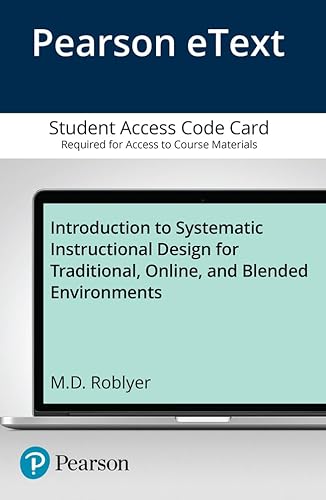
Introduction to Systematic Instructional Design for Traditional, Online, and Blended Environments, Enhanced Pearson Etext -- Access Card
Synopsis
An accessible introduction for instructional design novices.
Introduction to Systematic Instructional Design for Traditional, Online, and Blended Environments updates traditional, ADDIE-based approaches (named for the five-step Analysis, Design, Development, Implementation, and Evaluation sequence) to make them relevant for designing today's in-person, multimedia, and distance learning environments. The book's features reflect characteristics that make it uniquely useful among other texts on the topic. It illustrates design for online and blended learning environments, and encourages students to create their own instructional design projects.
For courses in Instructional Design, Instructional Design and Technology, or Instructional Technology.
Pearson eText is an easy-to-use digital textbook that you can purchase on your own or instructors can assign for their course. The mobile app lets you keep on learning, no matter where your day takes you, even offline. You can also add highlights, bookmarks, and notes in your Pearson eText to study how you like.
NOTE: This ISBN is for the Pearson eText access card. Pearson eText is a fully digital delivery of Pearson content. Before purchasing, check that you have the correct ISBN. To register for and use Pearson eText, you may also need a course invite link, which your instructor will provide. Follow the instructions provided on the access card to learn more.
Les informations fournies dans la section « Synopsis » peuvent faire référence à une autre édition de ce titre.
À propos de l?auteur
A graduate of Florida State University's instructional systems program, M. D. Roblyer has been a professor of instructional technology and educational leadership in higher education institutions for over 30 years. She has authored or coauthored hundreds of books, monographs, articles, columns, and papers on educational technology research and practice and has taught instructional design in both online and traditional formats at both undergraduate and graduate levels. Her textbook Integrating Educational Technology into Teaching (with Aaron Doering, Pearson Education, 2013) is internationally adopted for undergraduate and graduate instructional technology courses and has been translated into several languages. She is currently Adjunct Professor of Instructional Technology and Distance Education (ITDE) at Nova Southeastern University.
À propos de la quatrième de couverture
An accessible introduction for instructional design novices, this book updates traditional, ADDIE-based approaches (named for the five-step Analysis, Design, Development, Implementation, and Evaluation sequence) to make them relevant for designing today’s in-person, multimedia, and distance learning environments. The book’s features reflect characteristics that make it uniquely useful among other texts on the topic:
- Supports instructional design novices with features that make the ideas accessible, including:
- Chapter opening scenarios
- Listen to Learn audio overviews of chapter content (available in the Pearson eText)
- Check Your Understanding exercises (available in the Pearson eText)
- Example design projects
-
- Updates design to address new technologies with design steps, criteria, and resources for the full range of media options, including:
- Design tips for creating and/or using resources such as podcasts/vodcasts, social media, and apps.
- Steps and criteria for producing effective hypermedia, audio/video, and web-based materials.
-
- Illustrates design for online and blended learning environments to ensure successful learning of the implementation stage of the ADDIE process, including:
- Recommendations for designing learning environments ranging from traditional, in-person classrooms to completely online or virtual courses.
- Design principles and criteria for online and blended strategies ranging from the flipped-classroom model to MOOCs (Massive Open Online Courses).
-
- Students create their own instructional design projects as they move through the text.
Les informations fournies dans la section « A propos du livre » peuvent faire référence à une autre édition de ce titre.
Résultats de recherche pour Introduction to Systematic Instructional Design for...

Image d'archives
Introduction to Systematic Instructional Design for Traditional, Online, and Blended Environments -- Enhanced Pearson eText
Vendeur : BooksRun, Philadelphia, PA, Etats-Unis
Évaluation du vendeur 5 sur 5 étoiles

Printed Access Code. Etat : New. 1. The item is brand new, never used or read. It's in perfect condition and may include supplements and/or access codes or come shrink-wrapped. STANDALONE access code. N° de réf. du vendeur 0133827682-9-1-88
Acheter neuf
EUR 2,81
Livraison gratuite
Expédition nationale : Etats-Unis
Expédition nationale : Etats-Unis
Quantité disponible : 1 disponible(s)