
Articles liés à The Odyssey
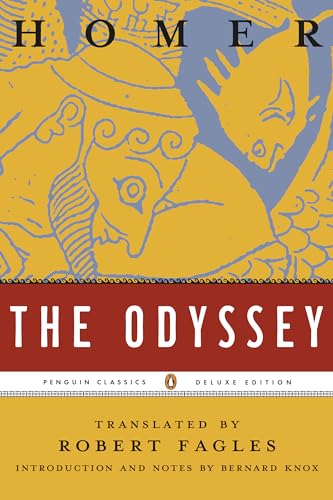
Synopsis
NOW A MAJOR FILM DIRECTED BY CHRISTOPHER NOLAN
If the Iliad is the world’s greatest war epic, the Odyssey is literature’s grandest evocation of an everyman’s journey through life. Odysseus’ reliance on wit and wiliness for survival in his encounters with divine and natural forces during his ten-year voyage home to Ithaca after the Trojan War is at once a timeless human story and an individual test of moral endurance.
In the myths and legends retold here, Fagles captures the energy and poetry of Homer’s original in a bold, contemporary idiom, giving us an Odyssey to read aloud, to savour, and to treasure for its sheer lyrical mastery. Renowned classicist Bernard Knox’s superb introduction and textual commentary provide insightful background information for the general reader and scholar alike, intensifying the strength of Fagles’s translation. This Penguin Classics Deluxe Edition features French flaps and deckle-edged paper.
Les informations fournies dans la section « Synopsis » peuvent faire référence à une autre édition de ce titre.
À propos de l'auteur
ROBERT FAGLES was Arthur W. Marks 1919 Professor of Comparative Literature at Princeton University and the winner of the 1996 Academy Award in Literature from the American Academy of Arts and Letters.
À propos de la quatrième de couverture
A translation that presents Homer's poem, recounting the great wandering of Odysseus during his ten-year voyage back home to Ithaca, after the Trojan War.
Extrait. © Reproduit sur autorisation. Tous droits réservés.
I
Athene Visits Telemachus
Tell me, Muse, the story of that resourceful man who was driven to wander far and wide after he had sacked the holy citadel of Troy. He saw the cities of many people and he learnt their ways. He suffered great anguish on the high seas in his struggles to preserve his life and bring his comrades home. But he failed to save those comrades, in spite of all his efforts. It was their own transgression that brought them to their doom, for in their folly they devoured the oxen of Hyperion the Sun-god and he saw to it that they would never return. Tell us this story, goddess daughter of Zeus, beginning at whatever point you will.
All the survivors of the war had reached their homes by now and so put the perils of battle and the sea behind them. Odysseus alone was prevented from returning to the home and wife he yearned for by that powerful goddess, the Nymph Calypso, who longed for him to marry her, and kept him in her vaulted cave. Not even when the rolling seasons brought in the year which the gods had chosen for his homecoming to Ithaca was he clear of his troubles and safe among his friends. Yet all the gods pitied him, except Poseidon, who pursued the heroic Odysseus with relentless malice till the day when he reached his own country.
Poseidon, however, was now gone on a visit to the distant Ethiopians, in the most remote part of the world, half of whom live where the Sun goes down, and half where he rises. He had gone to accept a sacrifice of bulls and rams, and there he sat and enjoyed the pleasures of the feast. Meanwhile the rest of the gods had assembled in the palace of Olympian Zeus, and the Father of men and gods opened a discussion among them. He had been thinking of the handsome Aegisthus, whom Agamemnon’s far-famed son Orestes killed; and it was with Aegisthus in his mind that Zeus now addressed the immortals:
‘What a lamentable thing it is that men should blame the gods and regard us as the source of their troubles, when it is their own transgressions which bring them suffering that was not their destiny. Consider Aegisthus: it was not his destiny to steal Agamemnon’s wife and murder her husband when he came home. He knew the result would be utter disaster, since we ourselves had sent Hermes, the keen-eyed Giant-slayer, to warn him neither to kill the man nor to court his wife. For Orestes, as Hermes told him, was bound to avenge Agamemnon as soon as he grew up and thought with longing of his home. Yet with all his friendly counsel Hermes failed to dissuade him. And now Aegisthus has paid the final price for all his sins.’
Les informations fournies dans la section « A propos du livre » peuvent faire référence à une autre édition de ce titre.
Résultats de recherche pour The Odyssey

Image fournie par le vendeur
The Odyssey
Edité par
Penguin Classics, 1999
ISBN 10 : 0140268863
ISBN 13 : 9780140268867
Ancien ou d'occasion
Couverture souple
Vendeur : Dream Books Co., Denver, CO, Etats-Unis
Évaluation du vendeur 5 sur 5 étoiles

Etat : acceptable. This copy has clearly been enjoyedâ"expect noticeable shelf wear and some minor creases to the cover. Binding is strong, and all pages are legible. May contain previous library markings or stamps. N° de réf. du vendeur DBV.0140268863.A
Acheter D'occasion
EUR 6,02
Livraison gratuite
Expédition nationale : Etats-Unis
Expédition nationale : Etats-Unis
Quantité disponible : 6 disponible(s)
Image fournie par le vendeur
The Odyssey
Edité par
Penguin Classics, 1999
ISBN 10 : 0140268863
ISBN 13 : 9780140268867
Ancien ou d'occasion
Couverture souple
Vendeur : Bay State Book Company, North Smithfield, RI, Etats-Unis
Évaluation du vendeur 5 sur 5 étoiles
Etat : good. The book is in good condition with all pages and cover intact, including the dust jacket if originally issued. The spine may show light wear. Pages may contain some notes or highlighting, and there might be a "From the library of" label. Boxed set packaging, shrink wrap, or included media like CDs may be missing. N° de réf. du vendeur BSM.1FD97
Acheter D'occasion
EUR 6,06
Livraison gratuite
Expédition nationale : Etats-Unis
Expédition nationale : Etats-Unis
Quantité disponible : 1 disponible(s)
Image d'archives
The Odyssey
Edité par
Penguin Classics (edition Reprint), 1999
ISBN 10 : 0140268863
ISBN 13 : 9780140268867
Ancien ou d'occasion
Paperback
Vendeur : BooksRun, Philadelphia, PA, Etats-Unis
Évaluation du vendeur 5 sur 5 étoiles
Paperback. Etat : Fair. Reprint. The item might be beaten up but readable. May contain markings or highlighting, as well as stains, bent corners, or any other major defect, but the text is not obscured in any way. N° de réf. du vendeur 0140268863-7-1
Acheter D'occasion
EUR 6,36
Livraison gratuite
Expédition nationale : Etats-Unis
Expédition nationale : Etats-Unis
Quantité disponible : 1 disponible(s)
Image fournie par le vendeur
The Odyssey
Edité par
Penguin Classics, 1999
ISBN 10 : 0140268863
ISBN 13 : 9780140268867
Ancien ou d'occasion
Couverture souple
Vendeur : ZBK Books, Carlstadt, NJ, Etats-Unis
Évaluation du vendeur 5 sur 5 étoiles
Etat : good. Fast & Free Shipping â" Good condition. It may show normal signs of use, such as light writing, highlighting, or library markings, but all pages are intact and the book is fully readable. A solid, complete copy that's ready to enjoy. N° de réf. du vendeur ZWV.0140268863.G
Acheter D'occasion
EUR 6,80
Livraison gratuite
Expédition nationale : Etats-Unis
Expédition nationale : Etats-Unis
Quantité disponible : 3 disponible(s)
Image fournie par le vendeur
The Odyssey
Edité par
Penguin Classics, 1999
ISBN 10 : 0140268863
ISBN 13 : 9780140268867
Ancien ou d'occasion
Couverture souple
Vendeur : Goodwill, Brooklyn Park, MN, Etats-Unis
Évaluation du vendeur 4 sur 5 étoiles

Etat : good. All pages and cover are intact including the dust cover, if applicable . Spine may show signs of wear. Pages may include limited notes and highlighting. May include "From the library of" labels. Shrink wrap, dust covers, or boxed set case may be missing. Item may be missing bundled media. N° de réf. du vendeur 2Y6OIV0032RF_ns
Acheter D'occasion
EUR 3,35
Expédition à EUR 3,56
Expédition nationale : Etats-Unis
Expédition nationale : Etats-Unis
Quantité disponible : 1 disponible(s)
Image fournie par le vendeur
The Odyssey
Edité par
Penguin Classics, 1999
ISBN 10 : 0140268863
ISBN 13 : 9780140268867
Ancien ou d'occasion
Couverture souple
Vendeur : Goodwill Books, Hillsboro, OR, Etats-Unis
Évaluation du vendeur 5 sur 5 étoiles
Etat : good. Signs of wear and consistent use. N° de réf. du vendeur GICWV.0140268863.G
Acheter D'occasion
EUR 3,50
Expédition à EUR 3,56
Expédition nationale : Etats-Unis
Expédition nationale : Etats-Unis
Quantité disponible : 1 disponible(s)
Image fournie par le vendeur
The Odyssey
Edité par
Penguin Classics, 1999
ISBN 10 : 0140268863
ISBN 13 : 9780140268867
Ancien ou d'occasion
Couverture souple
Vendeur : Greenworld Books, Arlington, TX, Etats-Unis
Évaluation du vendeur 5 sur 5 étoiles
Etat : good. Fast Free Shipping â" Good condition. It may show normal signs of use, such as light writing, highlighting, or library markings, but all pages are intact and the book is fully readable. A solid, complete copy that's ready to enjoy. N° de réf. du vendeur GWV.0140268863.G
Acheter D'occasion
EUR 7,17
Livraison gratuite
Expédition nationale : Etats-Unis
Expédition nationale : Etats-Unis
Quantité disponible : 1 disponible(s)
Image fournie par le vendeur
The Odyssey
Edité par
Penguin Classics, 1999
ISBN 10 : 0140268863
ISBN 13 : 9780140268867
Ancien ou d'occasion
Couverture souple
Vendeur : Greenworld Books, Arlington, TX, Etats-Unis
Évaluation du vendeur 5 sur 5 étoiles
Etat : very_good. Fast Free Shipping â" Very Good condition book with a firm cover and clean pages. Shows normal use and some light wear or limited notes markings. A solid, nice copy to enjoy. N° de réf. du vendeur GWV.0140268863.VG
Acheter D'occasion
EUR 7,95
Livraison gratuite
Expédition nationale : Etats-Unis
Expédition nationale : Etats-Unis
Quantité disponible : 2 disponible(s)
Image fournie par le vendeur
The Odyssey
Edité par
Penguin Classics, 1999
ISBN 10 : 0140268863
ISBN 13 : 9780140268867
Ancien ou d'occasion
Couverture souple
Vendeur : ZBK Books, Carlstadt, NJ, Etats-Unis
Évaluation du vendeur 5 sur 5 étoiles
Etat : very_good. Fast & Free Shipping â" Very Good condition book with a firm cover and clean pages. Shows normal use and some light wear or limited notes markings. A solid, nice copy to enjoy. N° de réf. du vendeur ZWV.0140268863.VG
Acheter D'occasion
EUR 7,97
Livraison gratuite
Expédition nationale : Etats-Unis
Expédition nationale : Etats-Unis
Quantité disponible : Plus de 20 disponibles
Image fournie par le vendeur
The Odyssey
Edité par
Penguin Classics, 1999
ISBN 10 : 0140268863
ISBN 13 : 9780140268867
Ancien ou d'occasion
Couverture souple
Vendeur : Goodwill of Central and Coastal Virginia, Richmond, VA, Etats-Unis
Évaluation du vendeur 4 sur 5 étoiles
Etat : acceptable. N° de réf. du vendeur CCVV.0140268863.A
Acheter D'occasion
EUR 3,23
Expédition à EUR 5,13
Expédition nationale : Etats-Unis
Expédition nationale : Etats-Unis
Quantité disponible : 1 disponible(s)