
Articles liés à The Prince
Synopsis
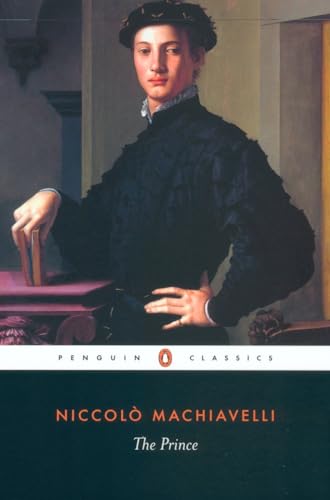
Niccolò Machiavelli's ruthless manual for aspiring rulers, this Penguin Classics edition of The Prince is translated with notes by George Bull and an introduction by Anthony Grafton.
The Prince shocked Europe on publication with its ruthless tactics for gaining absolute power and its abandonment of conventional morality. Niccolò Machiavelli came to be regarded as some by an agent of the Devil and his name taken for the intriguer 'Machevill' of Jacobean tragedy. For his treatise on statecraft Machiavelli drew upon his own experience of office under the turbulent Florentine republic, rejecting traditional values of political theory and recognizing the complicated, transient nature of political life. Concerned not with lofty ideals, but with a regime that would last, The Prince has become the Bible of realpolitik, and still retains its power to alarm and to instruct.
In this edition Machiavelli's tough-minded and pragmatic Italian is preserved in George Bull's clear, unambiguous translation, while Anthony Grafton's introduction depicts Machiavelli's world of power struggles and intrigue, and discusses his role as political teacher of Europe.
Niccolò Machiavelli (1469-1527) was born in Florence, and served the Florentine republic as a secretary and second chancellor, as ambassador and foreign policy-maker. When the Medici family returned to power in 1512 he was suspected of conspiracy, imprisoned and tortured and forced to retire from public life. His most famous work, The Prince, was written in an attempt to gain favour with the Medicis and return to politics.
If you enjoyed The Prince, you might like Plato's Republic, also available in Penguin Classics.
Les informations fournies dans la section « Synopsis » peuvent faire référence à une autre édition de ce titre.
À propos de l'auteur
Niccoló Machiavelli (1469-1527) was appointed secretary and Second Chancellor to the Florentine Republic in 1498. He was dismissed from his post in 1512 and forced to withdraw from public life, after which time he wrote THE PRINCE, a handbook for rulers. GEORGE BULL translated widely from the Italian, including for Penguin Classics including Cellini's 'Autobiography' and Vasari's 'Lives of the Artists'. ANTHONY GRAFTON teaches European intellectual history at Princeton University.
À propos de la quatrième de couverture
The Prince shocked Europe on publication with its ruthless tactics for gaining absolute power and its abandonment of conventional morality. Niccolo Machiavelli (1469-1527) came to be regarded as some by an agent of the Devil and his name taken for the intriguer 'Machevill' of Jacobean tragedy. For his treatise on statecraft Machiavelli drew upon his own experience of office under the turbulent Florentine republic, rejecting traditional values of political theory and recognizing the complicated, transient nature of political life. Concerned not with lofty ideals, but with a regime that would last, The Prince has become the Bible of realpolitik, and still retains its power to alarm and to instruct.
Extrait. © Reproduit sur autorisation. Tous droits réservés.
Seventeenth Chapter: Concerning Cruelty and Clemency, and Whether It Is Better to Be Loved Than Feared
...Upon this a question arises: whether it be better to be loved than feared or feared than loved? It may be answered that one should wish to be both, but, because it is difficult to unite them in one person, it is much safer to be feared than loved, when, of the two, either must be dispensed with. Because this is to be asserted in general of men, that they are ungrateful, fickle, false, cowardly, covetous, and as long as you succeed, they are yours entirely; they will offer you their blood, property, life, and children, as is said above, when the need is far distant; but when it approaches they turn against you. And that prince, who, relying entirely on their promises, has neglected other precautions, is ruined; because friendships that are obtained by payments, and not by greatness or by nobility of mind, may indeed be earned, but they are not secured, and in time of need cannot be relied upon; and men have less scruple in offending one who is beloved than one who is feared, for love is preserved by the link of obligation which, owing to the baseness of men, is broken at every opportunity for their advantage; but fear preserves you by a dread of punishment which never fails....
Twenty-First Chapter: How a Prince Should Conduct Himself So as to Gain Renown
...A prince is also respected when he is either a true friend or a downright enemy, that is to say, when, without any reservation, he declares himself in favour of one party against the other; which course will always be more advantageous than standing neutral; because if two of your powerful neighbours come to blows, they are of such a character that, if one of them conquers, you have either to fear him or not. In either case it will always be more advantageous for you to declare yourself and to make war strenously; because, in the first case, if you do not declare yourself, you will invariably fall a prey to the conqueror, to the pleasure and satisfaction of his who has been conquered, and you will have no reasons to offer, nor anything to protect or to shelter you. Because he who conquers does not want doubtful friends who will not aid him in the time of trial; and he who loses will not harbour you because you did not willingly, sword in hand, court his fate....
Les informations fournies dans la section « A propos du livre » peuvent faire référence à une autre édition de ce titre.
Résultats de recherche pour The Prince

Image fournie par le vendeur
The Prince (Penguin Classics)
Edité par
Penguin Classics, 2003
ISBN 10 : 0140449159
ISBN 13 : 9780140449150
Ancien ou d'occasion
Couverture souple
Vendeur : Dream Books Co., Denver, CO, Etats-Unis
Évaluation du vendeur 5 sur 5 étoiles

Etat : acceptable. This copy has clearly been enjoyedâ"expect noticeable shelf wear and some minor creases to the cover. Binding is strong, and all pages are legible. May contain previous library markings or stamps. N° de réf. du vendeur DBV.0140449159.A
Acheter D'occasion
EUR 5,13
Livraison gratuite
Expédition nationale : Etats-Unis
Expédition nationale : Etats-Unis
Quantité disponible : 1 disponible(s)
Image fournie par le vendeur
The Prince (Penguin Classics)
Edité par
Penguin Classics, 2003
ISBN 10 : 0140449159
ISBN 13 : 9780140449150
Ancien ou d'occasion
Couverture souple
Vendeur : Dream Books Co., Denver, CO, Etats-Unis
Évaluation du vendeur 5 sur 5 étoiles
Etat : good. Gently used with minimal wear on the corners and cover. A few pages may contain light highlighting or writing, but the text remains fully legible. Dust jacket may be missing, and supplemental materials like CDs or codes may not be included. May be ex-library with library markings. Ships promptly! N° de réf. du vendeur DBV.0140449159.G
Acheter D'occasion
EUR 5,66
Livraison gratuite
Expédition nationale : Etats-Unis
Expédition nationale : Etats-Unis
Quantité disponible : 1 disponible(s)
Image d'archives
The Prince
Edité par
Penguin Classics, 2003
ISBN 10 : 0140449159
ISBN 13 : 9780140449150
Ancien ou d'occasion
Paperback
Vendeur : ThriftBooks-Dallas, Dallas, TX, Etats-Unis
Évaluation du vendeur 5 sur 5 étoiles
Paperback. Etat : Fair. No Jacket. Former library book; Readable copy. Pages may have considerable notes/highlighting. ~ ThriftBooks: Read More, Spend Less. N° de réf. du vendeur G0140449159I5N10
Acheter D'occasion
EUR 5,72
Livraison gratuite
Expédition nationale : Etats-Unis
Expédition nationale : Etats-Unis
Quantité disponible : 1 disponible(s)
Image d'archives
The Prince
Edité par
Penguin Classics, 2003
ISBN 10 : 0140449159
ISBN 13 : 9780140449150
Ancien ou d'occasion
Paperback
Vendeur : ThriftBooks-Phoenix, Phoenix, AZ, Etats-Unis
Évaluation du vendeur 5 sur 5 étoiles
Paperback. Etat : Fair. No Jacket. Readable copy. Pages may have considerable notes/highlighting. ~ ThriftBooks: Read More, Spend Less. N° de réf. du vendeur G0140449159I5N00
Acheter D'occasion
EUR 5,72
Livraison gratuite
Expédition nationale : Etats-Unis
Expédition nationale : Etats-Unis
Quantité disponible : 12 disponible(s)
Image d'archives
The Prince
Edité par
Penguin Classics, 2003
ISBN 10 : 0140449159
ISBN 13 : 9780140449150
Ancien ou d'occasion
Paperback
Vendeur : ThriftBooks-Reno, Reno, NV, Etats-Unis
Évaluation du vendeur 5 sur 5 étoiles
Paperback. Etat : Good. No Jacket. Former library book; Pages can have notes/highlighting. Spine may show signs of wear. ~ ThriftBooks: Read More, Spend Less. N° de réf. du vendeur G0140449159I3N10
Acheter D'occasion
EUR 5,72
Livraison gratuite
Expédition nationale : Etats-Unis
Expédition nationale : Etats-Unis
Quantité disponible : 2 disponible(s)
Image d'archives
The Prince
Edité par
Penguin Classics, 2003
ISBN 10 : 0140449159
ISBN 13 : 9780140449150
Ancien ou d'occasion
Paperback
Vendeur : ThriftBooks-Phoenix, Phoenix, AZ, Etats-Unis
Évaluation du vendeur 5 sur 5 étoiles
Paperback. Etat : Good. No Jacket. Former library book; Pages can have notes/highlighting. Spine may show signs of wear. ~ ThriftBooks: Read More, Spend Less. N° de réf. du vendeur G0140449159I3N10
Acheter D'occasion
EUR 5,72
Livraison gratuite
Expédition nationale : Etats-Unis
Expédition nationale : Etats-Unis
Quantité disponible : 1 disponible(s)
Image d'archives
The Prince
Edité par
Penguin Classics, 2003
ISBN 10 : 0140449159
ISBN 13 : 9780140449150
Ancien ou d'occasion
Paperback
Vendeur : ThriftBooks-Atlanta, AUSTELL, GA, Etats-Unis
Évaluation du vendeur 5 sur 5 étoiles
Paperback. Etat : Good. No Jacket. Former library book; Pages can have notes/highlighting. Spine may show signs of wear. ~ ThriftBooks: Read More, Spend Less. N° de réf. du vendeur G0140449159I3N10
Acheter D'occasion
EUR 5,72
Livraison gratuite
Expédition nationale : Etats-Unis
Expédition nationale : Etats-Unis
Quantité disponible : 2 disponible(s)
Image d'archives
The Prince
Edité par
Penguin Classics, 2003
ISBN 10 : 0140449159
ISBN 13 : 9780140449150
Ancien ou d'occasion
Paperback
Vendeur : ThriftBooks-Dallas, Dallas, TX, Etats-Unis
Évaluation du vendeur 5 sur 5 étoiles
Paperback. Etat : Fair. No Jacket. Readable copy. Pages may have considerable notes/highlighting. ~ ThriftBooks: Read More, Spend Less. N° de réf. du vendeur G0140449159I5N00
Acheter D'occasion
EUR 5,72
Livraison gratuite
Expédition nationale : Etats-Unis
Expédition nationale : Etats-Unis
Quantité disponible : 13 disponible(s)
Image d'archives
The Prince
Edité par
Penguin Classics, 2003
ISBN 10 : 0140449159
ISBN 13 : 9780140449150
Ancien ou d'occasion
Paperback
Vendeur : ThriftBooks-Dallas, Dallas, TX, Etats-Unis
Évaluation du vendeur 5 sur 5 étoiles
Paperback. Etat : Good. No Jacket. Former library book; Pages can have notes/highlighting. Spine may show signs of wear. ~ ThriftBooks: Read More, Spend Less. N° de réf. du vendeur G0140449159I3N10
Acheter D'occasion
EUR 5,72
Livraison gratuite
Expédition nationale : Etats-Unis
Expédition nationale : Etats-Unis
Quantité disponible : 2 disponible(s)
Image d'archives
The Prince
Edité par
Penguin Classics, 2003
ISBN 10 : 0140449159
ISBN 13 : 9780140449150
Ancien ou d'occasion
Paperback
Vendeur : ThriftBooks-Atlanta, AUSTELL, GA, Etats-Unis
Évaluation du vendeur 5 sur 5 étoiles
Paperback. Etat : Fair. No Jacket. Readable copy. Pages may have considerable notes/highlighting. ~ ThriftBooks: Read More, Spend Less. N° de réf. du vendeur G0140449159I5N00
Acheter D'occasion
EUR 5,72
Livraison gratuite
Expédition nationale : Etats-Unis
Expédition nationale : Etats-Unis
Quantité disponible : 12 disponible(s)