
Articles liés à The Way of All Flesh
Synopsis
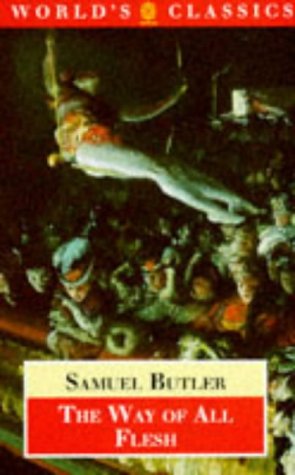
The Way of All Flesh (1903) `exploded like a bomb' in Edwardian England. Based on Samuel Butler's own life and published posthumously, it indicts Victorian bourgeois values as personified in five generations of the Pontifex family. Butler's satire centres on Ernest Pontifex, an orthodox young man who suddenly sees the falseness of the rules and aspirations forced on him by parents and teachers. He renounces his past morally, religiously, and socially - with startling results. Ernest's passage through self-deception and disgrace to nonchalant, hedonistic wisdom makes this one of the most involving novels of its era. Butler's candour spoke not only to the restless Edwardians, rebelling against the nineteenth century, but also continues to enthral readers today. In his Introduction to this richly annotated edition Michael Mason points out and explains the importance of the personal and public allusions which reverberate through the novel. This book is intended for general readers, those interested in Victorian fiction, students of 19th-century English literature at 6th form, undergraduate and post-graduate level.
Les informations fournies dans la section « Synopsis » peuvent faire référence à une autre édition de ce titre.
Biographie de l'auteur
Samuel Butler (1835-1902) was the son of a clergyman. He was educated at Shrewsbury and St John’s College Cambridge and, after a disagreement with his father about his choice of career, left England to become a sheep farmer in New Zealand, where he stayed until 1864. On his return to England, he took up residence in Clifford’s Inn where he stayed until his death. He began to study painting and worked at it for ten years, exhibiting occasionally at the Royal Academy. In 1872 he anonymously published Erewhon which was based on the letters he wrote to his father from New Zealand. This was followed by The Fair Haven, an attack on the Resurrection, making clear the religious skepticism which had turned Butler against a career in the church.
In the years that followed, Butler wrote several works attacking contemporary scientific ideas, in particular Darwin’s theory of natural selection. In 1881 he began to write books on art and travel, the first of these being Alps and Sanctuaries of Piedmont and the Canton Ticino. Around this time, he was also experimenting with musical composition and collaborated with Festing Jones on the oratorio entitled Narcissus. An interest in Homer led him to write lively translations of The Iliad and The Odyssey and he formed the theory that these two works were written by a woman. Butler’s partly autobiographical work The Way of All Flesh was the result of many years’ labor and appeared posthumously in 1903.
Revue de presse
It is read, I believe, mostly by the young, bent on making out a case against their elders, but Butler was fifty when he stopped working on it, and no reader much under that age is likely to appreciate the full beauty of its horrors. . . . Every contemporary novelist with a developed sense of irony is probably in some measure, directly or indirectly, indebted to Butler, who had the misfortune to be a twentieth-century man born in the year 1835 --The New Yorker
Les informations fournies dans la section « A propos du livre » peuvent faire référence à une autre édition de ce titre.
Résultats de recherche pour The Way of All Flesh

Image d'archives
The Way of All Flesh
Edité par
Oxford University Press, USA, 1993
ISBN 10 : 0192829807
ISBN 13 : 9780192829801
Ancien ou d'occasion
Paperback
Vendeur : ThriftBooks-Dallas, Dallas, TX, Etats-Unis
Évaluation du vendeur 5 sur 5 étoiles

Paperback. Etat : Very Good. No Jacket. May have limited writing in cover pages. Pages are unmarked. ~ ThriftBooks: Read More, Spend Less. N° de réf. du vendeur G0192829807I4N00
Acheter D'occasion
EUR 10,60
Livraison gratuite
Expédition nationale : Etats-Unis
Expédition nationale : Etats-Unis
Quantité disponible : 1 disponible(s)
Image d'archives
The Way of All Flesh
Edité par
Oxford University Press, Incorporated, 1993
ISBN 10 : 0192829807
ISBN 13 : 9780192829801
Ancien ou d'occasion
Couverture souple
Vendeur : Better World Books, Mishawaka, IN, Etats-Unis
Évaluation du vendeur 5 sur 5 étoiles
Etat : Good. Pages intact with minimal writing/highlighting. The binding may be loose and creased. Dust jackets/supplements are not included. Stock photo provided. Product includes identifying sticker. Better World Books: Buy Books. Do Good. N° de réf. du vendeur GRP16278379
Acheter D'occasion
EUR 10,69
Livraison gratuite
Expédition nationale : Etats-Unis
Expédition nationale : Etats-Unis
Quantité disponible : 1 disponible(s)
Image fournie par le vendeur
The Way of All Flesh (World's Classics)
Edité par
Oxford Paperbacks, 1993
ISBN 10 : 0192829807
ISBN 13 : 9780192829801
Ancien ou d'occasion
paperback
Vendeur : WeBuyBooks, Rossendale, LANCS, Royaume-Uni
Évaluation du vendeur 5 sur 5 étoiles
paperback. Etat : Good. Most items will be dispatched the same or the next working day. A copy that has been read but remains in clean condition. All of the pages are intact and the cover is intact and the spine may show signs of wear. The book may have minor markings which are not specifically mentioned. N° de réf. du vendeur rev9352975673
Acheter D'occasion
EUR 24,80
Expédition à EUR 5,47
Expédition depuis Royaume-Uni vers Etats-Unis
Expédition depuis Royaume-Uni vers Etats-Unis
Quantité disponible : 1 disponible(s)
Image d'archives
The Way of All Flesh (World's Classics)
Vendeur : AwesomeBooks, Wallingford, Royaume-Uni
Évaluation du vendeur 5 sur 5 étoiles
Paperback. Etat : Very Good. The Way of All Flesh (World's Classics) This book is in very good condition and will be shipped within 24 hours of ordering. The cover may have some limited signs of wear but the pages are clean, intact and the spine remains undamaged. This book has clearly been well maintained and looked after thus far. Money back guarantee if you are not satisfied. See all our books here, order more than 1 book and get discounted shipping. N° de réf. du vendeur 7719-9780192829801
Acheter D'occasion
EUR 27,30
Expédition à EUR 4,79
Expédition depuis Royaume-Uni vers Etats-Unis
Expédition depuis Royaume-Uni vers Etats-Unis
Quantité disponible : 2 disponible(s)
Image d'archives
The Way of All Flesh (World's Classics)
Vendeur : Bahamut Media, Reading, Royaume-Uni
Évaluation du vendeur 5 sur 5 étoiles
Paperback. Etat : Very Good. This book is in very good condition and will be shipped within 24 hours of ordering. The cover may have some limited signs of wear but the pages are clean, intact and the spine remains undamaged. This book has clearly been well maintained and looked after thus far. Money back guarantee if you are not satisfied. See all our books here, order more than 1 book and get discounted shipping. N° de réf. du vendeur 6545-9780192829801
Acheter D'occasion
EUR 26,94
Expédition à EUR 8,12
Expédition depuis Royaume-Uni vers Etats-Unis
Expédition depuis Royaume-Uni vers Etats-Unis
Quantité disponible : 2 disponible(s)