
Articles liés à The Politics of Individualism: Parties And the American...
The Politics of Individualism: Parties And the American Character in the Jacksonian Era - Couverture rigide
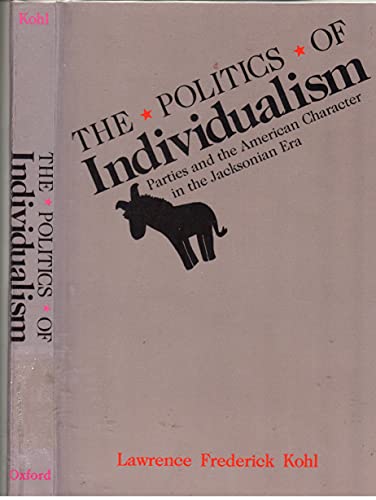
Synopsis
In the fifty years following the Revolution, America's population nearly quadrupled, its boundaries expanded, industrialization took root in the Northeast, new modes of transport flourished, state banks proliferated and offered easy credit to eager entrepreneurs, and Americans found themselves in the midst of an accelerating age of individualism and self-reliance. Kohl draws on the political rhetoric found in speeches, newspapers, periodicals and pamphlets to place the Whigs and Democrats in a solid social context. He contends that the political division between these two parties reflected the division between Americans unsettled by the new individualistic social order and those whoe character allowed them to strive more confidently within it. The author brings new insight into the politics and people of Jacksonian America.
Les informations fournies dans la section « Synopsis » peuvent faire référence à une autre édition de ce titre.
Revue de presse
"One of the many virtues of Kohl's analysis is that it points a way to reintegrate our rather splintered understanding of the relationship between social change and political agendas in the Jacksonian era....More persuasively than any historian since Arthur Schlessinger, Jr., Kohl shows why Andrew Jackson really did deserve his place at the center of Jacksonian politics."--Reviews in American History
"Kohl has an excellent grasp of how it felt to be a Jacksonian Democrat or Whig....Sensitive and gracefully written."--The Journal of Southern History
"Offers an intriguing perspective on the political world of Jacksonian America....Fascinating."--Journal of the Early Republic
"Kohl does an outstanding job of documenting his case....An extraordinarily worthwhile book."--Choice
"Kohl's explanation for the ideological differences between the Jacksonians and the Whigs is the most perceptive and persuasive one that I have ever encountered. It will surely influence all future accounts of the period."--J. Mills Thornton, III, University of Michigan
"This excellent, finely crafted book makes a significant addition to our understanding of party rhetoric and ideologies in the Jacksonian era. Kohl's is the first study to place what Democrats and Whigs said firmly in a psychological context--specifically their divergent personal reactions to an individualistic social order. The result is a persuasive and highly original reading of partisan rhetoric during the 1830s and 1840s. Kohl has produced perhaps the most persuasive explanation ever given for the intense party loyalties forged during the Jacksonian period."--Richard L. McCormick, Rutgers University
Présentation de l'éditeur
In the fifty years following the Revolution, America's population nearly quadrupled, its boundaries expanded, industrialization took root in the Northeast, new modes of transportation flourished, state banks proliferated and offered easy credit to eager entrepreneurs, and Americans found themselves in the midst of an accelerating age of individualism, equality, and self-reliance. To the Jacksonian generation, it seemed as if their world had changed practically overnight. The Politics of Individualism looks at the political manifestations of these staggering social transformations. During the 1830s and 1840s, Americans were consumed by politics and party loyalties were fierce. Here, Kohl draws on the political rhetoric found in speeches, newspapers, periodicals, and pamphlets to place the Democrats and the Whigs in a solid social and psychological context. He contends that the political division between these two parties reflected the division between Americans unsettled by the new individualistic social order and those whose character allowed them to strive more confidently within it. Democrats, says Kohl, were more "tradition-directed," bound to others in more personal ways; Whigs, on the other hand, were more "inner-directed" and embraced the impersonal, self-interested relationships of a market society. By examining this fascinating dialogue of parties, Kohl brings us bright new insight into the politics and people of Jacksonian America.
Les informations fournies dans la section « A propos du livre » peuvent faire référence à une autre édition de ce titre.
Résultats de recherche pour The Politics of Individualism: Parties And the American...

Image d'archives
The Politics of Individualism : Parties and the American Character in the Jacksonian Era
Edité par
Oxford University Press, Incorporated, 1989
ISBN 10 : 0195053745
ISBN 13 : 9780195053746
Ancien ou d'occasion
Couverture rigide
Vendeur : Better World Books, Mishawaka, IN, Etats-Unis
Évaluation du vendeur 5 sur 5 étoiles

Etat : Good. Pages intact with minimal writing/highlighting. The binding may be loose and creased. Dust jackets/supplements are not included. Stock photo provided. Product includes identifying sticker. Better World Books: Buy Books. Do Good. N° de réf. du vendeur 10206178-6
Acheter D'occasion
EUR 22,39
Livraison gratuite
Expédition nationale : Etats-Unis
Expédition nationale : Etats-Unis
Quantité disponible : 1 disponible(s)
Image d'archives
The Politics of Individualism: Parties and the American Character in the Jacksonian Era
Edité par
Oxford University Press, 1989
ISBN 10 : 0195053745
ISBN 13 : 9780195053746
Ancien ou d'occasion
Couverture rigide
Vendeur : ThriftBooks-Atlanta, AUSTELL, GA, Etats-Unis
Évaluation du vendeur 5 sur 5 étoiles
Hardcover. Etat : Very Good. No Jacket. May have limited writing in cover pages. Pages are unmarked. ~ ThriftBooks: Read More, Spend Less. N° de réf. du vendeur G0195053745I4N00
Acheter D'occasion
EUR 24,77
Livraison gratuite
Expédition nationale : Etats-Unis
Expédition nationale : Etats-Unis
Quantité disponible : 1 disponible(s)
Image fournie par le vendeur
THE POLITICS OF INDIVIDUALISM: Parties and the American Character in the Jacksonian Era
Edité par
Oxford, 1989
ISBN 10 : 0195053745
ISBN 13 : 9780195053746
Ancien ou d'occasion
Couverture rigide
Vendeur : Arches Bookhouse, Portland, OR, Etats-Unis
Évaluation du vendeur 5 sur 5 étoiles
Hardcover. Etat : FINE. Etat de la jaquette : NEAR FINE. xii, 266 pp. A pristine copy. DJ spine sunned. N° de réf. du vendeur 7210
Acheter D'occasion
EUR 20,20
Expédition à EUR 6,24
Expédition nationale : Etats-Unis
Expédition nationale : Etats-Unis
Quantité disponible : 1 disponible(s)
Image d'archives
The Politics Of Individualism. Parties and the American Character in the Jacksonian Era
ISBN 10 : 0195053745
ISBN 13 : 9780195053746
Ancien ou d'occasion
Vendeur : Oast Park Books, Southend -on- Sea, ESSEX, Royaume-Uni
Évaluation du vendeur 5 sur 5 étoiles
1989. Oxford University Press. Hardback. Book - VG. DJ - VG. Ex-lib. N° de réf. du vendeur 482
Acheter D'occasion
EUR 18,43
Expédition à EUR 23,85
Expédition depuis Royaume-Uni vers Etats-Unis
Expédition depuis Royaume-Uni vers Etats-Unis
Quantité disponible : 1 disponible(s)
Image fournie par le vendeur
The Politics of Individualism: Parties and the American Character in the Jacksonian Era
Edité par
Oxford University Press, 1989
ISBN 10 : 0195053745
ISBN 13 : 9780195053746
Ancien ou d'occasion
Couverture rigide
Vendeur : Saadeddine Books, Boston, MA, Etats-Unis
Évaluation du vendeur 4 sur 5 étoiles

Hardcover. Etat : As New. Etat de la jaquette : As New. N° de réf. du vendeur 883
Acheter D'occasion
EUR 50,50
Expédition à EUR 5,13
Expédition nationale : Etats-Unis
Expédition nationale : Etats-Unis
Quantité disponible : 1 disponible(s)