
Synopsis
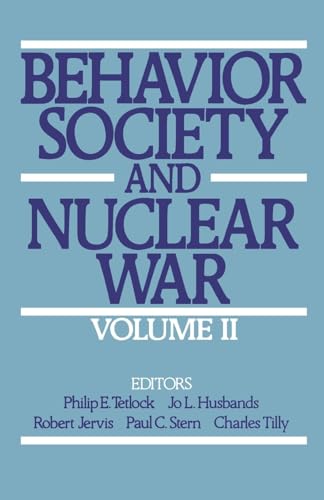
In the last year the world has witnessed changes in East-West relations that would have been unthinkable only a short time ago. The Berlin Wall has crumbled, Eastern Europe has thrown out its authoritarian leaders, and the Soviet Union itself has undergone dramatic changes in political structure and foreign policy. The U.S. public no longer regards the Eastern Bloc as the principal threat to national security. Yet even with the undeniable thaw in the Cold War many of the old scenarios for "World War III" remain as plausible as they were in the past, and new sources of instability could arise from ethnic conflicts, economic competition, or other sources. The second volume of Behavior, Society, and Nuclear War addresses the potential causes of nuclear war within the context of this changing political landscape. As in the first volume of this series, leading scholars review specific behavioral and social phenomena and processes that may be critical in determining war and peace--how foreign policy decision are made, the role of arms races, and the activities of third-party moderators. Volume Two also explores the effects of changing international conditions on the potential for the growing importance of conflicts between small powers, the possibility that techniques of reassurance can supplement deterrence, and the sources of moderation in Soviet security policy. Informed by the most up-to-date scholarship, Behavior, Society, and Nuclear War will be essential reading for anyone interested in international relations, disarmament, political science, and sociology.
Les informations fournies dans la section « Synopsis » peuvent faire référence à une autre édition de ce titre.
Présentation de l'éditeur
In the last year the world has witnessed changes in East-West relations that would have been unthinkable only a short time ago. The Berlin Wall has crumbled, Eastern Europe has thrown out its authoritarian leaders, and the Soviet Union itself has undergone dramatic changes in political structure and foreign policy. The U.S. public no longer regards the Eastern Bloc as the principal threat to national security. Yet even with the undeniable thaw in the Cold War many of the old scenarios for "World War III" remain as plausible as they were in the past, and new sources of instability could arise from ethnic conflicts, economic competition, or other sources. The second volume of Behavior, Society, and Nuclear War addresses the potential causes of nuclear war within the context of this changing political landscape. As in the first volume of this series, leading scholars review specific behavioral and social phenomena and processes that may be critical in determining war and peace--how foreign policy decision are made, the role of arms races, and the activities of third-party moderators. Volume Two also explores the effects of changing international conditions on the potential for the growing importance of conflicts between small powers, the possibility that techniques of reassurance can supplement deterrence, and the sources of moderation in Soviet security policy. Informed by the most up-to-date scholarship, Behavior, Society, and Nuclear War will be essential reading for anyone interested in international relations, disarmament, political science, and sociology.
Revue de presse
Timely and informative....There is hardly any topic more important than nuclear war, and the authors show the possibility of such a war despite the changes that have occurred in the world lately. The readings should spark some lively class discussion. (Robert W. Langran, Villanova University)
An excellent collection of essays...Serves as a good supplementary source for a course on 'International Security in the Nuclear Age.' (Nitish K. Dutt, Duke University)
Excellent, thought-provoking, insightful and well-written. (Dina Sspeehler, Indiana University)
Les informations fournies dans la section « A propos du livre » peuvent faire référence à une autre édition de ce titre.
Autres éditions populaires du même titre

Résultats de recherche pour Behavior, Society, and Nuclear War (Volume II)

Image d'archives
Behavior, Society, and Nuclear War Volume II
Edité par
Oxford University Press, 1999
ISBN 10 : 0195057686
ISBN 13 : 9780195057683
Ancien ou d'occasion
Softcover
Vendeur : Skoob-ebooks, Pontiac, QC, Canada
Évaluation du vendeur 5 sur 5 étoiles

Softcover. Etat : Very Good. Minor wear. The pages are clean and crisp with no highlighting or writing detected. 30-day returns. Ships from Canada. For shipments to the United States, any custom duties will be paid prior to shipping. ; 5.5 X 0.87 X 8.25 inches; 384 pages; R0 s0. N° de réf. du vendeur 10230
Acheter D'occasion
EUR 25,59
Expédition à EUR 11,43
Expédition depuis Canada vers Etats-Unis
Expédition depuis Canada vers Etats-Unis
Quantité disponible : 1 disponible(s)
Image d'archives
Behavior, Society, and Nuclear War (Behavior, Society, & Nuclear War)
Vendeur : BennettBooksLtd, Los Angeles, CA, Etats-Unis
Évaluation du vendeur 5 sur 5 étoiles
paperback. Etat : New. In shrink wrap. Looks like an interesting title! N° de réf. du vendeur Q-0195057686
Acheter neuf
EUR 85,35
Expédition à EUR 6,11
Expédition nationale : Etats-Unis
Expédition nationale : Etats-Unis
Quantité disponible : 1 disponible(s)
Image d'archives
Behavior, Society and Nuclear War, Vol. 2
Edité par
Oxford University Press OUP, 1990
ISBN 10 : 0195057686
ISBN 13 : 9780195057683
Neuf
Couverture souple
Vendeur : Books Puddle, New York, NY, Etats-Unis
Évaluation du vendeur 4 sur 5 étoiles

Etat : New. Print on Demand pp. 384. N° de réf. du vendeur 262263808
Acheter neuf
EUR 175,95
Expédition à EUR 3,51
Expédition nationale : Etats-Unis
Expédition nationale : Etats-Unis
Quantité disponible : 4 disponible(s)
Image d'archives
Behavior, Society and Nuclear War, Vol. 2
Edité par
Oxford University Press, 1990
ISBN 10 : 0195057686
ISBN 13 : 9780195057683
Neuf
Couverture souple
Vendeur : Majestic Books, Hounslow, Royaume-Uni
Évaluation du vendeur 4 sur 5 étoiles
Etat : New. Print on Demand pp. 384. N° de réf. du vendeur 5584095
Acheter neuf
EUR 185,25
Expédition à EUR 7,60
Expédition depuis Royaume-Uni vers Etats-Unis
Expédition depuis Royaume-Uni vers Etats-Unis
Quantité disponible : 4 disponible(s)
Image d'archives
Behavior, Society and Nuclear War, Vol. 2
Edité par
Oxford University Press, 1990
ISBN 10 : 0195057686
ISBN 13 : 9780195057683
Neuf
Couverture souple
Vendeur : Biblios, Frankfurt am main, HESSE, Allemagne
Évaluation du vendeur 4 sur 5 étoiles
Etat : New. PRINT ON DEMAND pp. 384. N° de réf. du vendeur 182263818
Acheter neuf
EUR 183,51
Expédition à EUR 9,95
Expédition depuis Allemagne vers Etats-Unis
Expédition depuis Allemagne vers Etats-Unis
Quantité disponible : 4 disponible(s)
Image d'archives
Behavior, Society, and Nuclear War: Volume II (Paperback)
Edité par
Oxford University Press Inc, New York, 1990
ISBN 10 : 0195057686
ISBN 13 : 9780195057683
Neuf
Paperback
Vendeur : CitiRetail, Stevenage, Royaume-Uni
Évaluation du vendeur 5 sur 5 étoiles
Paperback. Etat : new. Paperback. In the last year the world has witnessed changes in East-West relations that would have been unthinkable only a short time ago. The Berlin Wall has crumbled, Eastern Europe has thrown out its authoritarian leaders, and the Soviet Union itself has undergone dramatic changes in political structure and foreign policy. The U.S. public no longer regards the Eastern Bloc as the principal threat to national security. Yet even with the undeniable thaw in the Cold Warmany of the old scenarios for "World War III" remain as plausible as they were in the past, and new sources of instability could arise from ethnic conflicts, economic competition, or other sources. Thesecond volume of Behavior, Society, and Nuclear War addresses the potential causes of nuclear war within the context of this changing political landscape. As in the first volume of this series, leading scholars review specific behavioral and social phenomena and processes that may be critical in determining war and peace--how foreign policy decision are made, the role of arms races, and the activities of third-party moderators. Volume Two also explores the effects of changinginternational conditions on the potential for the growing importance of conflicts between small powers, the possibility that techniques of reassurance can supplement deterrence, and the sources of moderation in Sovietsecurity policy. Informed by the most up-to-date scholarship, Behavior, Society, and Nuclear War will be essential reading for anyone interested in international relations, disarmament, political science, and sociology. In the last year the world has witnessed changes in East-West relations that would have been unthinkable only a short time ago. The Berlin Wall has crumbled, Eastern Europe has thrown out its authoritarian leaders, and the Soviet Union itself has undergone dramatic changes in political structure and foreign policy. The U.S. public no longer regards the Eastern Bloc as the principal threat to national security. Yet even with the undeniable thaw in the Cold War many of the old scenarios for "World War III" remain as plausible as they were in the past, and new sources of instability could arise from ethnic conflicts, economic competition, or other sources. The second volume of Behavior, Society, and Nuclear War addresses the potential causes of nuclear war within the context of this changing political landscape. As in the first volume of this series, leading scholars review specific behavioral and social phenomena and processes that may be critical in determining war and peace—how foreign policy decision are made, the role of arms races, and the activities of third-party moderators. Volume Two also explores the effects of changing international conditions on the potential for the growing importance of conflicts between small powers, the possibility that techniques of reassurance can supplement deterrence, and the sources of moderation in Soviet security policy. Informed by the most up-to-date scholarship, Behavior, Society, and Nuclear War will be essential reading for anyone interested in international relations, disarmament, political science, and sociology. This item is printed on demand. Shipping may be from our UK warehouse or from our Australian or US warehouses, depending on stock availability. N° de réf. du vendeur 9780195057683
Acheter neuf
EUR 178,18
Expédition à EUR 43,25
Expédition depuis Royaume-Uni vers Etats-Unis
Expédition depuis Royaume-Uni vers Etats-Unis
Quantité disponible : 1 disponible(s)