
Articles liés à Emerging Minds : The Process of Change in Children's...
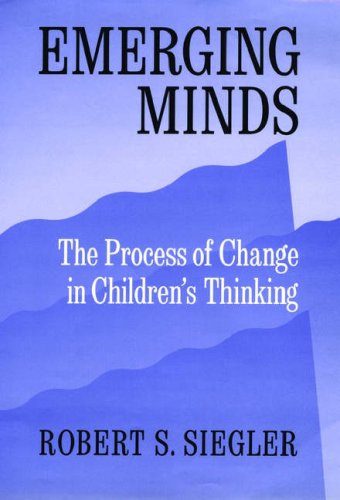
Emerging Minds : The Process of Change in Children's Thinking: Change Processes in Children's Thinking - Couverture rigide
Synopsis
How do children acquire the vast array of concepts, strategies, and skills that distinguish the thinking of infants and toddlers from that of preschoolers, older children, and adolescents? In this new book, Robert Siegler addresses these and other fundamental questions about children's thinking. Previous theories have tended to depict cognitive development much like a staircase. At an early age, children think in one way; as they get older, they step up to increasingly higher waysof thinking. Siegler proposes that viewing the development within an evolutionary framework is more useful than a staircase model. The evolution of species depends on mechanisms for generating variability, for choosing adaptively among the variants, and for preserving the lessons of past experience sothat successful variants become increasingly prevalent. The development of children's thinking appears to depend on mechanisms to fulfill these same functions. Siegler's theory is consistent with a great deal of evidence. It unifies phenomena from such areas as problem solving, reasoning, and memory, and reveals commonalities in the thinking of people of all ages. Most important, it leads to valuable insights regarding a basic question about children's thinking asked by cognitive,developmental, and educational psychologists: How does change occur?
Les informations fournies dans la section « Synopsis » peuvent faire référence à une autre édition de ce titre.
Présentation de l'éditeur
How do children acquire the vast array of concepts, strategies, and skills that distinguish the thinking of infants and toddlers from that of preschoolers, older children, and adolescents? In this new book, Robert Siegler addresses these and other fundamental questions about children's thinking. Previous theories have tended to depict cognitive development much like a staircase. At an early age, children think in one way; as they get older, they step up to increasingly higher ways of thinking. Siegler proposes that viewing the development within an evolutionary framework is more useful than a staircase model. The evolution of species depends on mechanisms for generating variability, for choosing adaptively among the variants, and for preserving the lessons of past experience so that successful variants become increasingly prevalent. The development of children's thinking appears to depend on mechanisms to fulfill these same functions. Siegler's theory is consistent with a great deal of evidence. It unifies phenomena from such areas as problem solving, reasoning, and memory, and reveals commonalities in the thinking of people of all ages. Most important, it leads to valuable insights regarding a basic question about children's thinking asked by cognitive, developmental, and educational psychologists: How does change occur?
Revue de presse
This is one of those rare books that promises to change the way that psychologists view the central problem of developmental psychology. . .Siegler provides a cogent and convincing argument that variability is a constant in thought at all levels and provides the key to cutting through to the problem of cognitive change. In addition to providing a wide range of examples showing the centrality of adaptive variability in children's thinking at all levels, Siegler describes a methodology for describing developmental change as it progresses. Few will be able to read it without considering how to apply this model and methods to their own domain of interest. This book will serve as a handbook for anyone who wants to take up the challenge of taking development seriously. (Kevin Miller, Dept. of Psychology, University of Illinois at Urbana-Champaign)
Les informations fournies dans la section « A propos du livre » peuvent faire référence à une autre édition de ce titre.
Résultats de recherche pour Emerging Minds : The Process of Change in Children's...

Image d'archives
Emerging Minds : The Process of Change in Children's Thinking
Edité par
Oxford University Press, Incorporated, 1996
ISBN 10 : 0195077873
ISBN 13 : 9780195077872
Ancien ou d'occasion
Couverture rigide
Vendeur : Better World Books, Mishawaka, IN, Etats-Unis
Évaluation du vendeur 5 sur 5 étoiles

Etat : Very Good. Former library copy. Pages intact with possible writing/highlighting. Binding strong with minor wear. Dust jackets/supplements may not be included. Includes library markings. Stock photo provided. Product includes identifying sticker. Better World Books: Buy Books. Do Good. N° de réf. du vendeur 322303-6
Acheter D'occasion
EUR 24,09
Livraison gratuite
Expédition nationale : Etats-Unis
Expédition nationale : Etats-Unis
Quantité disponible : 2 disponible(s)
Image fournie par le vendeur
Emerging Minds: The Process of Change in Children's Thinking
Edité par
Oxford University Press, 1996
ISBN 10 : 0195077873
ISBN 13 : 9780195077872
Ancien ou d'occasion
Couverture rigide
Vendeur : -OnTimeBooks-, Phoenix, AZ, Etats-Unis
Évaluation du vendeur 5 sur 5 étoiles
Etat : good. A copy that has been read, remains in good condition. All pages are intact, and the cover is intact. The spine and cover show signs of wear. Pages can include notes and highlighting and show signs of wear, and the copy can include "From the library of" labels or previous owner inscriptions. 100% GUARANTEE! Shipped with delivery confirmation, if you're not satisfied with purchase please return item! Ships via media mail. N° de réf. du vendeur OTV.0195077873.G
Acheter D'occasion
EUR 28,40
Livraison gratuite
Expédition nationale : Etats-Unis
Expédition nationale : Etats-Unis
Quantité disponible : 1 disponible(s)
Image d'archives
Emerging Minds: The Process of Change in Children's Thinking
Edité par
Oxford University Press, 1996
ISBN 10 : 0195077873
ISBN 13 : 9780195077872
Ancien ou d'occasion
Couverture rigide
Vendeur : Anybook.com, Lincoln, Royaume-Uni
Évaluation du vendeur 5 sur 5 étoiles
Etat : Good. This is an ex-library book and may have the usual library/used-book markings inside.This book has hardback covers. In good all round condition. Dust jacket in good condition. Please note the Image in this listing is a stock photo and may not match the covers of the actual item,650grams, ISBN:9780195077872. N° de réf. du vendeur 3954121
Acheter D'occasion
EUR 17,59
Expédition à EUR 15,87
Expédition depuis Royaume-Uni vers Etats-Unis
Expédition depuis Royaume-Uni vers Etats-Unis
Quantité disponible : 1 disponible(s)
Image d'archives
Emerging Minds: The Process of Change in Children's Thinking
Edité par
Oxford University Press, 1996
ISBN 10 : 0195077873
ISBN 13 : 9780195077872
Ancien ou d'occasion
Couverture rigide
Vendeur : PAPER CAVALIER UK, London, Royaume-Uni
Évaluation du vendeur 5 sur 5 étoiles
Etat : good. A good reading copy. May contain markings or be a withdrawn library copy. N° de réf. du vendeur 9780195077872-4
Acheter D'occasion
EUR 70,89
Expédition à EUR 7
Expédition depuis Royaume-Uni vers Etats-Unis
Expédition depuis Royaume-Uni vers Etats-Unis
Quantité disponible : 1 disponible(s)
Image d'archives
Emerging Minds: The Process of Change in Children's Thinking
Edité par
Oxford University Press, 1996
ISBN 10 : 0195077873
ISBN 13 : 9780195077872
Neuf
Couverture rigide
Vendeur : The Book Spot, Sioux Falls, MN, Etats-Unis
Évaluation du vendeur 4 sur 5 étoiles

Hardcover. Etat : New. N° de réf. du vendeur Abebooks4665
Acheter neuf
EUR 92,40
Livraison gratuite
Expédition nationale : Etats-Unis
Expédition nationale : Etats-Unis
Quantité disponible : 1 disponible(s)