
Articles liés à Brown V. Board of Education: A Civil Rights Milestone...
Brown V. Board of Education: A Civil Rights Milestone and Its Troubled Legacy - Couverture rigide
Livre 2 sur 29: Pivotal Moments in American History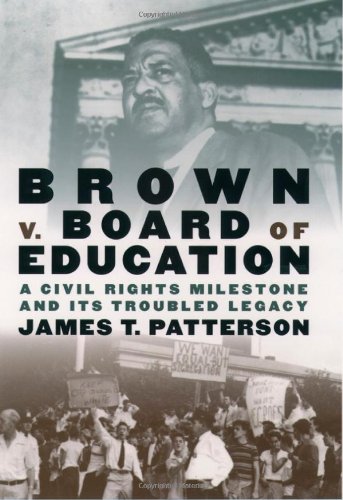
Synopsis
Many people were elated when Supreme Court Chief Justice Earl Warren delivered Brown versus Board of Education of Topeka in May 1954, the ruling that struck down state-sponsored racila segregation in America's public schools. Thurgood Marshall, chief attorney for the black families that launched the litigation, exclaimed later, "I was so happy, I was numb." The novelist Ralph Ellison wrote, "Another battle of the Civil War has been won. The rest is up to us and I'm very glad. What a wonderful world of possibilities are unfolded for the children!" Here, in a concise, narrative, Bancroft Prize-winning historian James T. Patterson takes readers through the dramatic case and its 50-year aftermath. A wide range of characters animates the story, from the little-known African-Americans who dared to challenge Jim Crow with lawsuits (at great personal cost); to Thurgood Marshall, who later became a Justice himself; to Earl Warren, who shephered a fractured Court to a unanimous decision.
Les informations fournies dans la section « Synopsis » peuvent faire référence à une autre édition de ce titre.
Présentation de l'éditeur
Many people were elated when Supreme Court Chief Justice Earl Warren delivered Brown v. Board of Education of Topeka in May 1954, the ruling that struck down state-sponsored racial segregation in America's public schools. Thurgood Marshall, chief attorney for the black families that launched the litigation, exclaimed later, "I was so happy, I was numb." The novelist Ralph Ellison wrote, "another battle of the Civil War has been won. The rest is up to us and I'm very glad. What a wonderful world of possibilities are unfolded for the children!" Here, in a concise, compelling narrative, Bancroft Prize-winning historian James T. Patterson takes readers through the dramatic case and its fifty-year aftermath. A wide range of characters animates the story, from the little-known African-Americans who dared to challenge Jim Crow with lawsuits (at great personal cost); to Thurgood Marshall, who later became a Justice himself; to Earl Warren, who shepherded a fractured Court to a unanimous decision. Others include segregationist politicians like Governor Orval Faubus of Arkansas; Presidents Eisenhower, Johnson, and Nixon; and controversial Supreme Court justices such as William Rehnquist and Clarence Thomas. Most Americans still see Brown as a triumph--but was it? Patterson shrewdly explores the provocative questions that still swirl around the case. Could the Court--or President Eisenhower--have done more to ensure compliance with Brown? Did the decision touch off the modern civil rights movement? How useful are court-ordered busing and affirmative action against racial segregation? To what extent has racial mixing affected the academic achievement of black children? Where indeed do we go from here to realize the expectations of Marshall, Ellison, and others in 1954?
Biographie de l'auteur
James T. Patterson won the Bancroft Prize in History for Grand Expectations: The United States, 1945-1974 (OUP, 1996). Author of numerous books concerning modern American life, he is Ford Foundation Professor of History at Brown University.
Les informations fournies dans la section « A propos du livre » peuvent faire référence à une autre édition de ce titre.
Résultats de recherche pour Brown V. Board of Education: A Civil Rights Milestone...

Image d'archives
Brown v. Board of Education: A Civil Rights Milestone and Its Troubled Legacy (Pivotal Moments in American History)
Edité par
Oxford University Press, 2001
ISBN 10 : 0195127161
ISBN 13 : 9780195127164
Ancien ou d'occasion
Couverture rigide
Vendeur : World of Books (was SecondSale), Montgomery, IL, Etats-Unis
Évaluation du vendeur 5 sur 5 étoiles

Etat : Very Good. Item in very good condition! Textbooks may not include supplemental items i.e. CDs, access codes etc. N° de réf. du vendeur 00110559837
Acheter D'occasion
EUR 5,51
Livraison gratuite
Expédition nationale : Etats-Unis
Expédition nationale : Etats-Unis
Quantité disponible : 1 disponible(s)
Image d'archives
Brown v. Board of Education: A Civil Rights Milestone and Its Troubled Legacy (Pivotal Moments in American History)
Edité par
Oxford University Press, 2001
ISBN 10 : 0195127161
ISBN 13 : 9780195127164
Ancien ou d'occasion
Couverture rigide
Vendeur : ThriftBooks-Dallas, Dallas, TX, Etats-Unis
Évaluation du vendeur 5 sur 5 étoiles
Hardcover. Etat : Good. No Jacket. Former library book; Pages can have notes/highlighting. Spine may show signs of wear. ~ ThriftBooks: Read More, Spend Less. N° de réf. du vendeur G0195127161I3N10
Acheter D'occasion
EUR 6,01
Livraison gratuite
Expédition nationale : Etats-Unis
Expédition nationale : Etats-Unis
Quantité disponible : 1 disponible(s)
Image d'archives
Brown v. Board of Education: A Civil Rights Milestone and Its Troubled Legacy (Pivotal Moments in American History)
Edité par
Oxford University Press, 2001
ISBN 10 : 0195127161
ISBN 13 : 9780195127164
Ancien ou d'occasion
Couverture rigide
Vendeur : ThriftBooks-Dallas, Dallas, TX, Etats-Unis
Évaluation du vendeur 5 sur 5 étoiles
Hardcover. Etat : Very Good. No Jacket. Former library book; Missing dust jacket; May have limited writing in cover pages. Pages are unmarked. ~ ThriftBooks: Read More, Spend Less. N° de réf. du vendeur G0195127161I4N11
Acheter D'occasion
EUR 6,01
Livraison gratuite
Expédition nationale : Etats-Unis
Expédition nationale : Etats-Unis
Quantité disponible : 1 disponible(s)
Image fournie par le vendeur
Brown v. Board of Education: A Civil Rights Milestone and Its Troubled Legacy (Pivotal Moments in American History)
Edité par
Oxford University Press, 2001
ISBN 10 : 0195127161
ISBN 13 : 9780195127164
Ancien ou d'occasion
Couverture rigide
Vendeur : -OnTimeBooks-, Phoenix, AZ, Etats-Unis
Évaluation du vendeur 5 sur 5 étoiles
Etat : good. A copy that has been read, remains in good condition. All pages are intact, and the cover is intact. The spine and cover show signs of wear. Pages can include notes and highlighting and show signs of wear, and the copy can include "From the library of" labels or previous owner inscriptions. 100% GUARANTEE! Shipped with delivery confirmation, if you're not satisfied with purchase please return item! Ships via media mail. N° de réf. du vendeur OTV.0195127161.G
Acheter D'occasion
EUR 6,43
Livraison gratuite
Expédition nationale : Etats-Unis
Expédition nationale : Etats-Unis
Quantité disponible : 2 disponible(s)
Image d'archives
Brown v. Board of Education: A Civil Rights Milestone and Its Troubled Legacy (Pivotal Moments in American History)
Edité par
Oxford University Press, 2001
ISBN 10 : 0195127161
ISBN 13 : 9780195127164
Ancien ou d'occasion
Couverture rigide
Vendeur : The Maryland Book Bank, Baltimore, MD, Etats-Unis
Évaluation du vendeur 5 sur 5 étoiles
hardcover. Etat : Very Good. Used - Very Good. N° de réf. du vendeur 6-U-5-0239
Acheter D'occasion
EUR 2,34
Expédition à EUR 4,19
Expédition nationale : Etats-Unis
Expédition nationale : Etats-Unis
Quantité disponible : 1 disponible(s)
Image d'archives
Brown V. Board of Education : A Civil Rights Milestone and Its Troubled Legacy
Edité par
Oxford University Press, Incorporated, 2001
ISBN 10 : 0195127161
ISBN 13 : 9780195127164
Ancien ou d'occasion
Couverture rigide
Vendeur : Better World Books, Mishawaka, IN, Etats-Unis
Évaluation du vendeur 5 sur 5 étoiles
Etat : Very Good. Former library copy. Pages intact with possible writing/highlighting. Binding strong with minor wear. Dust jackets/supplements may not be included. Includes library markings. Stock photo provided. Product includes identifying sticker. Better World Books: Buy Books. Do Good. N° de réf. du vendeur 3142619-6
Acheter D'occasion
EUR 7,39
Livraison gratuite
Expédition nationale : Etats-Unis
Expédition nationale : Etats-Unis
Quantité disponible : 1 disponible(s)
Image d'archives
Brown V. Board of Education : A Civil Rights Milestone and Its Troubled Legacy
Edité par
Oxford University Press, Incorporated, 2001
ISBN 10 : 0195127161
ISBN 13 : 9780195127164
Ancien ou d'occasion
Couverture rigide
Vendeur : Better World Books, Mishawaka, IN, Etats-Unis
Évaluation du vendeur 5 sur 5 étoiles
Etat : Good. Former library copy. Pages intact with minimal writing/highlighting. The binding may be loose and creased. Dust jackets/supplements are not included. Includes library markings. Stock photo provided. Product includes identifying sticker. Better World Books: Buy Books. Do Good. N° de réf. du vendeur 3142618-6
Acheter D'occasion
EUR 7,39
Livraison gratuite
Expédition nationale : Etats-Unis
Expédition nationale : Etats-Unis
Quantité disponible : 2 disponible(s)
Image d'archives
Brown v. Board of Education: A Civil Rights Milestone and Its Troubled Legacy (Pivotal Moments in American History)
Edité par
Oxford University Press, 2001
ISBN 10 : 0195127161
ISBN 13 : 9780195127164
Ancien ou d'occasion
Couverture rigide
Vendeur : St Vincent de Paul of Lane County, Eugene, OR, Etats-Unis
Évaluation du vendeur 5 sur 5 étoiles
Etat : Very Good. DUST JACKET HAS SOME SCRATCHES. Hardcover 100% of proceeds go to charity! May have signs of use, wear and minor cosmetic defects. N° de réf. du vendeur 2DD-004-2908
Acheter D'occasion
EUR 4,12
Expédition à EUR 3,56
Expédition nationale : Etats-Unis
Expédition nationale : Etats-Unis
Quantité disponible : 1 disponible(s)
Image d'archives
Brown v. Board of Education: A Civil Rights Milestone and Its Troubled Legacy (Pivotal Moments in American History)
Edité par
Oxford University Press, 2001
ISBN 10 : 0195127161
ISBN 13 : 9780195127164
Ancien ou d'occasion
Couverture rigide
Vendeur : HPB-Emerald, Dallas, TX, Etats-Unis
Évaluation du vendeur 5 sur 5 étoiles
hardcover. Etat : Very Good. Connecting readers with great books since 1972! Used books may not include companion materials, and may have some shelf wear or limited writing. We ship orders daily and Customer Service is our top priority! N° de réf. du vendeur S_468875896
Acheter D'occasion
EUR 4,60
Expédition à EUR 3,35
Expédition nationale : Etats-Unis
Expédition nationale : Etats-Unis
Quantité disponible : 1 disponible(s)
Image d'archives
Brown v. Board of Education: A Civil Rights Milestone and Its Troubled Legacy (Pivotal Moments in American History)
Edité par
Oxford University Press, 2001
ISBN 10 : 0195127161
ISBN 13 : 9780195127164
Ancien ou d'occasion
Couverture rigide
Vendeur : The Extreme History Project, Bozeman, MT, Etats-Unis
Évaluation du vendeur 4 sur 5 étoiles

Hardcover. Etat : Very Good. Etat de la jaquette : Very Good. In VERY GOOD condition. Some underlining inside. Hardcover. Jacket cover in very good condition. Previous owners name in inside cover. N° de réf. du vendeur ABE-1767809268606
Acheter D'occasion
EUR 3,68
Expédition à EUR 4,46
Expédition nationale : Etats-Unis
Expédition nationale : Etats-Unis
Quantité disponible : 1 disponible(s)