
Articles liés à Adaptive thinking: Rationality in the real world
Adaptive thinking: Rationality in the real world - Couverture rigide
Livre 3 sur 13: Evolution and Cognition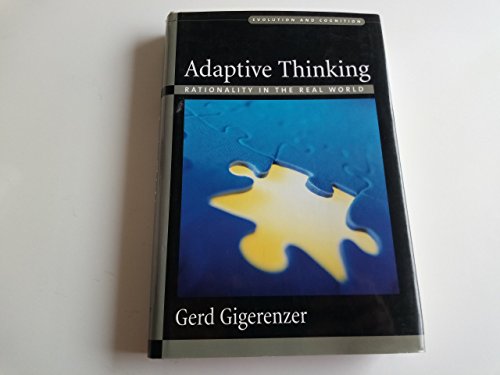
Synopsis
Where do new ideas come from? What is social intelligence? Why do social scientists perform mindless statistical rituals? This vital book is about rethinking rationality as adaptive thinking: to understand how minds cope with their environments, both ecological and social. Gerd Gigerenzer proposes and illustrates a bold new research programme that investigates the psychology of rationality, introducing the concepts of ecological, bounded, and social rationality. His path-breaking collection takes research on thinking, social intelligence, creativity, and decision-making out of an ethereal world where the laws of logic and probability reign, and places it into our real world of human behaviour and interaction. Adaptive Thinking is accessibly written for general readers with an interest in psychology, cognitive science, economics, sociology, philosophy, artificial intelligence, and animal behaviour. It also teaches a practical audience, such as physicians, AIDS counsellors, and experts in criminal law, how to understand and communicate uncertainties and risks.
Les informations fournies dans la section « Synopsis » peuvent faire référence à une autre édition de ce titre.
Présentation de l'éditeur
Where do new ideas come from? What is social intelligence? Why do social scientists perform mindless statistical rituals? This vital book is about rethinking rationality as adaptive thinking: to understand how minds cope with their environments, both ecological and social. Gerd Gigerenzer proposes and illustrates a bold new research program that investigates the psychology of rationality, introducing the concepts of ecological, bounded, and social rationality. His path-breaking collection takes research on thinking, social intelligence, creativity, and decision-making out of an ethereal world where the laws of logic and probability reign, and places it into our real world of human behavior and interaction. Adaptive Thinking is accessibly written for general readers with an interest in psychology, cognitive science, economics, sociology, philosophy, artificial intelligence, and animal behavior. It also teaches a practical audience, such as physicians, AIDS counselors, and experts in criminal law, how to understand and communicate uncertainties and risks.
Biographie de l'auteur
Gerd Gigerenzer is Director of the Center for Adaptive Behavior and Cognition at the Max Planck Institute for Human Development in Berlin, and was previously a professor of psychology at The University of Chicago and other institutions. His books include the recent Simple Heuristics that Make Us Smart (Oxford, 1999).
Les informations fournies dans la section « A propos du livre » peuvent faire référence à une autre édition de ce titre.
Résultats de recherche pour Adaptive thinking: Rationality in the real world

Image d'archives
Adaptive Thinking: Rationality in the Real World (Evolution and Cognition Series)
Edité par
Oxford University Press, 2000
ISBN 10 : 0195136225
ISBN 13 : 9780195136227
Ancien ou d'occasion
Couverture rigide
Vendeur : Tim's Used Books Provincetown Mass., Provincetown, MA, Etats-Unis
Évaluation du vendeur 5 sur 5 étoiles

Hardcover. Etat : Very Good. Etat de la jaquette : Very Good. No marks in text. No inscriptions etc. Not a library book. Ships today in a cardboard enclosure. Tim's Used Books, open shop in Provincetown, Massachusetts, providing good books at reasonable prices on the same spot since 1991. Shelf A. N° de réf. du vendeur 26212028
Acheter D'occasion
EUR 20,18
Expédition à EUR 5,79
Expédition nationale : Etats-Unis
Expédition nationale : Etats-Unis
Quantité disponible : 1 disponible(s)
Image d'archives
Adaptive Thinking: Rationality in the Real World (Evolution and Cognition Series)
Edité par
Oxford University Press, 2000
ISBN 10 : 0195136225
ISBN 13 : 9780195136227
Ancien ou d'occasion
Couverture rigide
Vendeur : Ezekial Books, LLC, Manchester, NH, Etats-Unis
Évaluation du vendeur 5 sur 5 étoiles
hardcover. Etat : Very Good. No Highlighting or underlining. Some Wear but overall very good condition. 100% Satisfaction Guaranteed. N° de réf. du vendeur 51UTKD0001Y6
Acheter D'occasion
EUR 25,74
Expédition à EUR 4,41
Expédition nationale : Etats-Unis
Expédition nationale : Etats-Unis
Quantité disponible : 1 disponible(s)
Image fournie par le vendeur
Adaptive Thinking: Rationality in The Real World
Edité par
Oxford University Press, Oxford, New York, 2000
ISBN 10 : 0195136225
ISBN 13 : 9780195136227
Ancien ou d'occasion
Couverture rigide
Vendeur : Sabra Books, Naperville, IL, Etats-Unis
Évaluation du vendeur 5 sur 5 étoiles
Hardcover. Etat : Very Good. Etat de la jaquette : Very Good. Minor wear along the DJ edges. Minor rubbing wear to DJ covers. Slight wear along the edges of the book. Book may contain some residual odor from prior storage. N° de réf. du vendeur 110173
Acheter D'occasion
EUR 55,04
Expédition à EUR 10,47
Expédition nationale : Etats-Unis
Expédition nationale : Etats-Unis
Quantité disponible : 1 disponible(s)