
Articles liés à Parables for Our Time: Rereading New Testament Scholarship...
Synopsis
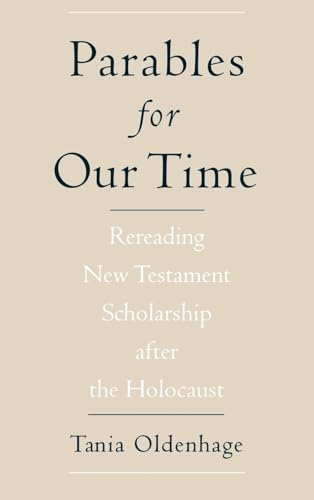
Over the centuries, New Testament texts have often been read in ways that reflect and encourage anti-Semitism. For example, the parable of the "wicked husbandmen," who kill the son of their landlord in order to seize the land, has been used to blame the Jews for the death of Christ. Since the Holocaust, Christian scholars have increasingly recognized and rejected this inheritance. In Parables for Our Time Tania Oldenhage seeks to fashion a biblical hermeneutics that consciously works with memories of the Holocaust.
New Testament scholars have not directly confronted the horror of Nazi crimes, Oldenhage argues, but their work has nonetheless been deeply affected by the events of the Holocaust. By placing twentieth-century biblical scholarship within its specific historical and cultural contexts, she is able to trace the process by which the Holocaust gradually moved into the collective consciousness of New Testament scholars, both in Germany and in the United States. Her focus is on the scholarly interpretation of the parables of Jesus. She sets the stage with the work of Wolfgang Harnisch who exemplifies the problems surrounding Holocaust remembrance in the Germany of the 1980s and 1990s. She then turns to Joachim Jeremias's eminent work on the parables, first published in 1947. Jeremias's anti-Jewish rhetoric, she argues, should be understood not only as a perpetuation of an age-old interpretive pattern, but as representative of German difficulties in responding to the Holocaust immediately after the war. Oldenhage goes on to explore the way in which Jeremias's approach was challenged by biblical scholars in the U.S. during the 1970s. In particular, she examines the turn to literature and literary theory exemplified in the works of John Dominic Crossan and Paul Ricoeur. Nazi atrocities became part of the cultural reservoir from which Crossan and Ricoeur drew, she shows, although they never engaged with the historical facts of the Holocaust. In conclusion, Oldenhage offers her own reading of the parable of the wicked husbandmen, demonstrating how the turn from historical to literary criticism opens up the text to interpretation in light of the Holocaust. If the parables are to be meaningful in our time, she contends, we must take account of the troubling resonances between these ancient Christian stories and the atrocities of Auschwitz.
Les informations fournies dans la section « Synopsis » peuvent faire référence à une autre édition de ce titre.
À propos de l'auteur
Tania Oldenhage is Assistant Professor of Religion at Mount Union College, in Alliance, Ohio. A native of Germany, she studied Protestant theology at the Universities of Heidelberg, Marburg, and Hamburg. She received her Ph.D. from Temple University.
Les informations fournies dans la section « A propos du livre » peuvent faire référence à une autre édition de ce titre.
Résultats de recherche pour Parables for Our Time: Rereading New Testament Scholarship...

Image fournie par le vendeur
Parables for Our Time: Rereading New Testament Scholarship after the Holocaust (AAR Cultural Criticism Series)
Edité par
Oxford University Press, 2002
ISBN 10 : 019515052X
ISBN 13 : 9780195150520
Ancien ou d'occasion
Couverture rigide
Vendeur : -OnTimeBooks-, Phoenix, AZ, Etats-Unis
Évaluation du vendeur 5 sur 5 étoiles

Etat : good. A copy that has been read, remains in good condition. All pages are intact, and the cover is intact. The spine and cover show signs of wear. Pages can include notes and highlighting and show signs of wear, and the copy can include "From the library of" labels or previous owner inscriptions. 100% GUARANTEE! Shipped with delivery confirmation, if you're not satisfied with purchase please return item! Ships via media mail. N° de réf. du vendeur OTV.019515052X.G
Acheter D'occasion
EUR 25,38
Livraison gratuite
Expédition nationale : Etats-Unis
Expédition nationale : Etats-Unis
Quantité disponible : 1 disponible(s)
Image d'archives
Parables for Our Time: Rereading New Testament Scholarship after the Holocaust (AAR Cultural Criticism Series)
Edité par
Oxford University Press, 2002
ISBN 10 : 019515052X
ISBN 13 : 9780195150520
Ancien ou d'occasion
Couverture rigide
Vendeur : Once Upon A Time Books, Siloam Springs, AR, Etats-Unis
Évaluation du vendeur 4 sur 5 étoiles

hardcover. Etat : Good. This is a used book in good condition and may show some signs of use or wear . This is a used book in good condition and may show some signs of use or wear . N° de réf. du vendeur mon0003551621
Acheter D'occasion
EUR 22,64
Expédition à EUR 3,44
Expédition nationale : Etats-Unis
Expédition nationale : Etats-Unis
Quantité disponible : 1 disponible(s)
Image fournie par le vendeur
Parables for Our Time: Rereading New Testament Scholarship after the Holocaust (AAR Cultural Criticism Series)
Edité par
Oxford University Press, 2002
ISBN 10 : 019515052X
ISBN 13 : 9780195150520
Ancien ou d'occasion
Couverture rigide
Vendeur : Big River Books, Powder Springs, GA, Etats-Unis
Évaluation du vendeur 5 sur 5 étoiles
Etat : good. The dust jacket is missing. N° de réf. du vendeur BRV.019515052X.G
Acheter D'occasion
EUR 26,25
Expédition à EUR 3,48
Expédition nationale : Etats-Unis
Expédition nationale : Etats-Unis
Quantité disponible : 1 disponible(s)
Image d'archives
Parables for Our Time: Rereading New Testament Scholarship after the Holocaust
Edité par
Oxford University Press, Incorporated, New York, NY, 2002
ISBN 10 : 019515052X
ISBN 13 : 9780195150520
Ancien ou d'occasion
Couverture rigide
Edition originale
Vendeur : Daedalus Books, Portland, OR, Etats-Unis
Évaluation du vendeur 4 sur 5 étoiles
Hardcover. Etat : Fine. Etat de la jaquette : Fine. First Edition. Cloth. 190 pp. As new in dustjacket.; 8vo; 189 pages. N° de réf. du vendeur 326319
Acheter D'occasion
EUR 24,21
Expédition à EUR 5,67
Expédition nationale : Etats-Unis
Expédition nationale : Etats-Unis
Quantité disponible : 1 disponible(s)
Image d'archives
Parables for Our Time: Rereading New Testament Scholarship after the Holocaust
Edité par
Oxford University Press, 2002
ISBN 10 : 019515052X
ISBN 13 : 9780195150520
Ancien ou d'occasion
Couverture rigide
Vendeur : Smith Family Bookstore Downtown, Eugene, OR, Etats-Unis
Évaluation du vendeur 4 sur 5 étoiles
Hardcover. Etat : Very Good. Etat de la jaquette : Very Good. Light wear and handling to boards and dust jacket, otherwise very good. Binding tight and text clean. Overall very good copy of this title. N° de réf. du vendeur 4430387
Acheter D'occasion
EUR 24,70
Expédition à EUR 5,19
Expédition nationale : Etats-Unis
Expédition nationale : Etats-Unis
Quantité disponible : 1 disponible(s)
Image d'archives
Parables for Our Time: Rereading New Testament Scholarship after the Holocaust (AAR Cultural Criticism Series)
Edité par
Oxford University Press, 2002
ISBN 10 : 019515052X
ISBN 13 : 9780195150520
Neuf
Couverture rigide
Vendeur : DeckleEdge LLC, Albuquerque, NM, Etats-Unis
Évaluation du vendeur 5 sur 5 étoiles
hardcover. Etat : new. N° de réf. du vendeur Shelfdream019515052X
Acheter neuf
EUR 81,33
Livraison gratuite
Expédition nationale : Etats-Unis
Expédition nationale : Etats-Unis
Quantité disponible : 1 disponible(s)
Image d'archives
Parables for Our Time: Rereading New Testament Scholarship after the Holocaust (AAR Cultural Criticism Series)
Vendeur : Kennys Bookshop and Art Galleries Ltd., Galway, GY, Irlande
Évaluation du vendeur 5 sur 5 étoiles
Etat : New. Over the centuries, New Testament texts have often been read in ways that reflect and encourage anti-Semitism. Since the Holocaust, Christian scholars have increasingly recognized and rejected this inheritance. In Parables for Our Time Tania Oldenhage seeks to fashion a biblical hermeneutics that consciously works with memories of the Holocaust. Series: AAR Cultural Criticism Series. Num Pages: 200 pages, black & white illustrations. BIC Classification: HBG; HBJD; HBLW3; HBTZ1; HRCG. Category: (P) Professional & Vocational. Dimension: 241 x 165 x 19. Weight in Grams: 452. . 2002. hardcover. . . . . N° de réf. du vendeur V9780195150520
Acheter neuf
EUR 87,44
Expédition à EUR 9,50
Expédition depuis Irlande vers Etats-Unis
Expédition depuis Irlande vers Etats-Unis
Quantité disponible : Plus de 20 disponibles
Image d'archives
Parables for Our Time: Rereading New Testament Scholarship after the Holocaust (eng)
Edité par
Oxford University Press, 2002
ISBN 10 : 019515052X
ISBN 13 : 9780195150520
Neuf
Couverture rigide
Vendeur : Brook Bookstore On Demand, Napoli, NA, Italie
Évaluation du vendeur 5 sur 5 étoiles
Etat : new. Questo è un articolo print on demand. N° de réf. du vendeur d98984a4617b2d8a18bd023137b707bd
Acheter neuf
EUR 93,51
Expédition à EUR 5,50
Expédition depuis Italie vers Etats-Unis
Expédition depuis Italie vers Etats-Unis
Quantité disponible : Plus de 20 disponibles
Image d'archives
Parables for Our Time: Rereading New Testament Scholarship after the Holocaust (AAR Cultural Criticism Series)
Vendeur : Kennys Bookstore, Olney, MD, Etats-Unis
Évaluation du vendeur 5 sur 5 étoiles
Etat : New. Over the centuries, New Testament texts have often been read in ways that reflect and encourage anti-Semitism. Since the Holocaust, Christian scholars have increasingly recognized and rejected this inheritance. In Parables for Our Time Tania Oldenhage seeks to fashion a biblical hermeneutics that consciously works with memories of the Holocaust. Series: AAR Cultural Criticism Series. Num Pages: 200 pages, black & white illustrations. BIC Classification: HBG; HBJD; HBLW3; HBTZ1; HRCG. Category: (P) Professional & Vocational. Dimension: 241 x 165 x 19. Weight in Grams: 452. . 2002. hardcover. . . . . Books ship from the US and Ireland. N° de réf. du vendeur V9780195150520
Acheter neuf
EUR 110,41
Expédition à EUR 9,16
Expédition nationale : Etats-Unis
Expédition nationale : Etats-Unis
Quantité disponible : Plus de 20 disponibles
Image d'archives
Parables for Our Time: Rereading New Testament Scholarship after the Holocaust (AAR Cultural Criticism Series)
Edité par
Oxford University Press, 2002
ISBN 10 : 019515052X
ISBN 13 : 9780195150520
Neuf
Couverture rigide
Vendeur : Ria Christie Collections, Uxbridge, Royaume-Uni
Évaluation du vendeur 5 sur 5 étoiles
Etat : New. In English. N° de réf. du vendeur ria9780195150520_new
Acheter neuf
EUR 116,45
Expédition à EUR 13,17
Expédition depuis Royaume-Uni vers Etats-Unis
Expédition depuis Royaume-Uni vers Etats-Unis
Quantité disponible : Plus de 20 disponibles