
Articles liés à Hating America: A History
Synopsis
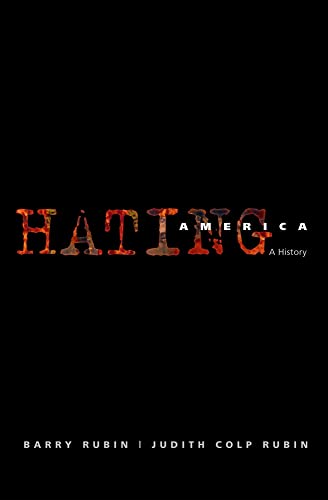
In the early twenty-first century, the world has been seized by one of the most intense periods of anti-Americanism in history. Reviled as an imperialist power, an exporter of destructive capitalism, an arrogant crusader against Islam, and a rapacious over-consumer casually destroying the planet, it seems that the United States of America has rarely been less esteemed in the eyes of the world. In such an environment, one can easily overlook the fact that people from other countries have, in fact, been hating America for centuries. Going back to the day of Thomas Jefferson and Ben Franklin, Americans have long been on the defensive. Barry Rubin and Judith Colp Rubin here draw on sources from a wide range of countries to track the entire trajectory of anti-Americanism. Most significantly, they identify how anti-Americanism evolved over time. In the 18th century, the newfound land was considered too wild and barbaric to support human society. No one, the argument went, could actually live there. Animals brought from Europe, one French commentator claimed, shrunk in size and power. Native Americans too were "small and feeble," lacking "body hair, beard and ardor for his female." The very land itself was "permeated with moist and poisonous vapors, unable to give proper nourishment except to snakes and insects." This opinion prevailed through most of the 19th century, with Keats even invoking the lack of nightingales as symptomatic of just how unlovely and unlivable a place this America was. As the young nation came together at the beginning of the twentieth century and could no longer be easily dismissed as a failure, its very success became cause for suspicion. The American model of populist democracy, the rise of mass culture, the spread of industrialization-all confirmed that America was now a viral threat that could destabilize the established order in Europe. After the paroxysm of World War II, the worst fears of anti-Americanists were realized as the United States became one of the two most powerful nations in the world. Then, with the collapse of the Soviet Union, America became the sole superpower it is today, and the object of global suspicion and scorn. With this powerful work, the Rubins trace the paradox that is America, a country that is both the most reviled and most envied land on earth. In the end, they demonstrate, anti-Americanism has often been a visceral response to the very idea-as well as both the ideals and policies - of America itself, its aggressive innovation, its self-confidence, and the challenge it poses to alternative ideologies.
Les informations fournies dans la section « Synopsis » peuvent faire référence à une autre édition de ce titre.
Présentation de l'éditeur
In the early twenty-first century, the world has been seized by one of the most intense periods of anti-Americanism in history. Reviled as an imperialist power, an exporter of destructive capitalism, an arrogant crusader against Islam, and a rapacious over-consumer casually destroying the planet, it seems that the United States of America has rarely been less esteemed in the eyes of the world. In such an environment, one can easily overlook the fact that people from other countries have, in fact, been hating America for centuries. Going back to the day of Thomas Jefferson and Ben Franklin, Americans have long been on the defensive. Barry Rubin and Judith Colp Rubin here draw on sources from a wide range of countries to track the entire trajectory of anti-Americanism. Most significantly, they identify how anti-Americanism evolved over time. In the 18th century, the newfound land was considered too wild and barbaric to support human society. No one, the argument went, could actually live there. Animals brought from Europe, one French commentator claimed, shrunk in size and power. Native Americans too were "small and feeble," lacking "body hair, beard and ardor for his female." The very land itself was "permeated with moist and poisonous vapors, unable to give proper nourishment except to snakes and insects." This opinion prevailed through most of the 19th century, with Keats even invoking the lack of nightingales as symptomatic of just how unlovely and unlivable a place this America was. As the young nation came together at the beginning of the twentieth century and could no longer be easily dismissed as a failure, its very success became cause for suspicion. The American model of populist democracy, the rise of mass culture, the spread of industrialization-all confirmed that America was now a viral threat that could destabilize the established order in Europe. After the paroxysm of World War II, the worst fears of anti-Americanists were realized as the United States became one of the two most powerful nations in the world. Then, with the collapse of the Soviet Union, America became the sole superpower it is today, and the object of global suspicion and scorn. With this powerful work, the Rubins trace the paradox that is America, a country that is both the most reviled and most envied land on earth. In the end, they demonstrate, anti-Americanism has often been a visceral response to the very idea-as well as both the ideals and policies--of America itself, its aggressive innovation, its self-confidence, and the challenge it poses to alternative ideologies.
Revue de presse
"But America... represents a special type of challenge to the world. That challenge has been recognized, feared, resented and finally hated, as Barry Rubin and Judith Colp Rubin amply illustrate in their fascinating study: Hating America: A History."--The Washington Times
"[A] wise, pungent, and (given its negative subject matter) enjoyable study."--Daniel Pipes, New York Sun
"Hating America treats fairly, and exhaustively, an issue that will challenge America for years at home and abroad."--Charlotte Observer
"A multifaceted national portrait.... This book provides entertaining glimpses of a nation that may have invented public relations to combat its own image problem."--Publishers Weekly
"In this comprehensive and compelling yet disturbing analysis, Barry and Judith Colp Rubin, authors of a superb biography last year on Yasser Arafat, delve deep into American history to uncover the roots of an omnipresent global phenomenon."--Miami Herald
Les informations fournies dans la section « A propos du livre » peuvent faire référence à une autre édition de ce titre.
Résultats de recherche pour Hating America: A History

Image d'archives
Hating America: A History
ISBN 10 : 0195167732
ISBN 13 : 9780195167733
Ancien ou d'occasion
Couverture rigide
Vendeur : BooksRun, Philadelphia, PA, Etats-Unis
Évaluation du vendeur 5 sur 5 étoiles

Hardcover. Etat : Very Good. Black Stripe on Bottom Fore-Edge. With dust jacket. It's a well-cared-for item that has seen limited use. The item may show minor signs of wear. All the text is legible, with all pages included. It may have slight markings and/or highlighting. N° de réf. du vendeur 0195167732-11-1-29
Acheter D'occasion
EUR 5,96
Livraison gratuite
Expédition nationale : Etats-Unis
Expédition nationale : Etats-Unis
Quantité disponible : 1 disponible(s)
Image d'archives
Hating America: A History
Edité par
Oxford University Press, 2004
ISBN 10 : 0195167732
ISBN 13 : 9780195167733
Ancien ou d'occasion
Couverture rigide
Vendeur : Wonder Book, Frederick, MD, Etats-Unis
Évaluation du vendeur 5 sur 5 étoiles
Etat : Very Good. Very Good condition. Very Good dust jacket. With remainder mark. A copy that may have a few cosmetic defects. May also contain light spine creasing or a few markings such as an owner's name, short gifter's inscription or light stamp. N° de réf. du vendeur N19N-00696
Acheter D'occasion
EUR 6,20
Livraison gratuite
Expédition nationale : Etats-Unis
Expédition nationale : Etats-Unis
Quantité disponible : 1 disponible(s)
Image d'archives
Hating America : A History
Edité par
Oxford University Press, Incorporated, 2004
ISBN 10 : 0195167732
ISBN 13 : 9780195167733
Ancien ou d'occasion
Couverture rigide
Vendeur : Better World Books, Mishawaka, IN, Etats-Unis
Évaluation du vendeur 5 sur 5 étoiles
Etat : Very Good. Former library copy. Pages intact with possible writing/highlighting. Binding strong with minor wear. Dust jackets/supplements may not be included. Includes library markings. Stock photo provided. Product includes identifying sticker. Better World Books: Buy Books. Do Good. N° de réf. du vendeur GRP104885874
Acheter D'occasion
EUR 6,51
Livraison gratuite
Expédition nationale : Etats-Unis
Expédition nationale : Etats-Unis
Quantité disponible : 2 disponible(s)
Image d'archives
Hating America: A History
Edité par
Oxford University Press August 2004, 2004
ISBN 10 : 0195167732
ISBN 13 : 9780195167733
Ancien ou d'occasion
Couverture rigide
Edition originale
Vendeur : Books End Bookshop, Syracuse, NY, Etats-Unis
Évaluation du vendeur 4 sur 5 étoiles

Hardcover. Etat : Very Good. Etat de la jaquette : Very Good. First Edition; First Printing. Light rubbing on DJ covers and spine. ; 9.30 X 6.50 X 1.30 inches. N° de réf. du vendeur 289962
Acheter D'occasion
EUR 5,32
Expédition à EUR 5,16
Expédition nationale : Etats-Unis
Expédition nationale : Etats-Unis
Quantité disponible : 1 disponible(s)
Image d'archives
Hating America
Edité par
Oxford ; Oxford University Press, 2004., 2004
ISBN 10 : 0195167732
ISBN 13 : 9780195167733
Ancien ou d'occasion
Couverture rigide
Vendeur : The Book Cellar, LLC, Nashua, NH, Etats-Unis
Évaluation du vendeur 5 sur 5 étoiles
hardcover. Etat : Very Good. Great used condition. A portion of your purchase of this book will be donated to non-profit organizations.Over 1,000,000 satisfied customers since 1997! Choose expedited shipping (if available) for much faster delivery. Delivery confirmation on all US orders. N° de réf. du vendeur 10868419
Acheter D'occasion
EUR 7,08
Expédition à EUR 3,43
Expédition nationale : Etats-Unis
Expédition nationale : Etats-Unis
Quantité disponible : 1 disponible(s)
Image d'archives
Hating America: A History
Edité par
Oxford University Press, U.S.A., 2004
ISBN 10 : 0195167732
ISBN 13 : 9780195167733
Neuf
Couverture rigide
Vendeur : Barsoom Books, Torrance, CA, Etats-Unis
Évaluation du vendeur 4 sur 5 étoiles
Hardcover. Etat : New. Etat de la jaquette : Near Fine. Square, solid, unread -- what more could you ask for? When you receive this book, you'll feel as though you've stumbled into a cave and come across.an elven sword named Glamdring -- or the crown of the fabled Prester John -- a ring of invisibility.or even a Magic Lamp, prosaic as that may sound! You MAY even cartwheel with glee! NOTE: Some minor evidence of edge wear to the DJ. N° de réf. du vendeur 021828
Acheter neuf
EUR 5,63
Expédition à EUR 5,12
Expédition nationale : Etats-Unis
Expédition nationale : Etats-Unis
Quantité disponible : 1 disponible(s)
Image fournie par le vendeur
Hating America: A History
Edité par
Oxford, 2004
ISBN 10 : 0195167732
ISBN 13 : 9780195167733
Ancien ou d'occasion
Couverture rigide
Vendeur : Jonathan Grobe Books, Deep River, IA, Etats-Unis
Évaluation du vendeur 5 sur 5 étoiles
Hardcover. Etat : Very Good. Etat de la jaquette : Very Good. Exlibrary with usual library markings. ; 307 pages. N° de réf. du vendeur 220758
Acheter D'occasion
EUR 7,09
Expédition à EUR 4,30
Expédition nationale : Etats-Unis
Expédition nationale : Etats-Unis
Quantité disponible : 1 disponible(s)
Image d'archives
Hating America : A History
Edité par
Oxford University Press, New York, NY, 2004
ISBN 10 : 0195167732
ISBN 13 : 9780195167733
Ancien ou d'occasion
Couverture rigide
Vendeur : Hourglass Books, Vancouver, BC, Canada
Évaluation du vendeur 5 sur 5 étoiles
Hardcover. Etat : Very Good. Etat de la jaquette : Very Good, Not Price Clipped. American First. Complete number line from 1 to 9; some edge wear to boards and dust jacket; otherwise a solid, clean copy with no marking or underlining; collectible condition. Book. N° de réf. du vendeur 005359
Acheter D'occasion
EUR 17,73
Livraison gratuite
Expédition depuis Canada vers Etats-Unis
Expédition depuis Canada vers Etats-Unis
Quantité disponible : 1 disponible(s)
Image fournie par le vendeur
Hating America: A History
Edité par
Oxford University Press, New York, 2004
ISBN 10 : 0195167732
ISBN 13 : 9780195167733
Ancien ou d'occasion
Couverture rigide
Vendeur : Kenneth A. Himber, Lebanon, NJ, Etats-Unis
Évaluation du vendeur 5 sur 5 étoiles
Hardcover. Etat : As New. Etat de la jaquette : As New. Book is a clean tight unmarked copy. N° de réf. du vendeur 015248
Acheter D'occasion
EUR 18,18
Expédition à EUR 5,16
Expédition nationale : Etats-Unis
Expédition nationale : Etats-Unis
Quantité disponible : 1 disponible(s)
Image d'archives
Hating America: A History
Edité par
Oxford University Press, 2004
ISBN 10 : 0195167732
ISBN 13 : 9780195167733
Neuf
Couverture rigide
Vendeur : Poverty Hill Books, Mt. Prospect, IL, Etats-Unis
Évaluation du vendeur 4 sur 5 étoiles
Hardcover. Etat : New. HARDCOVER, BRAND NEW, Perfect Shape, No Black Remainder Mark,Fast Shipping With Online Tracking, International Orders shipped Global Priority Air Mail, All orders handled with care and shipped promptly in secure packaging, we ship Mon-Sat and send shipment confirmation emails. Our customer service is friendly, we answer emails fast, accept returns and work hard to deliver 100% Customer Satisfaction! N° de réf. du vendeur 9033695
Acheter neuf
EUR 22,12
Expédition à EUR 3,43
Expédition nationale : Etats-Unis
Expédition nationale : Etats-Unis
Quantité disponible : 1 disponible(s)