
Articles liés à Bone Dysplasias: An Atlas of Genetic Disorders of Skeletal...
Synopsis
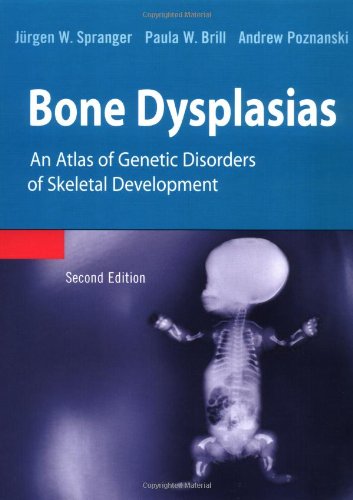
Many advances have been made in understanding skeletal dysplasias since the first edition of this classic text appeared in 1974. The diagnostic process has been refined, many new disorders have been recognized, and the molecular aspects in many cases have been elucidated. The second edition has been completely updated, with the help of two new co-authors, to incorporate these advances. The book's format is similar to the original but the number of conditions covered has almost doubled and molecular information has been added wherever available. The number of figures has been increased to the limit of economic wisdom. As in the first edition, the illustrations have been selected and sequenced to illustrate both the degree of variability of a given disorder and its changes with age. This book is designed for physicians involved in the evaluation and treatment of patients with skeletal dysplasias, including radiologists, medical geneticists, paediatricians, and orthopaedic surgeons. Its main goal is to assist in the diagnosis of specific conditions and the care of affected individuals. Though mutations of specific genes can produce dysplasias with very different phenotypes and prognoses, the primarily clinical aim of this book dictated a phenotypic classification in general, with compromises on etiologic grounds where necessary. Since the attempt to diagnose a skeletal dysplasia from single signs, alone or in combination, is fraught with errors, the authors focus on basic patterns of skeletal abnormalities.
Les informations fournies dans la section « Synopsis » peuvent faire référence à une autre édition de ce titre.
Présentation de l'éditeur
Many advances have been made in understanding skeletal dysplasias since the first edition of this classic text appeared in 1974. The diagnostic process has been refined, many new disorders have been recognized, and the molecular aspects in many cases have been elucidated. The second edition has been completely updated, with the help of two new co-authors, to incorporate these advances. The book's format is similar to the original but the number of conditions covered has almost doubled and molecular information has been added wherever available. The number of figures has been increased to the limit of economic wisdom. As in the first edition, the illustrations have been selected and sequenced to illustrate both the degree of variability of a given disorder and its changes with age. This book is designed for physicians involved in the evaluation and treatment of patients with skeletal dysplasias, including radiologists, medical geneticists, paediatricians, and orthopaedic surgeons. Its main goal is to assist in the diagnosis of specific conditions and the care of affected individuals. Though mutations of specific genes can produce dysplasias with very different phenotypes and prognoses, the primarily clinical aim of this book dictated a phenotypic classification in general, with compromises on etiologic grounds where necessary. Since the attempt to diagnose a skeletal dysplasia from single signs, alone or in combination, is fraught with errors, the authors focus on basic patterns of skeletal abnormalities.
Revue de presse
. . . brilliantly written and produced and deserves to be on the shelves of all pediatric radiologists. (Radiology)
This book has no peer and is an outstanding contribution to the medico-scientific books currently available . . . No practice of the specialties indicated above or indeed any hospital library should be without a copy even if contact with such patients is occasional. (Doody's Journal)
It is, in every sense, an outstanding book for which it is difficult to find worthy superlatives. In 600 pages, with 160 chapters and 1890 illustrations, Dr Spranger and his colleagues provide the definitive account of the state of the art . . . The radiographic illustrations are superbly reproduced and provide a unique, readily available, diagnostic resource. It is clear that several life-times of experience have been invested in this "tour-de-force" . . . Where the authors have succeeded is in producing a superb compendium of great scholarship, of which they can be justly proud and for which the rest of us mere mortals should be extremely grateful. (Human Genetics 113)
Les informations fournies dans la section « A propos du livre » peuvent faire référence à une autre édition de ce titre.
Résultats de recherche pour Bone Dysplasias: An Atlas of Genetic Disorders of Skeletal...

Image d'archives
Bone Dysplasias : An Atlas of Genetic Disorders of Skeletal Development
Edité par
Oxford University Press, Incorporated, 2002
ISBN 10 : 0195214749
ISBN 13 : 9780195214741
Ancien ou d'occasion
Couverture rigide
Vendeur : Better World Books, Mishawaka, IN, Etats-Unis
Évaluation du vendeur 5 sur 5 étoiles

Etat : Good. 2nd Edition. Former library copy. Pages intact with minimal writing/highlighting. The binding may be loose and creased. Dust jackets/supplements are not included. Includes library markings. Stock photo provided. Product includes identifying sticker. Better World Books: Buy Books. Do Good. N° de réf. du vendeur 68239916-6
Acheter D'occasion
EUR 78,01
Livraison gratuite
Expédition nationale : Etats-Unis
Expédition nationale : Etats-Unis
Quantité disponible : 1 disponible(s)
Image d'archives
Bone Dysplasias : An Atlas of Genetic Disorders of Skeletal Development
Edité par
Oxford University Press, Incorporated, 2002
ISBN 10 : 0195214749
ISBN 13 : 9780195214741
Ancien ou d'occasion
Couverture rigide
Vendeur : Better World Books Ltd, Dunfermline, Royaume-Uni
Évaluation du vendeur 5 sur 5 étoiles
Etat : Very Good. 2nd Edition. Former library copy. Pages intact with possible writing/highlighting. Binding strong with minor wear. Dust jackets/supplements may not be included. Includes library markings. Stock photo provided. Product includes identifying sticker. Better World Books: Buy Books. Do Good. N° de réf. du vendeur 10224995-6
Acheter D'occasion
EUR 104,99
Expédition à EUR 5,94
Expédition depuis Royaume-Uni vers Etats-Unis
Expédition depuis Royaume-Uni vers Etats-Unis
Quantité disponible : 1 disponible(s)