
Articles liés à The Bottom Billion: Why the Poorest Countries Are Failing...
The Bottom Billion: Why the Poorest Countries Are Failing and What Can Be Done About It - Couverture rigide
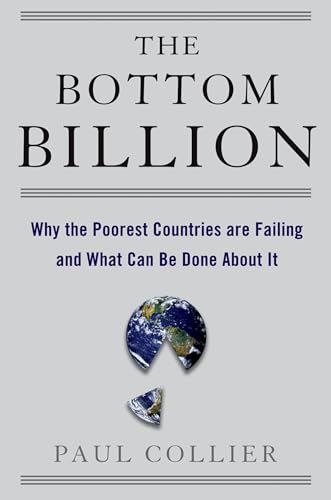
Synopsis
In the universally acclaimed and award-winning The Bottom Billion, Paul Collier reveals that fifty failed states--home to the poorest one billion people on Earth--pose the central challenge of the developing world in the twenty-first century. The book shines much-needed light on this group of small nations, largely unnoticed by the industrialized West, that are dropping further and further behind the majority of the world's people, often falling into an absolute decline in living standards. A struggle rages within each of these nations between reformers and corrupt leaders--and the corrupt are winning. Collier analyzes the causes of failure, pointing to a set of traps that ensnare these countries, including civil war, a dependence on the extraction and export of natural resources, and bad governance. Standard solutions do not work, he writes; aid is often ineffective, and globalization can actually make matters worse, driving development to more stable nations. What the bottom billion need, Collier argues, is a bold new plan supported by the Group of Eight industrialized nations. If failed states are ever to be helped, the G8 will have to adopt preferential trade policies, new laws against corruption, new international charters, and even conduct carefully calibrated military interventions. Collier has spent a lifetime working to end global poverty. In The Bottom Billion, he offers real hope for solving one of the great humanitarian crises facing the world today.
"Set to become a classic. Crammed with statistical nuggets and common sense, his book should be compulsory reading."--The Economist "If Sachs seems too saintly and Easterly too cynical, then Collier is the authentic old Africa hand: he knows the terrain and has a keen ear.... If you've ever found yourself on one side or the other of those arguments--and who hasn't?--then you simply must read this book."
--Niall Ferguson, The New York Times Book Review "Rich in both analysis and recommendations.... Read this book. You will learn much you do not know. It will also change the way you look at the tragedy of persistent poverty in a world of plenty."
--Financial Times
Les informations fournies dans la section « Synopsis » peuvent faire référence à une autre édition de ce titre.
À propos de l'auteur
Paul Collier is Professor of Economics and Director of the Center for the Study of African Economies at Oxford University. Former director of Development Research at the World Bank, he is one of the world's leading experts on African economies, and is the author of Breaking the Conflict Trap, among other books.
Les informations fournies dans la section « A propos du livre » peuvent faire référence à une autre édition de ce titre.
Résultats de recherche pour The Bottom Billion: Why the Poorest Countries Are Failing...

Image d'archives
The Bottom Billion: Why the Poorest Countries are Failing and What Can be Done About It
Edité par
Oxford University Press Inc, 2007
ISBN 10 : 0195311450
ISBN 13 : 9780195311457
Ancien ou d'occasion
Couverture rigide
Vendeur : World of Books (was SecondSale), Montgomery, IL, Etats-Unis
Évaluation du vendeur 5 sur 5 étoiles

Hardback. Etat : Fair. Global poverty, Paul Collier points out, is actually falling quite rapidly for about eighty percent of the world. The real crisis lies in a group of about 50 failing states, the bottom billion, whose problems defy traditional approaches to alleviating poverty. In The Bottom Billion, Collier contends that these fifty failed states pose the central challenge of the developing world in the twenty-first century. The book shines a much needed light on this group of small nations, largely unnoticed by the industrialized West, that are dropping further and further behind the majority of the world's people, often falling into an absolute decline in living standards. A struggle rages within each of these nation between reformers and corrupt leaders--and the corrupt are winning. Collier analyzes the causes of failure, pointing to a set of traps that snare these countries, including civil war, a dependence on the extraction and export of natural resources, and bad governance. Standard solutions do not work against these traps, he writes; aid is often ineffective, and globalization can actually make matters worse, driving development to more stable nations. What the bottom billion need, Collier argues, is a bold new plan supported by the Group of Eight industrialized nations. If failed states are ever to be helped, the G8 will have to adopt preferential trade policies, new laws against corruption, and new international charters, and even conduct carefully calibrated military interventions. As former director of research for the World Bank and current Director of the Center for the Study of African Economies at Oxford University, Paul Collier has spent a lifetime working to end global poverty. In The Bottom Billion, he offers real hope for solving one of the great humanitarian crises facing the world today. N° de réf. du vendeur 00106931639
Acheter D'occasion
EUR 4,04
Livraison gratuite
Expédition nationale : Etats-Unis
Expédition nationale : Etats-Unis
Quantité disponible : 1 disponible(s)
Image d'archives
The Bottom Billion: Why the Poorest Countries are Failing and What Can be Done About It
Edité par
Oxford University Press Inc, 2007
ISBN 10 : 0195311450
ISBN 13 : 9780195311457
Ancien ou d'occasion
Couverture rigide
Vendeur : World of Books (was SecondSale), Montgomery, IL, Etats-Unis
Évaluation du vendeur 5 sur 5 étoiles
Hardback. Etat : Good. Global poverty, Paul Collier points out, is actually falling quite rapidly for about eighty percent of the world. The real crisis lies in a group of about 50 failing states, the bottom billion, whose problems defy traditional approaches to alleviating poverty. In The Bottom Billion, Collier contends that these fifty failed states pose the central challenge of the developing world in the twenty-first century. The book shines a much needed light on this group of small nations, largely unnoticed by the industrialized West, that are dropping further and further behind the majority of the world's people, often falling into an absolute decline in living standards. A struggle rages within each of these nation between reformers and corrupt leaders--and the corrupt are winning. Collier analyzes the causes of failure, pointing to a set of traps that snare these countries, including civil war, a dependence on the extraction and export of natural resources, and bad governance. Standard solutions do not work against these traps, he writes; aid is often ineffective, and globalization can actually make matters worse, driving development to more stable nations. What the bottom billion need, Collier argues, is a bold new plan supported by the Group of Eight industrialized nations. If failed states are ever to be helped, the G8 will have to adopt preferential trade policies, new laws against corruption, and new international charters, and even conduct carefully calibrated military interventions. As former director of research for the World Bank and current Director of the Center for the Study of African Economies at Oxford University, Paul Collier has spent a lifetime working to end global poverty. In The Bottom Billion, he offers real hope for solving one of the great humanitarian crises facing the world today. N° de réf. du vendeur 00101872525
Acheter D'occasion
EUR 4,04
Livraison gratuite
Expédition nationale : Etats-Unis
Expédition nationale : Etats-Unis
Quantité disponible : 18 disponible(s)
Image fournie par le vendeur
The Bottom Billion: Why the Poorest Countries are Failing and What Can Be Done About It
Edité par
Oxford University Press, 2007
ISBN 10 : 0195311450
ISBN 13 : 9780195311457
Ancien ou d'occasion
Couverture rigide
Vendeur : Zoom Books East, Glendale Heights, IL, Etats-Unis
Évaluation du vendeur 5 sur 5 étoiles
Etat : very_good. Book is in very good condition and may include minimal underlining highlighting. The book can also include "From the library of" labels. May not contain miscellaneous items toys, dvds, etc. . We offer 100% money back guarantee and 24 7 customer service. N° de réf. du vendeur ZEV.0195311450.VG
Acheter D'occasion
EUR 4,05
Livraison gratuite
Expédition nationale : Etats-Unis
Expédition nationale : Etats-Unis
Quantité disponible : 4 disponible(s)
Image fournie par le vendeur
The Bottom Billion: Why the Poorest Countries are Failing and What Can Be Done About It
Edité par
Oxford University Press, 2007
ISBN 10 : 0195311450
ISBN 13 : 9780195311457
Ancien ou d'occasion
Couverture rigide
Vendeur : Zoom Books East, Glendale Heights, IL, Etats-Unis
Évaluation du vendeur 5 sur 5 étoiles
Etat : like_new. Book is in like new condition with minimal signs of wear. Pages are clean and free from notes or highlighting. Dust cover is intact. May not contain miscellaneous items toys, dvds, etc. . We offer 100% money back guarantee and 24 7 customer service. N° de réf. du vendeur ZEV.0195311450.LN
Acheter D'occasion
EUR 4,05
Livraison gratuite
Expédition nationale : Etats-Unis
Expédition nationale : Etats-Unis
Quantité disponible : 1 disponible(s)
Image fournie par le vendeur
The Bottom Billion: Why the Poorest Countries are Failing and What Can Be Done About It
Edité par
Oxford University Press, 2007
ISBN 10 : 0195311450
ISBN 13 : 9780195311457
Ancien ou d'occasion
Couverture rigide
Vendeur : Zoom Books Company, Lynden, WA, Etats-Unis
Évaluation du vendeur 5 sur 5 étoiles
Etat : very_good. Book is in very good condition and may include minimal underlining highlighting. The book can also include "From the library of" labels. May not contain miscellaneous items toys, dvds, etc. . We offer 100% money back guarantee and 24 7 customer service. N° de réf. du vendeur ZBV.0195311450.VG
Acheter D'occasion
EUR 4,09
Livraison gratuite
Expédition nationale : Etats-Unis
Expédition nationale : Etats-Unis
Quantité disponible : 1 disponible(s)
Image d'archives
The Bottom Billion: Why the Poorest Countries are Failing and What Can Be Done About It
Edité par
Oxford University Press (edition 1), 2007
ISBN 10 : 0195311450
ISBN 13 : 9780195311457
Ancien ou d'occasion
Couverture rigide
Vendeur : BooksRun, Philadelphia, PA, Etats-Unis
Évaluation du vendeur 5 sur 5 étoiles
Hardcover. Etat : Fair. 1. With dust jacket. The item might be beaten up but readable. May contain markings or highlighting, as well as stains, bent corners, or any other major defect, but the text is not obscured in any way. N° de réf. du vendeur 0195311450-7-1-29
Acheter D'occasion
EUR 5,05
Livraison gratuite
Expédition nationale : Etats-Unis
Expédition nationale : Etats-Unis
Quantité disponible : 1 disponible(s)
Image d'archives
The Bottom Billion: Why the Poorest Countries are Failing and What Can Be Done About It
Edité par
Oxford University Press, 2007
ISBN 10 : 0195311450
ISBN 13 : 9780195311457
Ancien ou d'occasion
Couverture rigide
Vendeur : HPB-Diamond, Dallas, TX, Etats-Unis
Évaluation du vendeur 5 sur 5 étoiles
hardcover. Etat : Very Good. Connecting readers with great books since 1972! Used books may not include companion materials, and may have some shelf wear or limited writing. We ship orders daily and Customer Service is our top priority! N° de réf. du vendeur S_481565705
Acheter D'occasion
EUR 2,38
Expédition à EUR 3,34
Expédition nationale : Etats-Unis
Expédition nationale : Etats-Unis
Quantité disponible : 1 disponible(s)
Image d'archives
The Bottom Billion: Why the Poorest Countries are Failing and What Can Be Done About It
Edité par
Oxford University Press (edition 1), 2007
ISBN 10 : 0195311450
ISBN 13 : 9780195311457
Ancien ou d'occasion
Couverture rigide
Vendeur : BooksRun, Philadelphia, PA, Etats-Unis
Évaluation du vendeur 5 sur 5 étoiles
Hardcover. Etat : Very Good. 1. With dust jacket. It's a well-cared-for item that has seen limited use. The item may show minor signs of wear. All the text is legible, with all pages included. It may have slight markings and/or highlighting. N° de réf. du vendeur 0195311450-8-1-29
Acheter D'occasion
EUR 5,75
Livraison gratuite
Expédition nationale : Etats-Unis
Expédition nationale : Etats-Unis
Quantité disponible : 1 disponible(s)
Image d'archives
The Bottom Billion: Why the Poorest Countries are Failing and What Can Be Done About It
Edité par
Oxford University Press, 2007
ISBN 10 : 0195311450
ISBN 13 : 9780195311457
Ancien ou d'occasion
Couverture rigide
Vendeur : Evergreen Goodwill, Seattle, WA, Etats-Unis
Évaluation du vendeur 5 sur 5 étoiles
hardcover. Etat : Good. N° de réf. du vendeur mon0000808222
Acheter D'occasion
EUR 2,30
Expédition à EUR 3,55
Expédition nationale : Etats-Unis
Expédition nationale : Etats-Unis
Quantité disponible : 1 disponible(s)
Image d'archives
The Bottom Billion: Why the Poorest Countries are Failing and What Can be Done About It
Edité par
Oxford University Press Inc, 2007
ISBN 10 : 0195311450
ISBN 13 : 9780195311457
Ancien ou d'occasion
Couverture rigide
Vendeur : World of Books Inc, Montgomery, IL, Etats-Unis
Évaluation du vendeur 4 sur 5 étoiles

Hardback. Etat : Fair. Global poverty, Paul Collier points out, is actually falling quite rapidly for about eighty percent of the world. The real crisis lies in a group of about 50 failing states, the bottom billion, whose problems defy traditional approaches to alleviating poverty. In The Bottom Billion, Collier contends that these fifty failed states pose the central challenge of the developing world in the twenty-first century. The book shines a much needed light on this group of small nations, largely unnoticed by the industrialized West, that are dropping further and further behind the majority of the world's people, often falling into an absolute decline in living standards. A struggle rages within each of these nation between reformers and corrupt leaders--and the corrupt are winning. Collier analyzes the causes of failure, pointing to a set of traps that snare these countries, including civil war, a dependence on the extraction and export of natural resources, and bad governance. Standard solutions do not work against these traps, he writes; aid is often ineffective, and globalization can actually make matters worse, driving development to more stable nations. What the bottom billion need, Collier argues, is a bold new plan supported by the Group of Eight industrialized nations. If failed states are ever to be helped, the G8 will have to adopt preferential trade policies, new laws against corruption, and new international charters, and even conduct carefully calibrated military interventions. As former director of research for the World Bank and current Director of the Center for the Study of African Economies at Oxford University, Paul Collier has spent a lifetime working to end global poverty. In The Bottom Billion, he offers real hope for solving one of the great humanitarian crises facing the world today. N° de réf. du vendeur CIN0195311450A
Acheter D'occasion
EUR 5,87
Livraison gratuite
Expédition nationale : Etats-Unis
Expédition nationale : Etats-Unis
Quantité disponible : 1 disponible(s)