
Articles liés à Cognition, Evolution, and Behavior
Synopsis
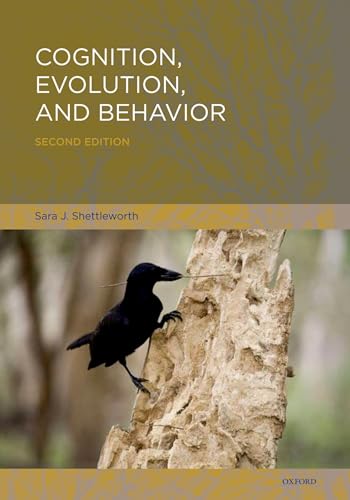
How do animals perceive the world, learn, remember, search for food or mates, communicate, and find their way around? Do any nonhuman animals count, imitate one another, use a language, or have a culture? What are the uses of cognition in nature and how might it have evolved? What is the current status of Darwin's claim that other species share the same "mental powers" as humans, but to different degrees? In this completely revised second edition of Cognition, Evolution, and Behavior, Sara Shettleworth addresses these questions, among others, by integrating findings from psychology, behavioral ecology, and ethology in a unique and wide-ranging synthesis of theory and research on animal cognition, in the broadest sense-from species-specific adaptations of vision in fish and associative learning in rats to discussions of theory of mind in chimpanzees, dogs, and ravens. She reviews the latest research on topics such as episodic memory, metacognition, and cooperation and other-regarding behavior in animals, as well as recent theories about what makes human cognition unique. In every part of this new edition, Shettleworth incorporates findings and theoretical approaches that have emerged since the first edition was published in 1998. The chapters are now organized into three sections: Fundamental Mechanisms (perception, learning, categorization, memory), Physical Cognition (space, time, number, physical causation), and Social Cognition (social knowledge, social learning, communication). Shettleworth has also added new chapters on evolution and the brain and on numerical cognition, and a new chapter on physical causation that integrates theories of instrumental behavior with discussions of foraging, planning, and tool using.
Les informations fournies dans la section « Synopsis » peuvent faire référence à une autre édition de ce titre.
À propos de l'auteur
Sara Shettleworth is Professor Emerita in the Departments of Psychology and Ecology & Evolutionary Biology at the University of Toronto, where she obtained her Ph.D. in 1970. Her research on learning and memory in a variety of species of birds and mammals has been published in over 100 articles and book chapters. Her contributions have been recognized by numerous awards, including the International Comparative Cognition Society's 2008 Research Award. She is a fellow of the Royal Society of Canada and Animal Behavior Society, and a member of the Society of Experimental Psychologists.
Les informations fournies dans la section « A propos du livre » peuvent faire référence à une autre édition de ce titre.
Résultats de recherche pour Cognition, Evolution, and Behavior

Image d'archives
Cognition, Evolution, and Behavior
Edité par
Oxford University Press, 2009
ISBN 10 : 0195319842
ISBN 13 : 9780195319842
Ancien ou d'occasion
Paperback
Vendeur : Textbook Bookie, Little Rock, AR, Etats-Unis
Évaluation du vendeur 5 sur 5 étoiles

Paperback. Etat : Fair. Book in Fair condition. N° de réf. du vendeur 9780195319842-acceptable
Acheter D'occasion
EUR 9,18
Expédition à EUR 3,79
Expédition nationale : Etats-Unis
Expédition nationale : Etats-Unis
Quantité disponible : 1 disponible(s)
Image d'archives
Cognition, Evolution, and Behavior
Edité par
Oxford University Press, Incorporated, 2009
ISBN 10 : 0195319842
ISBN 13 : 9780195319842
Ancien ou d'occasion
Couverture souple
Vendeur : Better World Books Ltd, Dunfermline, Royaume-Uni
Évaluation du vendeur 5 sur 5 étoiles
Etat : Good. Former library copy. Pages intact with minimal writing/highlighting. The binding may be loose and creased. Dust jackets/supplements are not included. Includes library markings. Stock photo provided. Product includes identifying sticker. Better World Books: Buy Books. Do Good. N° de réf. du vendeur GRP87749404
Acheter D'occasion
EUR 9,17
Expédition à EUR 5,93
Expédition depuis Royaume-Uni vers Etats-Unis
Expédition depuis Royaume-Uni vers Etats-Unis
Quantité disponible : 3 disponible(s)
Image d'archives
Cognition, Evolution, and Behavior
Edité par
Oxford University Press, Incorporated, 2009
ISBN 10 : 0195319842
ISBN 13 : 9780195319842
Ancien ou d'occasion
Couverture souple
Vendeur : Better World Books Ltd, Dunfermline, Royaume-Uni
Évaluation du vendeur 5 sur 5 étoiles
Etat : Good. Pages intact with minimal writing/highlighting. The binding may be loose and creased. Dust jackets/supplements are not included. Stock photo provided. Product includes identifying sticker. Better World Books: Buy Books. Do Good. N° de réf. du vendeur 19008221-6
Acheter D'occasion
EUR 9,17
Expédition à EUR 5,93
Expédition depuis Royaume-Uni vers Etats-Unis
Expédition depuis Royaume-Uni vers Etats-Unis
Quantité disponible : 8 disponible(s)
Image d'archives
Cognition, Evolution, and Behavior
Edité par
Oxford University Press, 2009
ISBN 10 : 0195319842
ISBN 13 : 9780195319842
Ancien ou d'occasion
Paperback
Vendeur : HPB-Red, Dallas, TX, Etats-Unis
Évaluation du vendeur 5 sur 5 étoiles
Paperback. Etat : Good. Connecting readers with great books since 1972! Used textbooks may not include companion materials such as access codes, etc. May have some wear or writing/highlighting. We ship orders daily and Customer Service is our top priority! N° de réf. du vendeur S_476036222
Acheter D'occasion
EUR 15,58
Expédition à EUR 3,34
Expédition nationale : Etats-Unis
Expédition nationale : Etats-Unis
Quantité disponible : 1 disponible(s)
Image d'archives
Cognition, Evolution, and Behavior
Edité par
Oxford University Press, 2009
ISBN 10 : 0195319842
ISBN 13 : 9780195319842
Ancien ou d'occasion
Paperback
Vendeur : HPB-Red, Dallas, TX, Etats-Unis
Évaluation du vendeur 5 sur 5 étoiles
Paperback. Etat : Acceptable. Connecting readers with great books since 1972. Used textbooks may not include companion materials such as access codes, etc. May have condition issues including wear and notes/highlighting. We ship orders daily and Customer Service is our top priority! N° de réf. du vendeur S_459389289
Acheter D'occasion
EUR 15,58
Expédition à EUR 3,34
Expédition nationale : Etats-Unis
Expédition nationale : Etats-Unis
Quantité disponible : 1 disponible(s)
Image d'archives
Cognition, Evolution, and Behavior
Edité par
Oxford University Press, 2009
ISBN 10 : 0195319842
ISBN 13 : 9780195319842
Ancien ou d'occasion
paperback
Vendeur : Textbooks_Source, Columbia, MO, Etats-Unis
Évaluation du vendeur 5 sur 5 étoiles
paperback. Etat : Good. 2nd Edition. Ships in a BOX from Central Missouri! May not include working access code. Will not include dust jacket. Has used sticker(s) and some writing or highlighting. UPS shipping for most packages, (Priority Mail for AK/HI/APO/PO Boxes). N° de réf. du vendeur 000969139U
Acheter D'occasion
EUR 29,33
Expédition à EUR 3,56
Expédition nationale : Etats-Unis
Expédition nationale : Etats-Unis
Quantité disponible : 10 disponible(s)
Image fournie par le vendeur
Cognition, Evolution, and Behavior
Edité par
Oxford University Press, USA, 2009
ISBN 10 : 0195319842
ISBN 13 : 9780195319842
Ancien ou d'occasion
paperback
Vendeur : WeBuyBooks, Rossendale, LANCS, Royaume-Uni
Évaluation du vendeur 5 sur 5 étoiles
paperback. Etat : Good. Most items will be dispatched the same or the next working day. A copy that has been read but remains in clean condition. All of the pages are intact and the cover is intact and the spine may show signs of wear. The book may have minor markings which are not specifically mentioned. N° de réf. du vendeur rev2526118722
Acheter D'occasion
EUR 48,77
Expédition à EUR 13,28
Expédition depuis Royaume-Uni vers Etats-Unis
Expédition depuis Royaume-Uni vers Etats-Unis
Quantité disponible : 1 disponible(s)
Image d'archives
Cognition, Evolution, and Behavior
Vendeur : GoldBooks, Denver, CO, Etats-Unis
Évaluation du vendeur 5 sur 5 étoiles
Paperback. Etat : new. New Copy. Customer Service Guaranteed. N° de réf. du vendeur 61F37_85_0195319842
Acheter neuf
EUR 62,74
Expédition à EUR 4,90
Expédition nationale : Etats-Unis
Expédition nationale : Etats-Unis
Quantité disponible : 1 disponible(s)
Image fournie par le vendeur
Cognition, Evolution, and Behavior
Edité par
Oxford University Press, 2009
ISBN 10 : 0195319842
ISBN 13 : 9780195319842
Ancien ou d'occasion
Couverture souple
Vendeur : GreatBookPrices, Columbia, MD, Etats-Unis
Évaluation du vendeur 5 sur 5 étoiles
Etat : good. May show signs of wear, highlighting, writing, and previous use. This item may be a former library book with typical markings. No guarantee on products that contain supplements Your satisfaction is 100% guaranteed. Twenty-five year bookseller with shipments to over fifty million happy customers. N° de réf. du vendeur 6514288-5
Acheter D'occasion
EUR 83,42
Expédition à EUR 2,35
Expédition nationale : Etats-Unis
Expédition nationale : Etats-Unis
Quantité disponible : 5 disponible(s)
Image fournie par le vendeur
Cognition, Evolution, and Behavior
Edité par
Oxford University Press, 2009
ISBN 10 : 0195319842
ISBN 13 : 9780195319842
Neuf
Couverture souple
Vendeur : GreatBookPrices, Columbia, MD, Etats-Unis
Évaluation du vendeur 5 sur 5 étoiles
Etat : New. N° de réf. du vendeur 6514288-n
Acheter neuf
EUR 98,40
Expédition à EUR 2,35
Expédition nationale : Etats-Unis
Expédition nationale : Etats-Unis
Quantité disponible : Plus de 20 disponibles