
Articles liés à Three Mughal Poets: Mir, Sauda, Mir Hasan
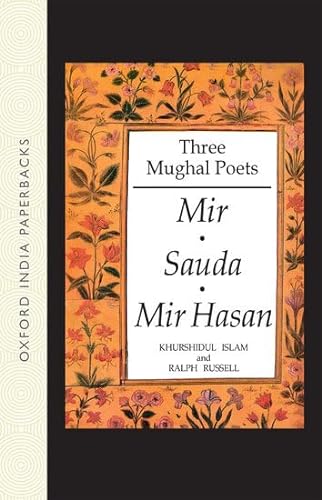
Synopsis
The three great poets presented in this volume - Mir, Mir Hasan and Sauda - lived in Delhi, or in its general vicinity, in the eighteenth century during a time of widespread violence and disaster. The Mughal Empire was crumbling and disintegrating internally as the great feudal nobles fought among themselves for control of the emperor. In this atmosphere of misery, demoralization, and despair occurred the first major flowering of Urdu literature.
Sauda, the first to be discussed, wrote poems in all the main classical forms, but he was an unequalled satirist in an age that cried for satire, and it is that portion of his work that is considered here.
Mir Hasan also was born in Delhi and probably lived there until after the occupation, massacre, and looting of 1739, which occurred when he was about fourteen. Like his two contmporaries, he wrote in all the classical forms and excelled in one, to which he devoted most of his effort. In his case it was the mansavi, a long narrative poem in rhymed couplets often telling a love story.
Mir, perhaps the greatest of the three, is, in the opinion of the authors, one of the great love poems of world literature. His favourite form was the ghazal, a subtle and difficult one which the authors discuss in detail, giving numerous examples.
In presenting these Mughal poets, the authors have let the literature speak for itself wherever possible, adding a minimum of comment.
(This is a paperback edition of the earlier hardback published in 1991.)
Les informations fournies dans la section « Synopsis » peuvent faire référence à une autre édition de ce titre.
Présentation de l'éditeur
The three great poets presented in this volume - Mir, Mir Hasan and Sauda - lived in Delhi, or in its general vicinity, in the eighteenth century during a time of widespread violence and disaster. The Mughal Empire was crumbling and disintegrating internally as the great feudal nobles fought among themselves for control of the emperor. In this atmosphere of misery, demoralization, and despair occurred the first major flowering of Urdu literature. Sauda, the first to be discussed, wrote poems in all the main classical forms, but he was an unequalled satirist in an age that cried for satire, and it is that portion of his work that is considered here. Mir Hasan also was born in Delhi and probably lived there until after the occupation, massacre, and looting of 1739, which occurred when he was about fourteen. Like his two contmporaries, he wrote in all the classical forms and excelled in one, to which he devoted most of his effort. In his case it was the mansavi, a long narrative poem in rhymed couplets often telling a love story. Mir, perhaps the greatest of the three, is, in the opinion of the authors, one of the great love poems of world literature. His favourite form was the ghazal, a subtle and difficult one which the authors discuss in detail, giving numerous examples. In presenting these Mughal poets, the authors have let the literature speak for itself wherever possible, adding a minimum of comment. (This is a paperback edition of the earlier hardback published in 1991.)
Les informations fournies dans la section « A propos du livre » peuvent faire référence à une autre édition de ce titre.
Résultats de recherche pour Three Mughal Poets: Mir, Sauda, Mir Hasan

Image d'archives
Three Mughal Poets
Edité par
Oxford University Press, 1998
ISBN 10 : 0195633911
ISBN 13 : 9780195633917
Ancien ou d'occasion
Paperback
Vendeur : ThriftBooks-Atlanta, AUSTELL, GA, Etats-Unis
Évaluation du vendeur 5 sur 5 étoiles

Paperback. Etat : Good. No Jacket. Former library book; Pages can have notes/highlighting. Spine may show signs of wear. ~ ThriftBooks: Read More, Spend Less. N° de réf. du vendeur G0195633911I3N10
Acheter D'occasion
EUR 16,49
Livraison gratuite
Expédition nationale : Etats-Unis
Expédition nationale : Etats-Unis
Quantité disponible : 1 disponible(s)
Image d'archives
Three Mughal Poets
Edité par
Oxford University Press, 1998
ISBN 10 : 0195633911
ISBN 13 : 9780195633917
Neuf
Couverture souple
Vendeur : Majestic Books, Hounslow, Royaume-Uni
Évaluation du vendeur 4 sur 5 étoiles

Etat : New. Print on Demand pp. xiv + 290. N° de réf. du vendeur 7813509
Acheter neuf
EUR 11,88
Expédition à EUR 7,75
Expédition depuis Royaume-Uni vers Etats-Unis
Expédition depuis Royaume-Uni vers Etats-Unis
Quantité disponible : 4 disponible(s)
Image d'archives
Three Mughal Poets
Edité par
Oxford University Press OUP, 1998
ISBN 10 : 0195633911
ISBN 13 : 9780195633917
Neuf
Couverture souple
Vendeur : Books Puddle, Woodside, NY, Etats-Unis
Évaluation du vendeur 4 sur 5 étoiles
Etat : New. pp. xiv + 290 Index 4th Impression. N° de réf. du vendeur 2634394
Acheter neuf
EUR 17,14
Expédition à EUR 3,55
Expédition nationale : Etats-Unis
Expédition nationale : Etats-Unis
Quantité disponible : 4 disponible(s)
Image d'archives
Three Mughal Poets
Edité par
Oxford University Press, 1998
ISBN 10 : 0195633911
ISBN 13 : 9780195633917
Neuf
Couverture souple
Vendeur : Biblios, Frankfurt am main, HESSE, Allemagne
Évaluation du vendeur 4 sur 5 étoiles
Etat : New. PRINT ON DEMAND pp. xiv + 290. N° de réf. du vendeur 1834384
Acheter neuf
EUR 12,27
Expédition à EUR 9,95
Expédition depuis Allemagne vers Etats-Unis
Expédition depuis Allemagne vers Etats-Unis
Quantité disponible : 4 disponible(s)