
Articles liés à The Language of Music (Clarendon Paperbacks)
Synopsis
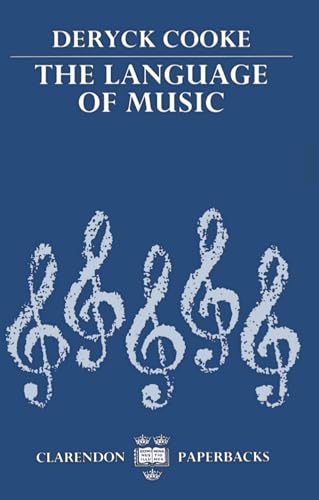
First published in 1959, this original study argues that the main characteristic of music is that it expresses and evokes emotion, and that all composers whose music has a tonal basis have used the same, or closely similar, melodic phrases, harmonies, and rhythms to affect the listener in the same ways. He supports this view with hundreds of musical examples, ranging from plainsong to Stravinsky, and contends that music is a language in the specific sense that we can identify idioms and draw up a list of meanings. The book's final section analyzes two symphonies, Mozart's Fortieth and Vaughan Williams's Sixth, to explore the nature of musical inspiration and the process whereby the notes actually convey emotion from composer to listener.
Les informations fournies dans la section « Synopsis » peuvent faire référence à une autre édition de ce titre.
Présentation de l'éditeur
This important and controversial book has come to be regarded as a modern classic. Originally published in 1959, it has exerted a profound influence on all subsequent discussion in the field of musical aesthetics. The author's thesis is that the main characteristic of music is to express and evoke emotion, and that all composers whose music has a tonal basis have used the same, or closely similar, melodic phrases, harmonies, and rhythms to express and evoke the same emotions. He supports this view with numerous musical examples, varying from plainsong to Stravinsky. Based on this evidence he argues that music is a language in the quite specific sense that idioms can be identified and a list of meanings compiled. While acknowledging that a 'dictionary' of the language of music cannot easily be provided, he attempts to supply what could at least be regarded as a 'phrase book'. The enlightening analysis of two complete symphonies by Mozart and Vaughan Williams demonstrates the expressive function of musical form, the latter being an element which the author considers inseparable from musical content.
Revue de presse
One of the most important publications of post-war English musicography...its honesty, its individualism, and its empiricism reflect the best intellectual traditions of English literature. (Music and Letters)
Les informations fournies dans la section « A propos du livre » peuvent faire référence à une autre édition de ce titre.
Résultats de recherche pour The Language of Music (Clarendon Paperbacks)

Image d'archives
The Language of Music (Clarendon Paperbacks)
Vendeur : AwesomeBooks, Wallingford, Royaume-Uni
Évaluation du vendeur 5 sur 5 étoiles

Paperback. Etat : Very Good. The Language of Music (Clarendon Paperbacks) This book is in very good condition and will be shipped within 24 hours of ordering. The cover may have some limited signs of wear but the pages are clean, intact and the spine remains undamaged. This book has clearly been well maintained and looked after thus far. Money back guarantee if you are not satisfied. See all our books here, order more than 1 book and get discounted shipping. N° de réf. du vendeur 7719-9780198161806
Acheter D'occasion
EUR 4,61
Expédition à EUR 4,80
Expédition depuis Royaume-Uni vers Etats-Unis
Expédition depuis Royaume-Uni vers Etats-Unis
Quantité disponible : 2 disponible(s)
Image d'archives
The Language of Music (Clarendon Paperbacks)
Edité par
Clarendon Press, 1990
ISBN 10 : 0198161808
ISBN 13 : 9780198161806
Ancien ou d'occasion
Paperback
Vendeur : WorldofBooks, Goring-By-Sea, WS, Royaume-Uni
Évaluation du vendeur 5 sur 5 étoiles
Paperback. Etat : Very Good. The book has been read, but is in excellent condition. Pages are intact and not marred by notes or highlighting. The spine remains undamaged. N° de réf. du vendeur GOR001266649
Acheter D'occasion
EUR 3
Expédition à EUR 6,52
Expédition depuis Royaume-Uni vers Etats-Unis
Expédition depuis Royaume-Uni vers Etats-Unis
Quantité disponible : 1 disponible(s)
Image d'archives
The Language of Music
Edité par
Oxford University Press, Incorporated, 1990
ISBN 10 : 0198161808
ISBN 13 : 9780198161806
Ancien ou d'occasion
Couverture souple
Vendeur : Better World Books Ltd, Dunfermline, Royaume-Uni
Évaluation du vendeur 5 sur 5 étoiles
Etat : Good. Former library copy. Pages intact with minimal writing/highlighting. The binding may be loose and creased. Dust jackets/supplements are not included. Includes library markings. Stock photo provided. Product includes identifying sticker. Better World Books: Buy Books. Do Good. N° de réf. du vendeur 5907377-6
Acheter D'occasion
EUR 5,64
Expédition à EUR 5,82
Expédition depuis Royaume-Uni vers Etats-Unis
Expédition depuis Royaume-Uni vers Etats-Unis
Quantité disponible : 1 disponible(s)
Image d'archives
The Language of Music (Clarendon Paperbacks)
Edité par
Oxford University Press, USA 08/03/1990, 1990
ISBN 10 : 0198161808
ISBN 13 : 9780198161806
Ancien ou d'occasion
Paperback
Vendeur : Bahamut Media, Reading, Royaume-Uni
Évaluation du vendeur 5 sur 5 étoiles
Paperback. Etat : Very Good. Shipped within 24 hours from our UK warehouse. Clean, undamaged book with no damage to pages and minimal wear to the cover. Spine still tight, in very good condition. Remember if you are not happy, you are covered by our 100% money back guarantee. N° de réf. du vendeur 6545-9780198161806
Acheter D'occasion
EUR 10,34
Expédition à EUR 8,12
Expédition depuis Royaume-Uni vers Etats-Unis
Expédition depuis Royaume-Uni vers Etats-Unis
Quantité disponible : 1 disponible(s)
Image d'archives
The Language of Music (Clarendon Paperbacks)
Edité par
OUP Oxford, 1989
ISBN 10 : 0198161808
ISBN 13 : 9780198161806
Ancien ou d'occasion
Paperback
Vendeur : Brit Books, Milton Keynes, Royaume-Uni
Évaluation du vendeur 4 sur 5 étoiles

Paperback. Etat : Used; Very Good. ***Simply Brit*** Welcome to our online used book store, where affordability meets great quality. Dive into a world of captivating reads without breaking the bank. We take pride in offering a wide selection of used books, from classics to hidden gems, ensuring there is something for every literary palate. All orders are shipped within 24 hours and our lightning fast-delivery within 48 hours coupled with our prompt customer service ensures a smooth journey from ordering to delivery. Discover the joy of reading with us, your trusted source for affordable books that do not compromise on quality. N° de réf. du vendeur 3980153
Acheter D'occasion
EUR 5,23
Expédition à EUR 18,61
Expédition depuis Royaume-Uni vers Etats-Unis
Expédition depuis Royaume-Uni vers Etats-Unis
Quantité disponible : 1 disponible(s)
Image d'archives
The Language of Music (Clarendon Paperbacks)
Edité par
Clarendon Press, 1990
ISBN 10 : 0198161808
ISBN 13 : 9780198161806
Ancien ou d'occasion
Couverture souple
Vendeur : medimops, Berlin, Allemagne
Évaluation du vendeur 5 sur 5 étoiles
Etat : good. Befriedigend/Good: Durchschnittlich erhaltenes Buch bzw. Schutzumschlag mit Gebrauchsspuren, aber vollständigen Seiten. / Describes the average WORN book or dust jacket that has all the pages present. N° de réf. du vendeur M00198161808-G
Acheter D'occasion
EUR 14,41
Expédition à EUR 10
Expédition depuis Allemagne vers Etats-Unis
Expédition depuis Allemagne vers Etats-Unis
Quantité disponible : 4 disponible(s)
Image d'archives
The Language of Music (Clarendon Paperbacks)
Edité par
Clarendon Press, 1990
ISBN 10 : 0198161808
ISBN 13 : 9780198161806
Ancien ou d'occasion
paperback
Vendeur : Books From California, Simi Valley, CA, Etats-Unis
Évaluation du vendeur 4 sur 5 étoiles
paperback. Etat : Good. N° de réf. du vendeur mon0004206773
Acheter D'occasion
EUR 24,54
Expédition à EUR 4,35
Expédition nationale : Etats-Unis
Expédition nationale : Etats-Unis
Quantité disponible : 1 disponible(s)
Image d'archives
The Language of Music (Clarendon Paperbacks)
Vendeur : SHIMEDIA, Brooklyn, NY, Etats-Unis
Évaluation du vendeur 4 sur 5 étoiles
Etat : New. Satisfaction Guaranteed or your money back. N° de réf. du vendeur 0198161808
Acheter neuf
EUR 59,23
Livraison gratuite
Expédition nationale : Etats-Unis
Expédition nationale : Etats-Unis
Quantité disponible : 1 disponible(s)
Image d'archives
The Language of Music (Clarendon Paperbacks)
Vendeur : DeckleEdge LLC, Albuquerque, NM, Etats-Unis
Évaluation du vendeur 5 sur 5 étoiles
paperback. Etat : new. N° de réf. du vendeur Shelfdream0198161808
Acheter neuf
EUR 64,42
Livraison gratuite
Expédition nationale : Etats-Unis
Expédition nationale : Etats-Unis
Quantité disponible : 1 disponible(s)
Image fournie par le vendeur
Language of Music
Edité par
Clarendon Press, 1990
ISBN 10 : 0198161808
ISBN 13 : 9780198161806
Ancien ou d'occasion
Couverture souple
Vendeur : GreatBookPrices, Columbia, MD, Etats-Unis
Évaluation du vendeur 5 sur 5 étoiles
Etat : As New. Unread book in perfect condition. N° de réf. du vendeur 72023
Acheter D'occasion
EUR 79,55
Expédition à EUR 2,30
Expédition nationale : Etats-Unis
Expédition nationale : Etats-Unis
Quantité disponible : Plus de 20 disponibles