
Articles liés à Predatory Value Extraction: How the Looting of the...
Predatory Value Extraction: How the Looting of the Business Enterprise Became the Us Norm and How Sustainable Prosperity Can Be Restored - Couverture rigide
Synopsis
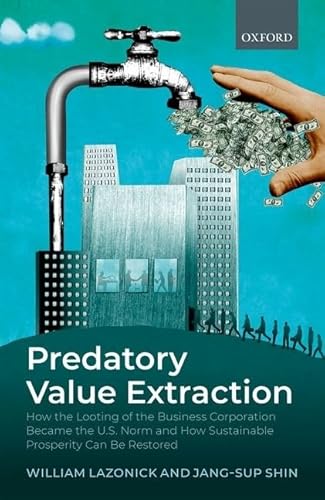
Predatory Value Extraction explains how an ideology of corporate resource allocation known as 'maximizing shareholder value' (MSV) that emerged in the 1980s came to dominate strategic thinking in business schools and corporate boardrooms in the United States. Undermining the social foundations of sustainable prosperity, it resulted in employment instability, income inequity, and slow productivity growth. In explaining what happened to sustainable prosperity, William Lazonick and Jang-Sup Shin focus on the growing imbalance between value creation and value extraction in the U.S. economy, and the corporate-governance institutions that determine this balance in the nation's major business corporations. The imbalance has become so extreme that predatory value extraction is now a central economic activity, to the point at which the U.S. economy as a whole can be aptly described as a value-extracting economy.
Balancing the contributions of economic actors to value creation with their power to extract value provides the foundation for stable and equitable economic growth. When certain economic actors are able to assert their power to extract far more value than they contribute to the value-creation process, an imbalance occurs which, when extreme, leads to dire economic, political, and social consequences. This book not only explores these consequences, but also sets out an agenda for restoring sustainable prosperity.
Les informations fournies dans la section « Synopsis » peuvent faire référence à une autre édition de ce titre.
À propos de l'auteur
William Lazonick is President of the Academic-Industry Research Network and Emeritus Professor of Economics at the University of Massachusetts. He has professorial affiliations with SOAS, University of London, and Institut Mines-Télécom in Paris. His research focuses on the social conditions of innovation, socioeconomic mobility, employment opportunity, income distribution, and economic development in advanced and emerging economies.
Jang-Sup Shin is professpr of Economics at the National University of Singapore. His research interests include East Asian economic growth, financial crises and restucturing, technology and innovation, competitive strategies, and organizations of firms. He has previously served as a part-time economic advisor to the Finance Minister of Korea, as well as an editorial writer for Maeli Business Newspaper, a leading economic newspaper in Korea. crises and restucturing.
Les informations fournies dans la section « A propos du livre » peuvent faire référence à une autre édition de ce titre.
Résultats de recherche pour Predatory Value Extraction: How the Looting of the...

Image d'archives
Predatory Value Extraction: How the Looting of the Business Corporation Became the Us Norm and How Sustainable Prosperity Can Be Restored
Edité par
Oxford University Press, 2019
ISBN 10 : 0198846770
ISBN 13 : 9780198846772
Ancien ou d'occasion
Couverture rigide
Vendeur : ThriftBooks-Dallas, Dallas, TX, Etats-Unis
Évaluation du vendeur 5 sur 5 étoiles

Hardcover. Etat : Very Good. No Jacket. May have limited writing in cover pages. Pages are unmarked. ~ ThriftBooks: Read More, Spend Less. N° de réf. du vendeur G0198846770I4N00
Acheter D'occasion
EUR 61,20
Livraison gratuite
Expédition nationale : Etats-Unis
Expédition nationale : Etats-Unis
Quantité disponible : 1 disponible(s)
Image d'archives
PRED VALUE EXTRACT:HOW LOOT BUS CORP US NORM & SUST PROS CAN BE REST CLOTH: How the Looting of the Business Corporation Became the US Norm and How Sustainable Prosperity Can Be Restored
Edité par
Oxford University Press, 2019
ISBN 10 : 0198846770
ISBN 13 : 9780198846772
Ancien ou d'occasion
Paperback
Vendeur : WorldofBooks, Goring-By-Sea, WS, Royaume-Uni
Évaluation du vendeur 5 sur 5 étoiles
Paperback. Etat : Very Good. The book has been read, but is in excellent condition. Pages are intact and not marred by notes or highlighting. The spine remains undamaged. N° de réf. du vendeur GOR015089462
Acheter D'occasion
EUR 56,96
Expédition à EUR 6,51
Expédition depuis Royaume-Uni vers Etats-Unis
Expédition depuis Royaume-Uni vers Etats-Unis
Quantité disponible : 1 disponible(s)
Image d'archives
Predatory Value Extraction: How the Looting of the Business Corporation Became the US Norm and How Sustainable Prosperity Can Be Restored (eng)
Edité par
Oxford University Press, 2019
ISBN 10 : 0198846770
ISBN 13 : 9780198846772
Neuf
Couverture rigide
Vendeur : Brook Bookstore On Demand, Napoli, NA, Italie
Évaluation du vendeur 5 sur 5 étoiles
Etat : new. Questo è un articolo print on demand. N° de réf. du vendeur 02a41d183d361f8b5e77454d9bd0ce4b
Acheter neuf
EUR 59,38
Expédition à EUR 6,80
Expédition depuis Italie vers Etats-Unis
Expédition depuis Italie vers Etats-Unis
Quantité disponible : Plus de 20 disponibles
Image fournie par le vendeur
Predatory Value Extraction : How the Looting of the Business Enterprise Became the Us Norm and How Sustainable Prosperity Can Be Restored
Edité par
Oxford University Press, 2019
ISBN 10 : 0198846770
ISBN 13 : 9780198846772
Ancien ou d'occasion
Couverture rigide
Vendeur : GreatBookPrices, Columbia, MD, Etats-Unis
Évaluation du vendeur 5 sur 5 étoiles
Etat : As New. Unread book in perfect condition. N° de réf. du vendeur 35801075
Acheter D'occasion
EUR 86,89
Expédition à EUR 2,32
Expédition nationale : Etats-Unis
Expédition nationale : Etats-Unis
Quantité disponible : 4 disponible(s)
Image d'archives
Predatory Value Extraction : How the Looting of the Business Enterprise Became the Us Norm and How Sustainable Prosperity Can Be Restored
Edité par
Oxford University Press, 2019
ISBN 10 : 0198846770
ISBN 13 : 9780198846772
Neuf
Couverture rigide
Vendeur : GreatBookPrices, Columbia, MD, Etats-Unis
Évaluation du vendeur 5 sur 5 étoiles
Etat : New. N° de réf. du vendeur 35801075-n
Acheter neuf
EUR 88,50
Expédition à EUR 2,32
Expédition nationale : Etats-Unis
Expédition nationale : Etats-Unis
Quantité disponible : 4 disponible(s)
Image fournie par le vendeur
Predatory Value Extraction (Hardcover)
Edité par
Oxford University Press, Oxford, 2019
ISBN 10 : 0198846770
ISBN 13 : 9780198846772
Neuf
Couverture rigide
Vendeur : Grand Eagle Retail, Bensenville, IL, Etats-Unis
Évaluation du vendeur 5 sur 5 étoiles
Hardcover. Etat : new. Hardcover. Predatory Value Extraction explains how an ideology of corporate resource allocation known as 'maximizing shareholder value' (MSV) that emerged in the 1980s came to dominate strategic thinking in business schools and corporate boardrooms in the United States. Undermining the social foundations of sustainable prosperity, it resulted in employment instability, income inequity, and slow productivity growth. In explaining what happened to sustainableprosperity, William Lazonick and Jang-Sup Shin focus on the growing imbalance between value creation and value extraction in the U.S. economy, and the corporate-governance institutions that determine this balance in thenation's major business corporations. The imbalance has become so extreme that predatory value extraction is now a central economic activity, to the point at which the U.S. economy as a whole can be aptly described as a value-extracting economy.Balancing the contributions of economic actors to value creation with their power to extract value provides the foundation for stable and equitable economic growth. When certain economic actors are able to asserttheir power to extract far more value than they contribute to the value-creation process, an imbalance occurs which, when extreme, leads to dire economic, political, and social consequences. This book not only exploresthese consequences, but also sets out an agenda for restoring sustainable prosperity. This book explains how an ideology of corporate resource allocation known as 'maximizing shareholder value' (MSV) that emerged in the 1980s undermined the social foundations of sustainable prosperity in the United States, resulting in rising inequality and slow productivity growth, and sets out an agenda for restoring sustainable prosperity. This item is printed on demand. Shipping may be from multiple locations in the US or from the UK, depending on stock availability. N° de réf. du vendeur 9780198846772
Acheter neuf
EUR 90,90
Livraison gratuite
Expédition nationale : Etats-Unis
Expédition nationale : Etats-Unis
Quantité disponible : 1 disponible(s)
Image d'archives
Predatory Value Extraction: How the Looting of the Business Corporation Became the US Norm and How Sustainable Prosperity Can Be Restored
Edité par
Oxford University Press, 2019
ISBN 10 : 0198846770
ISBN 13 : 9780198846772
Neuf
Couverture rigide
Vendeur : THE SAINT BOOKSTORE, Southport, Royaume-Uni
Évaluation du vendeur 5 sur 5 étoiles
Hardback. Etat : New. New copy - Usually dispatched within 4 working days. N° de réf. du vendeur B9780198846772
Acheter neuf
EUR 72,92
Expédition à EUR 18,31
Expédition depuis Royaume-Uni vers Etats-Unis
Expédition depuis Royaume-Uni vers Etats-Unis
Quantité disponible : 15 disponible(s)
Image fournie par le vendeur
Predatory Value Extraction : How the Looting of the Business Enterprise Became the Us Norm and How Sustainable Prosperity Can Be Restored
Edité par
Oxford University Press, 2019
ISBN 10 : 0198846770
ISBN 13 : 9780198846772
Ancien ou d'occasion
Couverture rigide
Vendeur : GreatBookPricesUK, Woodford Green, Royaume-Uni
Évaluation du vendeur 5 sur 5 étoiles
Etat : As New. Unread book in perfect condition. N° de réf. du vendeur 35801075
Acheter D'occasion
EUR 92,96
Expédition à EUR 17,44
Expédition depuis Royaume-Uni vers Etats-Unis
Expédition depuis Royaume-Uni vers Etats-Unis
Quantité disponible : 4 disponible(s)
Image fournie par le vendeur
Predatory Value Extraction : How the Looting of the Business Enterprise Became the Us Norm and How Sustainable Prosperity Can Be Restored
Edité par
Oxford University Press, 2019
ISBN 10 : 0198846770
ISBN 13 : 9780198846772
Neuf
Couverture rigide
Vendeur : GreatBookPricesUK, Woodford Green, Royaume-Uni
Évaluation du vendeur 5 sur 5 étoiles
Etat : New. N° de réf. du vendeur 35801075-n
Acheter neuf
EUR 100,58
Expédition à EUR 17,44
Expédition depuis Royaume-Uni vers Etats-Unis
Expédition depuis Royaume-Uni vers Etats-Unis
Quantité disponible : 4 disponible(s)
Image d'archives
Predatory Value Extraction: How the Looting of the Business Corporation Became the US Norm and How Sustainable Prosperity Can Be Restored
Edité par
Oxford University Press, 2019
ISBN 10 : 0198846770
ISBN 13 : 9780198846772
Neuf
Couverture rigide
Vendeur : Majestic Books, Hounslow, Royaume-Uni
Évaluation du vendeur 4 sur 5 étoiles

Etat : New. Print on Demand 252. N° de réf. du vendeur 390174320
Acheter neuf
EUR 111,12
Expédition à EUR 7,56
Expédition depuis Royaume-Uni vers Etats-Unis
Expédition depuis Royaume-Uni vers Etats-Unis
Quantité disponible : 4 disponible(s)