
Articles liés à India: Development and Participation
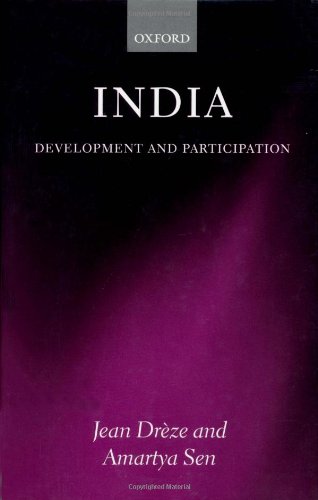
Synopsis
This book explores the role of public action in eliminating deprivation and expanding human freedoms in India. The analysis is based on a broad and integrated view of development, which focuses on well-being and freedom rather than the standard indicators of economic growth. The authors place human agency at the centre of stage, and stress the complementary roles of different institutions (economic, social, and political) in enhancing effective freedoms. In comparative international perspective, the Indian economy has done reasonably well in the period following the economic reforms initiated in the early 1990s. However, relatively high aggregate economic growth coexists with the persistence of endemic deprivation and deep social failures. Jean Dreze and Amartya Sen relate this imbalance to the continued neglect, in the post-reform period, of public involvement in crucial fields such as basic education, health care, social security, environmental protection, gender equity, and civil rights, and also to the imposition of new burdens such as the accelerated expansion of military expenditure.
Les informations fournies dans la section « Synopsis » peuvent faire référence à une autre édition de ce titre.
Présentation de l'éditeur
This book explores the role of public action in eliminating deprivation and expanding human freedoms in India. The analysis is based on a broad and integrated view of development, which focuses on well-being and freedom rather than the standard indicators of economic growth. The authors place human agency at the centre of stage, and stress the complementary roles of different institutions (economic, social, and political) in enhancing effective freedoms. In comparative international perspective, the Indian economy has done reasonably well in the period following the economic reforms initiated in the early nineties. However, relatively high aggregate economic growth coexists with the persistence of endemic deprivation and deep social failures. Jean Drèze and Amartya Sen relate this imbalance to the continued neglect, in the post-reform period, of public involvement in crucial fields such as basic education, health care, social security, environmental protection, gender equity, and civil rights, and also to the imposition of new burdens such as the accelerated expansion of military expenditure. Further, the authors link these distortions of public priorities with deep-seated inequalities of social influence and political power. The book discusses the possibility of addressing these biases through more active democratic practice.
Biographie de l'auteur
Jean Drèze is a Visiting Professor at the Delhi School of Economics and an international authority on development economics. His association with India goes back more than twenty years during which time he has studied the issues in India minutely and has authored many books, research papers, and newspaper articles on education, poverty, development, nuclear doctrine, freedom of information, and the Narmada Struggle.; Amartya Sen is the Master of Trinity College, Cambridge, and the winner of the 1998 Nobel Prize in Economic Science. He has been President of the Indian Economic Association, the American Economic Association, the International Economic Association, and the Econometric Society. He has taught at Calcutta, Delhi, Oxford, Cambridge, the London School of Economics, and Harvard.
Les informations fournies dans la section « A propos du livre » peuvent faire référence à une autre édition de ce titre.
Résultats de recherche pour India: Development and Participation

Image fournie par le vendeur
India: Development and Participation
Edité par
OUP Oxford, 2002
ISBN 10 : 0199257485
ISBN 13 : 9780199257485
Ancien ou d'occasion
Couverture rigide
Vendeur : WeBuyBooks, Rossendale, LANCS, Royaume-Uni
Évaluation du vendeur 5 sur 5 étoiles

hardcover. Etat : Good. Most items will be dispatched the same or the next working day. A copy that has been read but remains in clean condition. All of the pages are intact and the cover is intact and the spine may show signs of wear. The book may have minor markings which are not specifically mentioned. N° de réf. du vendeur rev8677572224
Acheter D'occasion
EUR 20,20
Expédition à EUR 8,95
Expédition depuis Royaume-Uni vers Etats-Unis
Expédition depuis Royaume-Uni vers Etats-Unis
Quantité disponible : 1 disponible(s)
Image d'archives
India: Development and Participation
Edité par
Oxford University Press, 2002
ISBN 10 : 0199257485
ISBN 13 : 9780199257485
Neuf
Couverture rigide
Vendeur : Nauka Japan LLC, Tokyo, Japon
Évaluation du vendeur 4 sur 5 étoiles

Hardcover. Etat : New. [oup3c 1363]. N° de réf. du vendeur NJ001363
Acheter neuf
EUR 73,80
Expédition à EUR 13,17
Expédition depuis Japon vers Etats-Unis
Expédition depuis Japon vers Etats-Unis
Quantité disponible : 1 disponible(s)