
Articles liés à Debating Procreation: Is It Wrong to Reproduce? (Debating...
Debating Procreation: Is It Wrong to Reproduce? (Debating Ethics) - Couverture souple
Livre 2 sur 13: Debating Ethics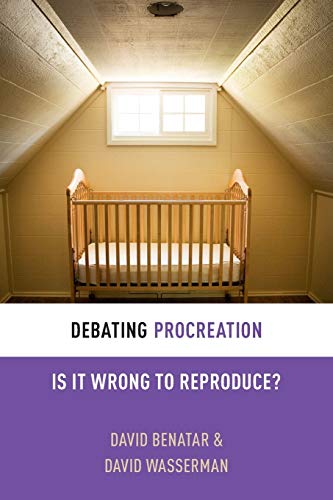
Synopsis
While procreation is ubiquitous, attention to the ethical issues involved in creating children is relatively rare. In Debating Procreation, David Benatar and David Wasserman take opposing views on this important question. David Benatar argues for the anti-natalist view that it is always wrong to bring new people into existence. He argues that coming into existence is always a serious harm and that even if it were not always so, the risk of serious harm is sufficiently great to make procreation wrong. In addition to these "philanthropic" arguments, he advances the "misanthropic" one that because humans are so defective and cause vast amounts of harm, it is wrong to create more of them.
David Wasserman defends procreation against the anti-natalist challenge. He outlines a variety of moderate pro-natalist positions, which all see procreation as often permissible but never required. After criticizing the main anti-natalist arguments, he reviews those pronatalist positions. He argues that constraints on procreation are best understood in terms of the role morality of prospective parents, considers different views of that role morality, and argues for one that imposes only limited constraints based on the well-being of the future child. He then argues that the expected good of a future child and of the parent-child relationship can provide a strong justification for procreation in the face of expected adversities without giving individuals any moral reason to procreateLes informations fournies dans la section « Synopsis » peuvent faire référence à une autre édition de ce titre.
À propos de l'auteur
David Benatar is Professor and Head of Philosophy at the University of Cape Town, South Africa. He is the author of Better Never to Have Been: The Harm of Coming into Existence (Oxford), and The Second Sexism: Discrimination Against Men and Boys (Wiley-Blackwell).
David Wasserman works at the Center for Bioethics at Yeshiva University and is a Visiting Scholar in the Department of Bioethics of the National Institutes of Health. He has written extensively on ethical issues in reproduction, disability, genetics, biotechnology, and neuroscience.Les informations fournies dans la section « A propos du livre » peuvent faire référence à une autre édition de ce titre.
Autres éditions populaires du même titre

Résultats de recherche pour Debating Procreation: Is It Wrong to Reproduce? (Debating...

Image d'archives
Debating Procreation: is it Wrong to Reproduce?
Edité par
Oxford University Press, NY, 2015
ISBN 10 : 0199333556
ISBN 13 : 9780199333554
Ancien ou d'occasion
Paperback
Vendeur : Daedalus Books, Portland, OR, Etats-Unis
Évaluation du vendeur 4 sur 5 étoiles

Paperback. Etat : Near Fine. A nice, solid copy. ; Debating Ethics; 8vo; 269 pages. N° de réf. du vendeur 322556
Acheter D'occasion
EUR 16,03
Expédition à EUR 5,63
Expédition nationale : Etats-Unis
Expédition nationale : Etats-Unis
Quantité disponible : 1 disponible(s)
Image d'archives
Debating Procreation: Is It Wrong to Reproduce?
Edité par
Oxford University Press, 2015
ISBN 10 : 0199333556
ISBN 13 : 9780199333554
Ancien ou d'occasion
Paperback
Vendeur : ThriftBooks-Atlanta, AUSTELL, GA, Etats-Unis
Évaluation du vendeur 5 sur 5 étoiles

Paperback. Etat : Very Good. No Jacket. May have limited writing in cover pages. Pages are unmarked. ~ ThriftBooks: Read More, Spend Less. N° de réf. du vendeur G0199333556I4N00
Acheter D'occasion
EUR 25,71
Livraison gratuite
Expédition nationale : Etats-Unis
Expédition nationale : Etats-Unis
Quantité disponible : 1 disponible(s)
Image d'archives
Debating Procreation Deb Eth P
impression à la demandeVendeur : PBShop.store US, Wood Dale, IL, Etats-Unis
Évaluation du vendeur 5 sur 5 étoiles
PAP. Etat : New. New Book. Shipped from UK. THIS BOOK IS PRINTED ON DEMAND. Established seller since 2000. N° de réf. du vendeur L0-9780199333554
Acheter neuf
EUR 34,66
Livraison gratuite
Expédition nationale : Etats-Unis
Expédition nationale : Etats-Unis
Quantité disponible : Plus de 20 disponibles
Image fournie par le vendeur
Debating Procreation
Edité par
Oxford University Press Inc, US, 2015
ISBN 10 : 0199333556
ISBN 13 : 9780199333554
Neuf
Paperback
Vendeur : Rarewaves.com USA, London, LONDO, Royaume-Uni
Évaluation du vendeur 5 sur 5 étoiles
Paperback. Etat : New. While procreation is ubiquitous, attention to the ethical issues involved in creating children is relatively rare. In Debating Procreation, David Benatar and David Wasserman take opposing views on this important question. David Benatar argues for the anti-natalist view that it is always wrong to bring new people into existence. He argues that coming into existence is always a serious harm and that even if it were not always so, the risk of serious harm is sufficiently great to make procreation wrong. In addition to these "philanthropic" arguments, he advances the "misanthropic" one that because humans are so defective and cause vast amounts of harm, it is wrong to create more of them.David Wasserman defends procreation against the anti-natalist challenge. He outlines a variety of moderate pro-natalist positions, which all see procreation as often permissible but never required. After criticizing the main anti-natalist arguments, he reviews those pronatalist positions. He argues that constraints on procreation are best understood in terms of the role morality of prospective parents, considers different views of that role morality, and argues for one that imposes only limited constraints based on the well-being of the future child. He then argues that the expected good of a future child and of the parent-child relationship can provide a strong justification for procreation in the face of expected adversities without giving individuals any moral reason to procreate. N° de réf. du vendeur LU-9780199333554
Acheter neuf
EUR 35,10
Livraison gratuite
Expédition depuis Royaume-Uni vers Etats-Unis
Expédition depuis Royaume-Uni vers Etats-Unis
Quantité disponible : Plus de 20 disponibles
Image d'archives
Debating Procreation: Is It Wrong to Reproduce? (Debating Ethics)
Edité par
Oxford University Press OUP, 2015
ISBN 10 : 0199333556
ISBN 13 : 9780199333554
Neuf
Couverture souple
Vendeur : Books Puddle, New York, NY, Etats-Unis
Évaluation du vendeur 4 sur 5 étoiles
Etat : New. pp. 280. N° de réf. du vendeur 26323936981
Acheter neuf
EUR 37,45
Expédition à EUR 3,46
Expédition nationale : Etats-Unis
Expédition nationale : Etats-Unis
Quantité disponible : 1 disponible(s)
Image d'archives
Debating Procreation: Is It Wrong to Reproduce? (Debating Ethics)
Edité par
Oxford University Press, 2015
ISBN 10 : 0199333556
ISBN 13 : 9780199333554
Neuf
Couverture souple
Vendeur : Majestic Books, Hounslow, Royaume-Uni
Évaluation du vendeur 4 sur 5 étoiles
Etat : New. pp. 280. N° de réf. du vendeur 322526474
Acheter neuf
EUR 33,87
Expédition à EUR 7,60
Expédition depuis Royaume-Uni vers Etats-Unis
Expédition depuis Royaume-Uni vers Etats-Unis
Quantité disponible : 1 disponible(s)
Image d'archives
Debating Procreation: Is It Wrong to Reproduce? (Debating Ethics)
Edité par
Oxford University Press, 2015
ISBN 10 : 0199333556
ISBN 13 : 9780199333554
Neuf
Couverture souple
Vendeur : Biblios, Frankfurt am main, HESSE, Allemagne
Évaluation du vendeur 4 sur 5 étoiles
Etat : New. pp. 280. N° de réf. du vendeur 18323936991
Acheter neuf
EUR 34,86
Expédition à EUR 9,95
Expédition depuis Allemagne vers Etats-Unis
Expédition depuis Allemagne vers Etats-Unis
Quantité disponible : 1 disponible(s)
Image d'archives
Debating Procreation: Is It Wrong to Reproduce? (Debating Ethics)
Edité par
Oxford University Press, 2015
ISBN 10 : 0199333556
ISBN 13 : 9780199333554
Neuf
Couverture souple
Vendeur : Ria Christie Collections, Uxbridge, Royaume-Uni
Évaluation du vendeur 5 sur 5 étoiles
Etat : New. In. N° de réf. du vendeur ria9780199333554_new
Acheter neuf
EUR 33,41
Expédition à EUR 14
Expédition depuis Royaume-Uni vers Etats-Unis
Expédition depuis Royaume-Uni vers Etats-Unis
Quantité disponible : Plus de 20 disponibles
Image fournie par le vendeur
Debating Procreation : Is It Wrong to Reproduce?
Edité par
Oxford University Press, 2015
ISBN 10 : 0199333556
ISBN 13 : 9780199333554
Neuf
Couverture souple
Vendeur : GreatBookPrices, Columbia, MD, Etats-Unis
Évaluation du vendeur 5 sur 5 étoiles
Etat : New. N° de réf. du vendeur 23089504-n
Acheter neuf
EUR 46,43
Expédition à EUR 2,29
Expédition nationale : Etats-Unis
Expédition nationale : Etats-Unis
Quantité disponible : Plus de 20 disponibles
Image d'archives
Debating Procreation: Is It Wrong to Reproduce? (eng)
Edité par
Oxford University Press, 2015
ISBN 10 : 0199333556
ISBN 13 : 9780199333554
Neuf
Couverture souple
Vendeur : Brook Bookstore On Demand, Napoli, NA, Italie
Évaluation du vendeur 5 sur 5 étoiles
Etat : new. Questo è un articolo print on demand. N° de réf. du vendeur 7462908f2fefae150c883dc83357040c
Acheter neuf
EUR 44,71
Expédition à EUR 5,50
Expédition depuis Italie vers Etats-Unis
Expédition depuis Italie vers Etats-Unis
Quantité disponible : Plus de 20 disponibles