
Articles liés à The Structure of Objects
Synopsis
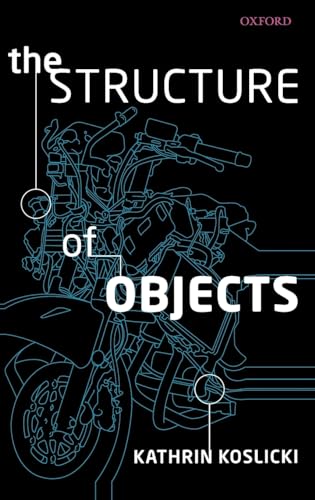
Kathrin Koslicki offers an analysis of ordinary materials objects, those material objects to which we take ourselves to be committed in ordinary, scientifically informed discourse. She focuses particularly on the question of how the parts of such objects are related to the wholes which they compose.
Many philosophers today find themselves in the grip of an exceedingly deflationary conception of what it means to be an object. According to this conception, any plurality of objects, no matter how disparate or gerrymandered, itself composes an object, even if the objects in question fail to exhibit interesting similarities, internal unity, cohesion, or causl interaction amongst each other.
This commitment to initially counterintuitive objects follows from the belief that no principled set of criteria is available by means of which to distinguish intuitively gerrymandered objects from commonsensical ones; the project of this book is to persuade the reader that systematic principles can be found by means of which composition can be restricted, and hence that we need not embrace this deflationary approach to the question of what it means to be an object.
To this end, a more full-blooded neo-Aristotelian account of parthood and composition is developed according to which objects are structured wholes: it is integral to the existence and identity of an object, on this conception, that its parts exhibit a certain manner of arrangement. This structure-based conception of parthood and composition is explored in detail, along with some of its historical precursors as well as some of its contemporary competitors.
Les informations fournies dans la section « Synopsis » peuvent faire référence à une autre édition de ce titre.
À propos de l'auteur
Kathrin Koslicki is Associate Professor of Philosophy at the University of Colorado, Boulder. Her interests are metaphysics, philosophy of language, and ancient Greek philosophy, particularly Aristotle.
Les informations fournies dans la section « A propos du livre » peuvent faire référence à une autre édition de ce titre.
Résultats de recherche pour The Structure of Objects

Image d'archives
The Structure of Objects
Edité par
Oxford University Press, Incorporated, 2008
ISBN 10 : 0199539898
ISBN 13 : 9780199539895
Ancien ou d'occasion
Couverture rigide
Vendeur : Better World Books, Mishawaka, IN, Etats-Unis
Évaluation du vendeur 5 sur 5 étoiles

Etat : Good. Former library copy. Pages intact with minimal writing/highlighting. The binding may be loose and creased. Dust jackets/supplements are not included. Includes library markings. Stock photo provided. Product includes identifying sticker. Better World Books: Buy Books. Do Good. N° de réf. du vendeur 40120158-75
Acheter D'occasion
EUR 60,39
Livraison gratuite
Expédition nationale : Etats-Unis
Expédition nationale : Etats-Unis
Quantité disponible : 1 disponible(s)
Image fournie par le vendeur
The Structure of Objects
Edité par
Oxford University Press, 2008
ISBN 10 : 0199539898
ISBN 13 : 9780199539895
Ancien ou d'occasion
Couverture rigide
Vendeur : Cycle Books LA, South el monte, CA, Etats-Unis
Évaluation du vendeur 5 sur 5 étoiles
Etat : very_good. N° de réf. du vendeur AMTV.0199539898.VG
Acheter D'occasion
EUR 107,32
Expédition à EUR 2,63
Expédition nationale : Etats-Unis
Expédition nationale : Etats-Unis
Quantité disponible : 1 disponible(s)
Image fournie par le vendeur
The Structure of Objects (Hardcover)
Edité par
Oxford University Press, Oxford, 2008
ISBN 10 : 0199539898
ISBN 13 : 9780199539895
Neuf
Couverture rigide
Vendeur : AussieBookSeller, Truganina, VIC, Australie
Évaluation du vendeur 5 sur 5 étoiles
Hardcover. Etat : new. Hardcover. Kathrin Koslicki offers an analysis of ordinary materials objects, those material objects to which we take ourselves to be committed in ordinary, scientifically informed discourse. She focuses particularly on the question of how the parts of such objects are related to the wholes which they compose.Many philosophers today find themselves in the grip of an exceedingly deflationary conception of what it means to be an object. According to thisconception, any plurality of objects, no matter how disparate or gerrymandered, itself composes an object, even if the objects in question fail to exhibit interesting similarities, internal unity,cohesion, or causl interaction amongst each other.This commitment to initially counterintuitive objects follows from the belief that no principled set of criteria is available by means of which to distinguish intuitively gerrymandered objects from commonsensical ones; the project of this book is to persuade the reader that systematic principles can be found by means of which composition can be restricted, and hence that we need not embrace this deflationary approach tothe question of what it means to be an object.To this end, a more full-blooded neo-Aristotelian account of parthood and composition is developed according to which objects arestructured wholes: it is integral to the existence and identity of an object, on this conception, that its parts exhibit a certain manner of arrangement. This structure-based conception of parthood and composition is explored in detail, along with some of its historical precursors as well as some of its contemporary competitors. Kathrin Koslicki offers an analysis of ordinary material objects, those material objects to which we take ourselves to be committed in ordinary, scientifically informed discourse. She focuses particularly on the question of how the parts of such objects are related to the wholes which they compose. This item is printed on demand. Shipping may be from our Sydney, NSW warehouse or from our UK or US warehouse, depending on stock availability. N° de réf. du vendeur 9780199539895
Acheter neuf
EUR 104,10
Expédition à EUR 32,54
Expédition depuis Australie vers Etats-Unis
Expédition depuis Australie vers Etats-Unis
Quantité disponible : 1 disponible(s)
Image d'archives
The Structure of Objects (eng)
Edité par
Oxford University Press, 2008
ISBN 10 : 0199539898
ISBN 13 : 9780199539895
Neuf
Couverture rigide
Vendeur : Brook Bookstore On Demand, Napoli, NA, Italie
Évaluation du vendeur 5 sur 5 étoiles
Etat : new. Questo è un articolo print on demand. N° de réf. du vendeur 3b17165797b547620dee30f0ac0c2ed5
Acheter neuf
EUR 174,43
Expédition à EUR 6,80
Expédition depuis Italie vers Etats-Unis
Expédition depuis Italie vers Etats-Unis
Quantité disponible : Plus de 20 disponibles
Image fournie par le vendeur
The Structure of Objects
Edité par
OUP Oxford Apr 2008, 2008
ISBN 10 : 0199539898
ISBN 13 : 9780199539895
Neuf
Couverture rigide
Vendeur : AHA-BUCH GmbH, Einbeck, Allemagne
Évaluation du vendeur 5 sur 5 étoiles
Buch. Etat : Neu. Neuware - Kathrin Koslicki offers an analysis of ordinary materials objects, those material objects to which we take ourselves to be committed in ordinary, scientifically informed discourse. She focuses particularly on the question of how the parts of such objects are related to the wholes which they compose.Many philosophers today find themselves in the grip of an exceedingly deflationary conception of what it means to be an object. According to this conception, any plurality of objects, no matter how disparate or gerrymandered, itself composes an object, even if the objects in question fail to exhibit interesting similarities, internal unity, cohesion, or causl interaction amongst each other.This commitment to initially counterintuitive objects follows from the belief that no principled set of criteria is available by means of which to distinguish intuitively gerrymandered objects from commonsensical ones; the project of this book is to persuade the reader that systematic principles can be found by means of which composition can be restricted, and hence that we need not embrace this deflationary approach to the question of what it means to be an object.To this end, a more full-blooded neo-Aristotelian account of parthood and composition is developed according to which objects are structured wholes: it is integral to the existence and identity of an object, on this conception, that its parts exhibit a certain manner of arrangement. This structure-based conception of parthood and composition is explored in detail, along with some of its historical precursors as well as some of its contemporary competitors. N° de réf. du vendeur 9780199539895
Acheter neuf
EUR 176,82
Expédition à EUR 35
Expédition depuis Allemagne vers Etats-Unis
Expédition depuis Allemagne vers Etats-Unis
Quantité disponible : 2 disponible(s)
Image d'archives
Structure of Objects
Edité par
Oxford University Press, 2008
ISBN 10 : 0199539898
ISBN 13 : 9780199539895
Neuf
Couverture rigide
Vendeur : GreatBookPricesUK, Woodford Green, Royaume-Uni
Évaluation du vendeur 5 sur 5 étoiles
Etat : New. N° de réf. du vendeur 5629300-n
Acheter neuf
EUR 204,04
Expédition à EUR 17,48
Expédition depuis Royaume-Uni vers Etats-Unis
Expédition depuis Royaume-Uni vers Etats-Unis
Quantité disponible : Plus de 20 disponibles
Image fournie par le vendeur
Structure of Objects
Edité par
Oxford University Press, 2008
ISBN 10 : 0199539898
ISBN 13 : 9780199539895
Neuf
Couverture rigide
Vendeur : GreatBookPrices, Columbia, MD, Etats-Unis
Évaluation du vendeur 5 sur 5 étoiles
Etat : New. N° de réf. du vendeur 5629300-n
Acheter neuf
EUR 221,37
Expédition à EUR 2,32
Expédition nationale : Etats-Unis
Expédition nationale : Etats-Unis
Quantité disponible : Plus de 20 disponibles
Image d'archives
The Structure of Objects
impression à la demandeVendeur : PBShop.store UK, Fairford, GLOS, Royaume-Uni
Évaluation du vendeur 5 sur 5 étoiles
HRD. Etat : New. New Book. Delivered from our UK warehouse in 4 to 14 business days. THIS BOOK IS PRINTED ON DEMAND. Established seller since 2000. N° de réf. du vendeur L1-9780199539895
Acheter neuf
EUR 224,03
Expédition à EUR 5,85
Expédition depuis Royaume-Uni vers Etats-Unis
Expédition depuis Royaume-Uni vers Etats-Unis
Quantité disponible : Plus de 20 disponibles
Image fournie par le vendeur
The Structure of Objects (Hardcover)
Edité par
Oxford University Press, Oxford, 2008
ISBN 10 : 0199539898
ISBN 13 : 9780199539895
Neuf
Couverture rigide
Vendeur : Grand Eagle Retail, Bensenville, IL, Etats-Unis
Évaluation du vendeur 5 sur 5 étoiles
Hardcover. Etat : new. Hardcover. Kathrin Koslicki offers an analysis of ordinary materials objects, those material objects to which we take ourselves to be committed in ordinary, scientifically informed discourse. She focuses particularly on the question of how the parts of such objects are related to the wholes which they compose.Many philosophers today find themselves in the grip of an exceedingly deflationary conception of what it means to be an object. According to thisconception, any plurality of objects, no matter how disparate or gerrymandered, itself composes an object, even if the objects in question fail to exhibit interesting similarities, internal unity,cohesion, or causl interaction amongst each other.This commitment to initially counterintuitive objects follows from the belief that no principled set of criteria is available by means of which to distinguish intuitively gerrymandered objects from commonsensical ones; the project of this book is to persuade the reader that systematic principles can be found by means of which composition can be restricted, and hence that we need not embrace this deflationary approach tothe question of what it means to be an object.To this end, a more full-blooded neo-Aristotelian account of parthood and composition is developed according to which objects arestructured wholes: it is integral to the existence and identity of an object, on this conception, that its parts exhibit a certain manner of arrangement. This structure-based conception of parthood and composition is explored in detail, along with some of its historical precursors as well as some of its contemporary competitors. Kathrin Koslicki offers an analysis of ordinary material objects, those material objects to which we take ourselves to be committed in ordinary, scientifically informed discourse. She focuses particularly on the question of how the parts of such objects are related to the wholes which they compose. This item is printed on demand. Shipping may be from multiple locations in the US or from the UK, depending on stock availability. N° de réf. du vendeur 9780199539895
Acheter neuf
EUR 232,79
Livraison gratuite
Expédition nationale : Etats-Unis
Expédition nationale : Etats-Unis
Quantité disponible : 1 disponible(s)
Image d'archives
The Structure of Objects
Vendeur : Revaluation Books, Exeter, Royaume-Uni
Évaluation du vendeur 5 sur 5 étoiles
Hardcover. Etat : Brand New. 1st edition. 320 pages. 9.25x6.25x0.75 inches. In Stock. N° de réf. du vendeur x-0199539898
Acheter neuf
EUR 238,48
Expédition à EUR 14,57
Expédition depuis Royaume-Uni vers Etats-Unis
Expédition depuis Royaume-Uni vers Etats-Unis
Quantité disponible : 2 disponible(s)