
Articles liés à Global Economic History: A Very Short Introduction
Global Economic History: A Very Short Introduction - Couverture souple
Livre 88 sur 405: Very Short Introductions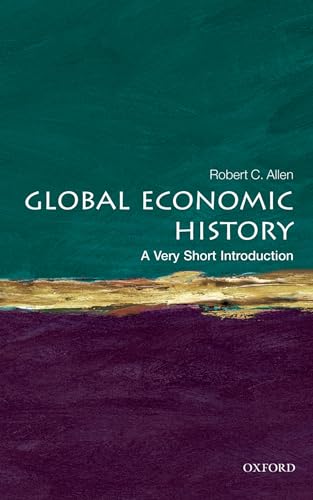
Synopsis
Why are some countries rich and others poor? In 1500, the income differences were small, but they have grown dramatically since Columbus reached America. Since then, the interplay between geography, globalization, technological change, and economic policy has determined the wealth and poverty of nations. The industrial revolution was Britain's path breaking response to the challenge of globalization. Western Europe and North America joined Britain to form a club of rich nations by pursuing four polices-creating a national market by abolishing internal tariffs and investing in transportation, erecting an external tariff to protect their fledgling industries from British competition, banks to stabilize the currency and mobilize domestic savings for investment, and mass education to prepare people for industrial work.
Together these countries pioneered new technologies that have made them ever richer. Before the Industrial Revolution, most of the world's manufacturing was done in Asia, but industries from Casablanca to Canton were destroyed by western competition in the nineteenth century, and Asia was transformed into 'underdeveloped countries' specializing in agriculture. The spread of economic development has been slow since modern technology was invented to fit the needs of rich countries and is ill adapted to the economic and geographical conditions of poor countries. A few countries - Japan, Soviet Russia, South Korea, Taiwan, and perhaps China - have, nonetheless, caught up with the West through creative responses to the technological challenge and with Big Push industrialization that has achieved rapid growth through investment coordination. Whether other countries can emulate the success of East Asia is a challenge for the future.
ABOUT THE SERIES: The Very Short Introductions series from Oxford University Press contains hundreds of titles in almost every subject area. These pocket-sized books are the perfect way to get ahead in a new subject quickly. Our expert authors combine facts, analysis, perspective, new ideas, and enthusiasm to make interesting and challenging topics highly readable.
Les informations fournies dans la section « Synopsis » peuvent faire référence à une autre édition de ce titre.
À propos de l'auteur
Robert C. Allen is Professor of Economic History at Oxford Univeristy and a Fellow of Nuffield College. He has written on English agricultural history, international competition in the steel industry, the extinction of whales, andt he contemporary policies on education. His articles have won the Cole Prize, the Redlich Prize, and the Explorations Prize. His previous books include Enclosure and the Yeoman: The Agricultural Development of the South Midlands, 1450-1850 (2009), and Farm to Factory: A Re-interpretation of the Soviet Industrial Revolution (2003), both of which won the Ranki Prize of the Economic History Association.He is currently studying the global history of wages and prices and pre-industrial living standards around the world. He is a Fellow of the British Academy and the Royal Society of Canada.
Les informations fournies dans la section « A propos du livre » peuvent faire référence à une autre édition de ce titre.
Résultats de recherche pour Global Economic History: A Very Short Introduction

Image d'archives
Global Economic History: A Very Short Introduction
Edité par
Oxford University Press, 2011
ISBN 10 : 0199596654
ISBN 13 : 9780199596652
Ancien ou d'occasion
Couverture souple
Vendeur : World of Books (was SecondSale), Montgomery, IL, Etats-Unis
Évaluation du vendeur 5 sur 5 étoiles

Etat : Good. Item in good condition and has highlighting/writing on text. Used texts may not contain supplemental items such as CDs, info-trac etc. N° de réf. du vendeur 00106634132
Acheter D'occasion
EUR 3,98
Livraison gratuite
Expédition nationale : Etats-Unis
Expédition nationale : Etats-Unis
Quantité disponible : 1 disponible(s)
Image d'archives
Global Economic History: A Very Short Introduction
Edité par
Oxford University Press, 2011
ISBN 10 : 0199596654
ISBN 13 : 9780199596652
Ancien ou d'occasion
Couverture souple
Vendeur : World of Books (was SecondSale), Montgomery, IL, Etats-Unis
Évaluation du vendeur 5 sur 5 étoiles
Etat : Good. Good condition ex-library book with usual library markings and stickers. N° de réf. du vendeur 00108809752
Acheter D'occasion
EUR 4,33
Livraison gratuite
Expédition nationale : Etats-Unis
Expédition nationale : Etats-Unis
Quantité disponible : 1 disponible(s)
Image d'archives
Global Economic History: A Very Short Introduction
Edité par
Oxford University Press, 2011
ISBN 10 : 0199596654
ISBN 13 : 9780199596652
Ancien ou d'occasion
Couverture souple
Vendeur : World of Books (was SecondSale), Montgomery, IL, Etats-Unis
Évaluation du vendeur 5 sur 5 étoiles
Etat : Acceptable. Item in acceptable condition! Textbooks may not include supplemental items i.e. CDs, access codes etc. N° de réf. du vendeur 00109044799
Acheter D'occasion
EUR 4,33
Livraison gratuite
Expédition nationale : Etats-Unis
Expédition nationale : Etats-Unis
Quantité disponible : 1 disponible(s)
Image fournie par le vendeur
Global Economic History: A Very Short Introduction
Edité par
Oxford University Press, 2011
ISBN 10 : 0199596654
ISBN 13 : 9780199596652
Ancien ou d'occasion
Couverture souple
Vendeur : Zoom Books Company, Lynden, WA, Etats-Unis
Évaluation du vendeur 5 sur 5 étoiles
Etat : very_good. Book is in very good condition and may include minimal underlining highlighting. The book can also include "From the library of" labels. May not contain miscellaneous items toys, dvds, etc. . We offer 100% money back guarantee and 24 7 customer service. N° de réf. du vendeur ZBV.0199596654.VG
Acheter D'occasion
EUR 4,96
Livraison gratuite
Expédition nationale : Etats-Unis
Expédition nationale : Etats-Unis
Quantité disponible : 1 disponible(s)
Image fournie par le vendeur
Global Economic History: A Very Short Introduction
Edité par
Oxford University Press, 2011
ISBN 10 : 0199596654
ISBN 13 : 9780199596652
Ancien ou d'occasion
Couverture souple
Vendeur : Greenworld Books, Arlington, TX, Etats-Unis
Évaluation du vendeur 5 sur 5 étoiles
Etat : very_good. Fast Free Shipping â" Very Good condition book with a firm cover and clean pages. Shows normal use and some light wear or limited notes markings. A solid, nice copy to enjoy. N° de réf. du vendeur GWV.0199596654.VG
Acheter D'occasion
EUR 5,22
Livraison gratuite
Expédition nationale : Etats-Unis
Expédition nationale : Etats-Unis
Quantité disponible : 1 disponible(s)
Image fournie par le vendeur
Global Economic History: A Very Short Introduction
Edité par
Oxford University Press, 2011
ISBN 10 : 0199596654
ISBN 13 : 9780199596652
Ancien ou d'occasion
Couverture souple
Vendeur : Goodwill Books, Hillsboro, OR, Etats-Unis
Évaluation du vendeur 5 sur 5 étoiles
Etat : acceptable. Fairly worn, but readable and intact. If applicable: Dust jacket, disc or access code may not be included. N° de réf. du vendeur GICWV.0199596654.A
Acheter D'occasion
EUR 2,74
Expédition à EUR 3,44
Expédition nationale : Etats-Unis
Expédition nationale : Etats-Unis
Quantité disponible : 1 disponible(s)
Image d'archives
Global Economic History: A Very Short Introduction
Edité par
Oxford University Press, 2011
ISBN 10 : 0199596654
ISBN 13 : 9780199596652
Ancien ou d'occasion
Paperback
Vendeur : ThriftBooks-Dallas, Dallas, TX, Etats-Unis
Évaluation du vendeur 5 sur 5 étoiles
Paperback. Etat : Very Good. No Jacket. May have limited writing in cover pages. Pages are unmarked. ~ ThriftBooks: Read More, Spend Less. N° de réf. du vendeur G0199596654I4N00
Acheter D'occasion
EUR 6,23
Livraison gratuite
Expédition nationale : Etats-Unis
Expédition nationale : Etats-Unis
Quantité disponible : 1 disponible(s)
Image d'archives
Global Economic History: A Very Short Introduction
Edité par
Oxford University Press, 2011
ISBN 10 : 0199596654
ISBN 13 : 9780199596652
Ancien ou d'occasion
Paperback
Vendeur : ThriftBooks-Phoenix, Phoenix, AZ, Etats-Unis
Évaluation du vendeur 5 sur 5 étoiles
Paperback. Etat : Very Good. No Jacket. May have limited writing in cover pages. Pages are unmarked. ~ ThriftBooks: Read More, Spend Less. N° de réf. du vendeur G0199596654I4N00
Acheter D'occasion
EUR 6,23
Livraison gratuite
Expédition nationale : Etats-Unis
Expédition nationale : Etats-Unis
Quantité disponible : 1 disponible(s)
Image d'archives
Global Economic History: A Very Short Introduction
Edité par
Oxford University Press, 2011
ISBN 10 : 0199596654
ISBN 13 : 9780199596652
Ancien ou d'occasion
Paperback
Vendeur : ThriftBooks-Dallas, Dallas, TX, Etats-Unis
Évaluation du vendeur 5 sur 5 étoiles
Paperback. Etat : Fair. No Jacket. Readable copy. Pages may have considerable notes/highlighting. ~ ThriftBooks: Read More, Spend Less. N° de réf. du vendeur G0199596654I5N00
Acheter D'occasion
EUR 6,23
Livraison gratuite
Expédition nationale : Etats-Unis
Expédition nationale : Etats-Unis
Quantité disponible : 1 disponible(s)
Image d'archives
Global Economic History : A Very Short Introduction
Edité par
Oxford University Press, Incorporated, 2011
ISBN 10 : 0199596654
ISBN 13 : 9780199596652
Ancien ou d'occasion
Couverture souple
Vendeur : Better World Books: West, Reno, NV, Etats-Unis
Évaluation du vendeur 5 sur 5 étoiles
Etat : Good. Pages intact with minimal writing/highlighting. The binding may be loose and creased. Dust jackets/supplements are not included. Stock photo provided. Product includes identifying sticker. Better World Books: Buy Books. Do Good. N° de réf. du vendeur 18017662-6
Acheter D'occasion
EUR 6,35
Livraison gratuite
Expédition nationale : Etats-Unis
Expédition nationale : Etats-Unis
Quantité disponible : 1 disponible(s)