
Articles liés à Beyond GDP: Measuring Welfare and Assessing Sustainability
Synopsis
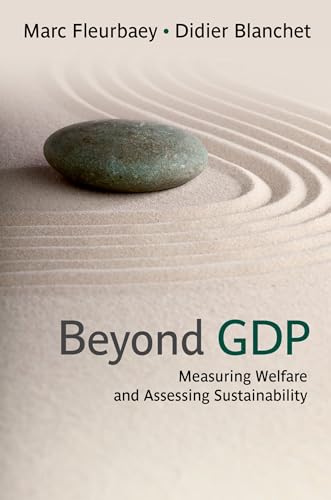
In spite of recurrent criticism and an impressive production of alternative indicators by scholars and NGOs, GDP remains the central indicator of countries' success. This book revisits the foundations of indicators of social welfare, and critically examines the four main alternatives to GDP that have been proposed: composite indicators, subjective well-being indexes, capabilities (the underlying philosophy of the Human Development Index), and equivalent incomes.
Its provocative thesis is that the problem with GDP is not that it uses a monetary metric but that it focuses on a narrow set of aspects of individual lives. It is actually possible to build an alternative, more comprehensive, monetary indicator that takes income as its first benchmark and adds or subtracts corrections that represent the benefit or cost of non-market aspects of individual lives. Such a measure can respect the values and preferences of the people and give as much weight as they do to the non-market dimensions.
A further provocative idea is that, in contrast, most of the currently available alternative indicators, including subjective well-being indexes, are not as respectful of people's values because, like GDP, they are too narrow and give specific weights to the various dimensions of life in a more uniform way, without taking account of the diversity of views on life in the population. The popular attraction that such alternative indicators derive from being non-monetary is therefore based on equivocation.
Moreover, it is argued in this book that "greening" GDP and relative indicators is not the proper way to incorporate sustainability concerns. Sustainability involves predicting possible future paths, therefore different indicators than those assessing the current situation. While various indicators have been popular (adjusted net savings, ecological footprint), none of them involves the necessary forecasting effort that a proper evaluation of possible futures requires.
Les informations fournies dans la section « Synopsis » peuvent faire référence à une autre édition de ce titre.
À propos de l'auteur
Marc Fleurbaey is the Robert E. Kuenne Professor of Economics and Humanistic Studies, Professor of Public Affairs and the University Center for Human Values
Les informations fournies dans la section « A propos du livre » peuvent faire référence à une autre édition de ce titre.
Résultats de recherche pour Beyond GDP: Measuring Welfare and Assessing Sustainability

Image fournie par le vendeur
Beyond GDP: Measuring Welfare and Assessing Sustainability
Edité par
OUP USA, 2013
ISBN 10 : 019976719X
ISBN 13 : 9780199767199
Ancien ou d'occasion
Couverture rigide
Vendeur : WeBuyBooks, Rossendale, LANCS, Royaume-Uni
Évaluation du vendeur 5 sur 5 étoiles

hardcover. Etat : Like New. Most items will be dispatched the same or the next working day. An apparently unread copy in perfect condition. Dust cover is intact with no nicks or tears. Spine has no signs of creasing. Pages are clean and not marred by notes or folds of any kind. N° de réf. du vendeur rev2186247498
Acheter D'occasion
EUR 65,33
Expédition à EUR 8,71
Expédition depuis Royaume-Uni vers Etats-Unis
Expédition depuis Royaume-Uni vers Etats-Unis
Quantité disponible : 1 disponible(s)
Image fournie par le vendeur
Beyond GDP: Measuring Welfare and Assessing Sustainability
Edité par
Oxford University Press, 2013
ISBN 10 : 019976719X
ISBN 13 : 9780199767199
Ancien ou d'occasion
Couverture rigide
Vendeur : Buchkanzlei, Bremen, Allemagne
Évaluation du vendeur 5 sur 5 étoiles
Hardcover. Etat : Gut. 324 pp. Very well preserved copy 375 Sprache: Englisch Gewicht in Gramm: 585. N° de réf. du vendeur 39934
Acheter D'occasion
EUR 56,40
Expédition à EUR 33
Expédition depuis Allemagne vers Etats-Unis
Expédition depuis Allemagne vers Etats-Unis
Quantité disponible : 1 disponible(s)
Image d'archives
Beyond GDP (Hardcover)
Edité par
Oxford University Press Inc, New York, 2013
ISBN 10 : 019976719X
ISBN 13 : 9780199767199
Neuf
Couverture rigide
Vendeur : AussieBookSeller, Truganina, VIC, Australie
Évaluation du vendeur 5 sur 5 étoiles
Hardcover. Etat : new. Hardcover. In spite of recurrent criticism and an impressive production of alternative indicators by scholars and NGOs, GDP remains the central indicator of countries' success. This book revisits the foundations of indicators of social welfare, and critically examines the four main alternatives to GDP that have been proposed: composite indicators, subjective well-being indexes, capabilities (the underlying philosophy of the Human Development Index), and equivalent incomes.Its provocative thesis is that the problem with GDP is not that it uses a monetary metric but that it focuses on a narrow set of aspects of individual lives. It is actually possible to build analternative, more comprehensive, monetary indicator that takes income as its first benchmark and adds or subtracts corrections that represent the benefit or cost of non-market aspects of individual lives. Such a measure can respect the values and preferences of the people and give as much weight as they do to the non-market dimensions.A further provocative idea is that, in contrast, most of the currently available alternative indicators, including subjective well-being indexes,are not as respectful of people's values because, like GDP, they are too narrow and give specific weights to the various dimensions of life in a more uniform way, without taking account of thediversity of views on life in the population. The popular attraction that such alternative indicators derive from being non-monetary is therefore based on equivocation.Moreover, it is argued in this book that "greening" GDP and relative indicators is not the proper way to incorporate sustainability concerns. Sustainability involves predicting possible future paths, therefore different indicators than those assessing the current situation. While various indicators have beenpopular (adjusted net savings, ecological footprint), none of them involves the necessary forecasting effort that a proper evaluation of possible futures requires. Is GDP a good proxy for social welfare? Building on economic theory, this book confirms that it is not, but also that most alternatives to it share its basic flaw, i.e., a focus on specific aspects of people's lives without sufficiently taking account of people's values and goals. A better approach is possible. This item is printed on demand. Shipping may be from our Sydney, NSW warehouse or from our UK or US warehouse, depending on stock availability. N° de réf. du vendeur 9780199767199
Acheter neuf
EUR 79,40
Expédition à EUR 32,89
Expédition depuis Australie vers Etats-Unis
Expédition depuis Australie vers Etats-Unis
Quantité disponible : 1 disponible(s)
Image d'archives
Beyond GDP: Measuring Welfare and Assessing Sustainability (eng)
Edité par
Oxford University Press, 2013
ISBN 10 : 019976719X
ISBN 13 : 9780199767199
Neuf
Couverture rigide
Vendeur : Brook Bookstore On Demand, Napoli, NA, Italie
Évaluation du vendeur 5 sur 5 étoiles
Etat : new. Questo è un articolo print on demand. N° de réf. du vendeur 1ddd24443b5db8c2dde83a9efc5d9898
Acheter neuf
EUR 106,74
Expédition à EUR 6,80
Expédition depuis Italie vers Etats-Unis
Expédition depuis Italie vers Etats-Unis
Quantité disponible : Plus de 20 disponibles
Image fournie par le vendeur
Beyond GDP : Measuring Welfare and Assessing Sustainability
Edité par
Oxford University Press, 2013
ISBN 10 : 019976719X
ISBN 13 : 9780199767199
Neuf
Couverture rigide
Vendeur : GreatBookPrices, Columbia, MD, Etats-Unis
Évaluation du vendeur 5 sur 5 étoiles
Etat : New. N° de réf. du vendeur 19139568-n
Acheter neuf
EUR 113,24
Expédition à EUR 2,35
Expédition nationale : Etats-Unis
Expédition nationale : Etats-Unis
Quantité disponible : Plus de 20 disponibles
Image fournie par le vendeur
Beyond GDP : Measuring Welfare and Assessing Sustainability
Edité par
Oxford University Press, 2013
ISBN 10 : 019976719X
ISBN 13 : 9780199767199
Ancien ou d'occasion
Couverture rigide
Vendeur : GreatBookPrices, Columbia, MD, Etats-Unis
Évaluation du vendeur 5 sur 5 étoiles
Etat : As New. Unread book in perfect condition. N° de réf. du vendeur 19139568
Acheter D'occasion
EUR 129,58
Expédition à EUR 2,35
Expédition nationale : Etats-Unis
Expédition nationale : Etats-Unis
Quantité disponible : Plus de 20 disponibles
Image d'archives
Beyond GDP : Measuring Welfare and Assessing Sustainability
Edité par
Oxford University Press, 2013
ISBN 10 : 019976719X
ISBN 13 : 9780199767199
Neuf
Couverture rigide
Vendeur : GreatBookPricesUK, Woodford Green, Royaume-Uni
Évaluation du vendeur 5 sur 5 étoiles
Etat : New. N° de réf. du vendeur 19139568-n
Acheter neuf
EUR 115,65
Expédition à EUR 17,60
Expédition depuis Royaume-Uni vers Etats-Unis
Expédition depuis Royaume-Uni vers Etats-Unis
Quantité disponible : Plus de 20 disponibles
Image fournie par le vendeur
Beyond GDP (Hardcover)
Edité par
Oxford University Press Inc, New York, 2013
ISBN 10 : 019976719X
ISBN 13 : 9780199767199
Neuf
Couverture rigide
Vendeur : Grand Eagle Retail, Bensenville, IL, Etats-Unis
Évaluation du vendeur 5 sur 5 étoiles
Hardcover. Etat : new. Hardcover. In spite of recurrent criticism and an impressive production of alternative indicators by scholars and NGOs, GDP remains the central indicator of countries' success. This book revisits the foundations of indicators of social welfare, and critically examines the four main alternatives to GDP that have been proposed: composite indicators, subjective well-being indexes, capabilities (the underlying philosophy of the Human Development Index), and equivalent incomes.Its provocative thesis is that the problem with GDP is not that it uses a monetary metric but that it focuses on a narrow set of aspects of individual lives. It is actually possible to build analternative, more comprehensive, monetary indicator that takes income as its first benchmark and adds or subtracts corrections that represent the benefit or cost of non-market aspects of individual lives. Such a measure can respect the values and preferences of the people and give as much weight as they do to the non-market dimensions.A further provocative idea is that, in contrast, most of the currently available alternative indicators, including subjective well-being indexes,are not as respectful of people's values because, like GDP, they are too narrow and give specific weights to the various dimensions of life in a more uniform way, without taking account of thediversity of views on life in the population. The popular attraction that such alternative indicators derive from being non-monetary is therefore based on equivocation.Moreover, it is argued in this book that "greening" GDP and relative indicators is not the proper way to incorporate sustainability concerns. Sustainability involves predicting possible future paths, therefore different indicators than those assessing the current situation. While various indicators have beenpopular (adjusted net savings, ecological footprint), none of them involves the necessary forecasting effort that a proper evaluation of possible futures requires. Is GDP a good proxy for social welfare? Building on economic theory, this book confirms that it is not, but also that most alternatives to it share its basic flaw, i.e., a focus on specific aspects of people's lives without sufficiently taking account of people's values and goals. A better approach is possible. This item is printed on demand. Shipping may be from multiple locations in the US or from the UK, depending on stock availability. N° de réf. du vendeur 9780199767199
Acheter neuf
EUR 135,50
Livraison gratuite
Expédition nationale : Etats-Unis
Expédition nationale : Etats-Unis
Quantité disponible : 1 disponible(s)
Image d'archives
Beyond GDP
Edité par
Oxford University Press, 2013
ISBN 10 : 019976719X
ISBN 13 : 9780199767199
Neuf
Couverture rigide
Vendeur : PBShop.store UK, Fairford, GLOS, Royaume-Uni
Évaluation du vendeur 5 sur 5 étoiles
HRD. Etat : New. New Book. Delivered from our UK warehouse in 4 to 14 business days. THIS BOOK IS PRINTED ON DEMAND. Established seller since 2000. N° de réf. du vendeur L1-9780199767199
Acheter neuf
EUR 136
Expédition à EUR 5,89
Expédition depuis Royaume-Uni vers Etats-Unis
Expédition depuis Royaume-Uni vers Etats-Unis
Quantité disponible : Plus de 20 disponibles
Image d'archives
Beyond GDP
Edité par
Oxford University Press, 2013
ISBN 10 : 019976719X
ISBN 13 : 9780199767199
Neuf
Couverture rigide
Vendeur : PBShop.store US, Wood Dale, IL, Etats-Unis
Évaluation du vendeur 5 sur 5 étoiles
HRD. Etat : New. New Book. Shipped from UK. THIS BOOK IS PRINTED ON DEMAND. Established seller since 2000. N° de réf. du vendeur L1-9780199767199
Acheter neuf
EUR 143,29
Livraison gratuite
Expédition nationale : Etats-Unis
Expédition nationale : Etats-Unis
Quantité disponible : Plus de 20 disponibles