
Articles liés à Unruly Words: A Study of Vague Language
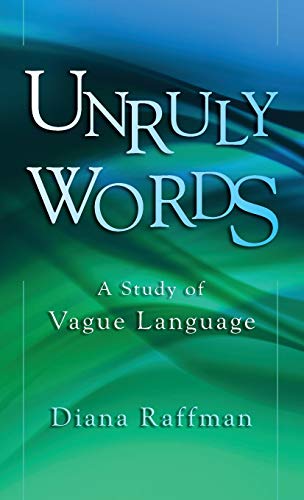
Synopsis
Vague words, like "tall," "rich," and "old," lack clear boundaries of application: no clear line divides the tall people from the above average, or the old people from the middle-aged. Because they lack clear boundaries, these ordinary words cause logical and semantic problems in various disciplines including philosophy, decision theory, and the law. Philosophers and linguists have proposed several theories of vagueness to handle these difficulties, but none has been widely accepted.
Raffman contends that virtually all previous treatments of vagueness have made two crucial mistakes: they have supposed that a semantic (non-epistemic) theory must abandon bivalence, and they have paid insufficient attention to the character of ordinary speech using vague words. She develops a new theory of vagueness-the multiple range theory-that corrects both of these errors. The new theory begins with the observation that ordinary speakers seem to apply vague words in multiple arbitrarily different but equally competent ways, even when all contextual factors are held fixed. Raffman interprets this feature of their use as evidence of multiple ranges of application in the semantics of vague words, where a range of application is a range of properties whose instances satisfy the word in question; for example, a range of application of "tall" is a range of heights, a range of "old" a range of ages, and so forth. The fundamental idea is that a vague word has multiple ranges of application, and applies to things relative to those ranges, even given a single fixed context. The fact that the ranges of a vague word are arbitrarily different-there is no reason to favor any particular one-is key to solving the notorious sorites paradox.
The multiple range theory preserves bivalence and is more intuitive than other approaches. It is also simpler; for instance, it has no need of a definiteness operator, and it rules out the possibility of higher-order borderline cases, both of which introduce severe complications into other accounts. Some of the evidence Raffman draws upon in constructing her theory comes from a new psychological study of the way ordinary speakers actually use vague words.
Les informations fournies dans la section « Synopsis » peuvent faire référence à une autre édition de ce titre.
À propos de l'auteur
Diana Raffman is a professor of philosophy at the University of Toronto. She has published a number of papers in the philosophy of mind, primarily about consciousness and perception, in the philosophy of language, primarily about vagueness, and in the philosophy of art, primarily about music. She is currently writing a series of papers about the role of vagueness in legal language.
Les informations fournies dans la section « A propos du livre » peuvent faire référence à une autre édition de ce titre.
Résultats de recherche pour Unruly Words: A Study of Vague Language

Image d'archives
Unruly Words: A Study of Vague Language
Edité par
Oxford University Press, 2014
ISBN 10 : 0199915105
ISBN 13 : 9780199915101
Ancien ou d'occasion
Couverture rigide
Vendeur : Mesquite Booksellers, Tucson, AZ, Etats-Unis
Évaluation du vendeur 5 sur 5 étoiles

Hardcover. Etat : Very Good. Etat de la jaquette : Fine. xvi,215. Rear board is slightly bowed. A couple little smudges at the top edge of the text block. Negligible ordinary shelfwear to the jacket. Otherwise pristine/as new. Bound in light blue paper, with stamped silver lettering to the spine. If you order this from outside the United States, we will almost certainly request an additional payment to help cover the postage. Please feel welcome to message us with any questions, or a request for photographs. Every order includes tracking and is wrapped and robustly packaged with care in Tucson, AZ. ~Mesquite Booksellers. N° de réf. du vendeur 75646
Acheter D'occasion
EUR 35,99
Expédition à EUR 2,62
Expédition nationale : Etats-Unis
Expédition nationale : Etats-Unis
Quantité disponible : 1 disponible(s)
Image d'archives
Unruly Words: A Study of Vague Language
Vendeur : Kennys Bookshop and Art Galleries Ltd., Galway, GY, Irlande
Évaluation du vendeur 5 sur 5 étoiles
Etat : New. Num Pages: 240 pages, Illustrations. BIC Classification: CFA; CFG; HPK; HPM. Category: (G) General (US: Trade). Dimension: 214 x 149 x 23. Weight in Grams: 402. . 2014. Illustrated. hardcover. . . . . N° de réf. du vendeur V9780199915101
Acheter neuf
EUR 69,74
Expédition à EUR 9,50
Expédition depuis Irlande vers Etats-Unis
Expédition depuis Irlande vers Etats-Unis
Quantité disponible : Plus de 20 disponibles
Image d'archives
Unruly Words: A Study of Vague Language (eng)
impression à la demandeVendeur : Brook Bookstore On Demand, Napoli, NA, Italie
Évaluation du vendeur 5 sur 5 étoiles
Etat : new. Questo è un articolo print on demand. N° de réf. du vendeur 1a9eae8a92f90c8e162fd7e075cc426c
Acheter neuf
EUR 74,72
Expédition à EUR 6,80
Expédition depuis Italie vers Etats-Unis
Expédition depuis Italie vers Etats-Unis
Quantité disponible : Plus de 20 disponibles
Image d'archives
Unruly Words : A Study of Vague Language
Edité par
Oxford University Press, 2014
ISBN 10 : 0199915105
ISBN 13 : 9780199915101
Neuf
Couverture rigide
Vendeur : GreatBookPrices, Columbia, MD, Etats-Unis
Évaluation du vendeur 5 sur 5 étoiles
Etat : New. N° de réf. du vendeur 19852217-n
Acheter neuf
EUR 81,39
Expédition à EUR 2,31
Expédition nationale : Etats-Unis
Expédition nationale : Etats-Unis
Quantité disponible : Plus de 20 disponibles
Image fournie par le vendeur
Unruly Words : A Study of Vague Language
Edité par
Oxford University Press, 2014
ISBN 10 : 0199915105
ISBN 13 : 9780199915101
Ancien ou d'occasion
Couverture rigide
Vendeur : GreatBookPrices, Columbia, MD, Etats-Unis
Évaluation du vendeur 5 sur 5 étoiles
Etat : As New. Unread book in perfect condition. N° de réf. du vendeur 19852217
Acheter D'occasion
EUR 85,44
Expédition à EUR 2,31
Expédition nationale : Etats-Unis
Expédition nationale : Etats-Unis
Quantité disponible : Plus de 20 disponibles
Image d'archives
Unruly Words: A Study of Vague Language
Vendeur : Kennys Bookstore, Olney, MD, Etats-Unis
Évaluation du vendeur 5 sur 5 étoiles
Etat : New. Num Pages: 240 pages, Illustrations. BIC Classification: CFA; CFG; HPK; HPM. Category: (G) General (US: Trade). Dimension: 214 x 149 x 23. Weight in Grams: 402. . 2014. Illustrated. hardcover. . . . . Books ship from the US and Ireland. N° de réf. du vendeur V9780199915101
Acheter neuf
EUR 87,73
Expédition à EUR 9,17
Expédition nationale : Etats-Unis
Expédition nationale : Etats-Unis
Quantité disponible : Plus de 20 disponibles
Image d'archives
Unruly Words
Edité par
Oxford University Press, 2014
ISBN 10 : 0199915105
ISBN 13 : 9780199915101
Neuf
Couverture rigide
Vendeur : PBShop.store US, Wood Dale, IL, Etats-Unis
Évaluation du vendeur 5 sur 5 étoiles
HRD. Etat : New. New Book. Shipped from UK. THIS BOOK IS PRINTED ON DEMAND. Established seller since 2000. N° de réf. du vendeur L1-9780199915101
Acheter neuf
EUR 97,73
Livraison gratuite
Expédition nationale : Etats-Unis
Expédition nationale : Etats-Unis
Quantité disponible : Plus de 20 disponibles
Image d'archives
Unruly Words
Edité par
Oxford University Press, 2014
ISBN 10 : 0199915105
ISBN 13 : 9780199915101
Neuf
Couverture rigide
Vendeur : PBShop.store UK, Fairford, GLOS, Royaume-Uni
Évaluation du vendeur 5 sur 5 étoiles
HRD. Etat : New. New Book. Delivered from our UK warehouse in 4 to 14 business days. THIS BOOK IS PRINTED ON DEMAND. Established seller since 2000. N° de réf. du vendeur L1-9780199915101
Acheter neuf
EUR 94,16
Expédition à EUR 4,85
Expédition depuis Royaume-Uni vers Etats-Unis
Expédition depuis Royaume-Uni vers Etats-Unis
Quantité disponible : Plus de 20 disponibles
Image d'archives
Unruly Words
Edité par
Oxford University Press, 2014
ISBN 10 : 0199915105
ISBN 13 : 9780199915101
Neuf
Couverture rigide
Vendeur : Majestic Books, Hounslow, Royaume-Uni
Évaluation du vendeur 4 sur 5 étoiles

Etat : New. Print on Demand pp. 240 Figures. N° de réf. du vendeur 96170803
Acheter neuf
EUR 94,11
Expédition à EUR 7,58
Expédition depuis Royaume-Uni vers Etats-Unis
Expédition depuis Royaume-Uni vers Etats-Unis
Quantité disponible : 4 disponible(s)
Image d'archives
Unruly Words
Edité par
Oxford University Press OUP, 2014
ISBN 10 : 0199915105
ISBN 13 : 9780199915101
Neuf
Couverture rigide
Vendeur : Books Puddle, Woodside, NY, Etats-Unis
Évaluation du vendeur 4 sur 5 étoiles
Etat : New. Print on Demand pp. 240 Index. N° de réf. du vendeur 2697307884
Acheter neuf
EUR 100,18
Expédition à EUR 3,49
Expédition nationale : Etats-Unis
Expédition nationale : Etats-Unis
Quantité disponible : 4 disponible(s)