
Articles liés à On to C++
Synopsis
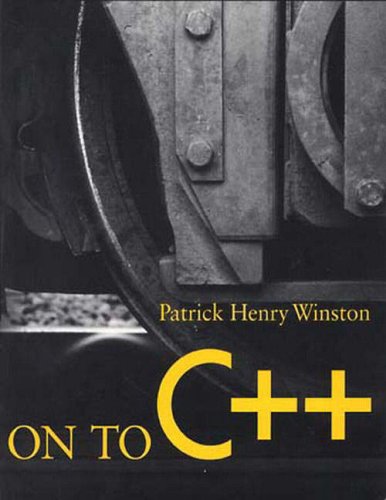
This book is a concise, yet clear introduction to the C++ programming language. Practicing programmers can use this book to learn the essentials of the language without a lot of time-consuming overhead. Key concepts and techniques are learned in their natural order as features are added to a short, yet representative C++ program. Also available: On to C and On to Java.
Les informations fournies dans la section « Synopsis » peuvent faire référence à une autre édition de ce titre.
À propos de l'auteur
About Patrick Henry Winston
Well-known author Patrick Henry Winston teaches computer science and directs the Artificial Intelligence Laboratory at theMassachusetts Institute of Technology.
0201580438AB04062001
À propos de la quatrième de couverture
Read this book if you want to add C++ to your programming-language repertoire. If you are a practicing programmer, you can use this book to learn the essentials of the language. If you are a student, you can use it to learn C++ to prepare for real-world work. You also can use this book to learn about the benefits of object-oriented programming and how to maximize those benefits through the principled design of C++ class hierarchies.
You learn the key concepts as features are added to a short, yet representative C++ program. The program uses knowledge about containers and railroad cars to display a capacity report for a freight train, thereby demonstrating the ability of C++ classes to capture knowledge about naturally occurring categories.
As you see the class-enabled program evolve, you learn how to:
- create classes and objects
- define constructor, reader, and writer functions
- benefit from data abstraction
- inherit member variable values and member functions
- create new class objects at run time
- find the right function at run time
- use constructors in class hierarchies
- use protected and private member variables and member functions
- use protected and private member variables and member functions
- use protected and private class derivations
- design class hierarchies
- reuse class definitions using templates
- and much, much more.
0201580438B04062001
Les informations fournies dans la section « A propos du livre » peuvent faire référence à une autre édition de ce titre.
Résultats de recherche pour On to C++

Image d'archives
On to C++
Edité par
Addison-Wesley, 1994
ISBN 10 : 0201580438
ISBN 13 : 9780201580433
Ancien ou d'occasion
Couverture souple
Vendeur : World of Books (was SecondSale), Montgomery, IL, Etats-Unis
Évaluation du vendeur 5 sur 5 étoiles

Etat : Good. Item in very good condition! Textbooks may not include supplemental items i.e. CDs, access codes etc. N° de réf. du vendeur 00078473050
Acheter D'occasion
EUR 5,13
Livraison gratuite
Expédition nationale : Etats-Unis
Expédition nationale : Etats-Unis
Quantité disponible : 1 disponible(s)
Image d'archives
On to C++
Edité par
Addison-Wesley, 1994
ISBN 10 : 0201580438
ISBN 13 : 9780201580433
Ancien ou d'occasion
Couverture souple
Vendeur : BookHolders, Towson, MD, Etats-Unis
Évaluation du vendeur 5 sur 5 étoiles
Etat : Good. [ No Hassle 30 Day Returns ][ Ships Daily ] [ Underlining/Highlighting: NONE ] [ Writing: NONE ] [ Edition: first ] Publisher: Addison Wesley Pub Date: 5/10/1994 Binding: Paperback Pages: 305 first edition. N° de réf. du vendeur 6940924
Acheter D'occasion
EUR 5,14
Livraison gratuite
Expédition nationale : Etats-Unis
Expédition nationale : Etats-Unis
Quantité disponible : 1 disponible(s)
Image d'archives
On to C++
Edité par
Addison-Wesley, 1994
ISBN 10 : 0201580438
ISBN 13 : 9780201580433
Ancien ou d'occasion
Couverture souple
Vendeur : Wonder Book, Frederick, MD, Etats-Unis
Évaluation du vendeur 5 sur 5 étoiles
Etat : Good. Good condition. A copy that has been read but remains intact. May contain markings such as bookplates, stamps, limited notes and highlighting, or a few light stains. N° de réf. du vendeur V02N-01498
Acheter D'occasion
EUR 6,43
Livraison gratuite
Expédition nationale : Etats-Unis
Expédition nationale : Etats-Unis
Quantité disponible : 2 disponible(s)
Image d'archives
On to C++
Edité par
Addison-Wesley, 1994
ISBN 10 : 0201580438
ISBN 13 : 9780201580433
Ancien ou d'occasion
Couverture souple
Vendeur : Wonder Book, Frederick, MD, Etats-Unis
Évaluation du vendeur 5 sur 5 étoiles
Etat : Very Good. Very Good condition. A copy that may have a few cosmetic defects. May also contain light spine creasing or a few markings such as an owner's name, short gifter's inscription or light stamp. N° de réf. du vendeur Q17E-01083
Acheter D'occasion
EUR 6,43
Livraison gratuite
Expédition nationale : Etats-Unis
Expédition nationale : Etats-Unis
Quantité disponible : 1 disponible(s)
Image d'archives
On to C++
Edité par
Addison-Wesley, 1994
ISBN 10 : 0201580438
ISBN 13 : 9780201580433
Ancien ou d'occasion
Paperback
Vendeur : ThriftBooks-Dallas, Dallas, TX, Etats-Unis
Évaluation du vendeur 5 sur 5 étoiles
Paperback. Etat : Very Good. No Jacket. May have limited writing in cover pages. Pages are unmarked. ~ ThriftBooks: Read More, Spend Less. N° de réf. du vendeur G0201580438I4N00
Acheter D'occasion
EUR 6,60
Livraison gratuite
Expédition nationale : Etats-Unis
Expédition nationale : Etats-Unis
Quantité disponible : 1 disponible(s)
Image d'archives
On to C++
Edité par
Addison-Wesley, 1994
ISBN 10 : 0201580438
ISBN 13 : 9780201580433
Ancien ou d'occasion
Paperback
Vendeur : ThriftBooks-Atlanta, AUSTELL, GA, Etats-Unis
Évaluation du vendeur 5 sur 5 étoiles
Paperback. Etat : Good. No Jacket. Pages can have notes/highlighting. Spine may show signs of wear. ~ ThriftBooks: Read More, Spend Less. N° de réf. du vendeur G0201580438I3N00
Acheter D'occasion
EUR 6,60
Livraison gratuite
Expédition nationale : Etats-Unis
Expédition nationale : Etats-Unis
Quantité disponible : 1 disponible(s)
Image d'archives
On to C Plus Plus
Edité par
Pearson Education, Limited, 1994
ISBN 10 : 0201580438
ISBN 13 : 9780201580433
Ancien ou d'occasion
Couverture souple
Vendeur : Better World Books, Mishawaka, IN, Etats-Unis
Évaluation du vendeur 5 sur 5 étoiles
Etat : Good. 2nd Ed. Pages intact with minimal writing/highlighting. The binding may be loose and creased. Dust jackets/supplements are not included. Stock photo provided. Product includes identifying sticker. Better World Books: Buy Books. Do Good. N° de réf. du vendeur 4513967-6
Acheter D'occasion
EUR 6,75
Livraison gratuite
Expédition nationale : Etats-Unis
Expédition nationale : Etats-Unis
Quantité disponible : 3 disponible(s)
Image d'archives
On to C++
Edité par
Pearson Education (US), 1994
ISBN 10 : 0201580438
ISBN 13 : 9780201580433
Ancien ou d'occasion
Couverture rigide
Vendeur : World of Books Inc, Montgomery, IL, Etats-Unis
Évaluation du vendeur 4 sur 5 étoiles

Hardback. Etat : Good. A concise introduction to the C++ programming language. Key concepts and techniques are introduced in their logical order. The short, yet representative program used demonstrates the ability of C++ classes to capture knowledge about naturally-occurring categories. N° de réf. du vendeur CIN0201580438G
Acheter D'occasion
EUR 6,97
Livraison gratuite
Expédition nationale : Etats-Unis
Expédition nationale : Etats-Unis
Quantité disponible : 3 disponible(s)
Image d'archives
On to C++
Edité par
Pearson Education (US), United States, Upper Saddle River, 1994
ISBN 10 : 0201580438
ISBN 13 : 9780201580433
Ancien ou d'occasion
Paperback
Vendeur : WorldofBooks, Goring-By-Sea, WS, Royaume-Uni
Évaluation du vendeur 5 sur 5 étoiles
Paperback. Etat : Very Good. This book is a concise, yet clear introduction to the C++ programming language. Practicing programmers can use this book to learn the essentials of the language without a lot of time-consuming overhead. Key concepts and techniques are learned in their natural order as features are added to a short, yet representative C++ program. Also available: On to C and On to Java. The book has been read, but is in excellent condition. Pages are intact and not marred by notes or highlighting. The spine remains undamaged. N° de réf. du vendeur GOR001578811
Acheter D'occasion
EUR 3,40
Expédition à EUR 6,62
Expédition depuis Royaume-Uni vers Etats-Unis
Expédition depuis Royaume-Uni vers Etats-Unis
Quantité disponible : 2 disponible(s)
Image d'archives
On to C Plus Plus
Edité par
Pearson Education, Limited, 1994
ISBN 10 : 0201580438
ISBN 13 : 9780201580433
Ancien ou d'occasion
Couverture souple
Vendeur : Better World Books Ltd, Dunfermline, Royaume-Uni
Évaluation du vendeur 5 sur 5 étoiles
Etat : Very Good. 2nd Ed. Former library copy. Pages intact with possible writing/highlighting. Binding strong with minor wear. Dust jackets/supplements may not be included. Includes library markings. Stock photo provided. Product includes identifying sticker. Better World Books: Buy Books. Do Good. N° de réf. du vendeur 56017084-20
Acheter D'occasion
EUR 6,11
Expédition à EUR 5,91
Expédition depuis Royaume-Uni vers Etats-Unis
Expédition depuis Royaume-Uni vers Etats-Unis
Quantité disponible : 1 disponible(s)