
Articles liés à Empire of Signs
Synopsis
Now it happens that in this country (Japan),' wrote Barthes, 'the empire of signifiers is so immense, so in excess of speech, that the exchange of signs remains of a fascinating richness mobility and subtlety.' It is not the voice that communicates, but the whole body - eyes, smiles, hair, gestures. The body is savoured, received and displays its own narrative, its own text. Barthes discusses bowing, the courtesy in which two bodies inscribe but do not prostrate themselves, and why in the West politeness is regarded with suspicion - why informal relations are though more desired than coded ones. He described the progressive Japanese spectacle and the demeanor worth regard to food: the essentially visual denotation of the coloured state of raw flesh or vegetable of Sukiyaki or tempura. The cook's purpose is 'to make us witness to the extreme purity of his cuisine; it is because his activity is literally graphic.' He explains the relation between ideographic writing and painting; the theatrical traditions of No, Kabuki and Bunraku; the pure designation (which abolishes finality) of the Zen literary expression, the haiku; the organization of space in the ideal Japanese house, in which propriety or ownership is never delineated - walls slide, partitions are fragile - and there is nothing to grasp. 'What will be in question,' wrote Barthes of this seminal, previously untranslated work, 'will be the city, the shop, the theatre; manners, gardens, violence; faces, eyes and the brushes with which it is all written but not painted.' Translated from the French by Richard Howard.
Les informations fournies dans la section « Synopsis » peuvent faire référence à une autre édition de ce titre.
À propos de l'auteur
Roland Barthes was born in 1915 and studied French literature and classics at the University of Paris. After teaching French at universities in Rumania and Egypt, he joined the Centre Nationale de Recherche Scientifique, where he devoted himself to research in sociology and lexicology. He was a Professor at the College de France until his death in 1980.
Les informations fournies dans la section « A propos du livre » peuvent faire référence à une autre édition de ce titre.
Résultats de recherche pour Empire of Signs

Image d'archives
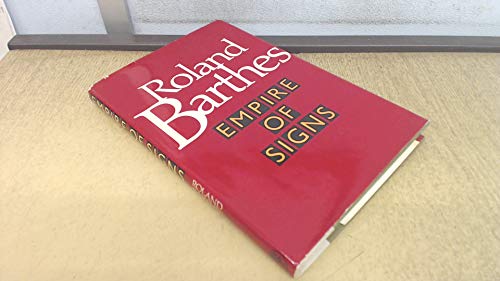
Empire of Signs
Edité par
Jonathan Cape, 1983
ISBN 10 : 0224029460
ISBN 13 : 9780224029469
Ancien ou d'occasion
Couverture rigide
Vendeur : Sell Books, Elland, YORKS, Royaume-Uni
Évaluation du vendeur 5 sur 5 étoiles

hardcover. Etat : Acceptable. Water damage to book. Please see the condition note after this for details, if this is missing please consider Acceptable to mean poor quality that could include major staining, water damage, writing, missing dustjacket, etc etc. Our books are dispatched from a Yorkshire former cotton mill. We list via barcode/ISBN so please note that the images are stock images and may not be the exact copy you receive, furthermore the details about edition and year might not be accurate as many publishers reuse the same ISBN for multiple editions and as we simply scan a barcode or enter an ISBN we do not check the validity of the edition data when listing. If you're looking for an exact edition please don't order (at least not without checking with us first, although we don't always have time to check). We aim to dispatch prompty, the service used will depend on order value and book size. We can ship to most countries, see our shipping policies. Payment is via Abe only. N° de réf. du vendeur SBAB-mon0000142703
Acheter D'occasion
EUR 1 108,33
Expédition à EUR 9,27
Expédition depuis Royaume-Uni vers Etats-Unis
Expédition depuis Royaume-Uni vers Etats-Unis
Quantité disponible : 1 disponible(s)