
Articles liés à The Politics
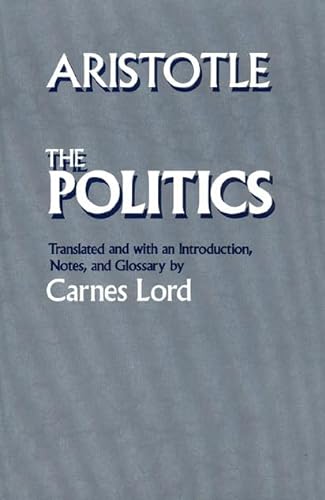
Synopsis
Book by Aristotle
Les informations fournies dans la section « Synopsis » peuvent faire référence à une autre édition de ce titre.
Résultats de recherche pour The Politics

Image d'archives
The Politics
Edité par
The University of Chicago Press, 1985
ISBN 10 : 0226026698
ISBN 13 : 9780226026695
Ancien ou d'occasion
Paperback
Vendeur : World of Books (was SecondSale), Montgomery, IL, Etats-Unis
Évaluation du vendeur 5 sur 5 étoiles

Paperback. Etat : Fair. Aristotle's life was primarily that of a scholar. However, like the other ancient philosophers, it was not the stereotypical ivory tower existence. His father was court physician to Amyntas I of Macedon, so Aristotle grew up in a royal household. Aristotle also knew Philip of Macedon (son of Amyntas I) and there is a tradition that says Aristotle tutored Philip's son Alexander, who would later be called the Great after expanding the Macedonian Empire all the way to what is now India. Clearly, Aristotle had significant firsthand experience with politics, though scholars disagree about how much influence, if any, this experience had on Aristotle's thought. There is certainly no evidence that Alexander's subsequent career was much influenced by Aristotle's teaching, which is uniformly critical of war and conquest as goals for human beings and which praises the intellectual, contemplative lifestyle. It is noteworthy that although Aristotle praises the politically active life, he spent most of his own life in Athens, where he was not a citizen and would not have been allowed to participate directly in politics. Aristotle studied under Plato at Plato's Academy in Athens, and eventually opened a school of his own (the Lyceum) there. As a scholar, Aristotle had a wide range of interests. He wrote about meteorology, biology, physics, poetry, logic, rhetoric, and politics and ethics, among other subjects. His writings on many of these interests remained definitive for almost two millennia. They remained, and remain, so valuable in part because of the comprehensiveness of his efforts. For example, in order to understand political phenomena, he had his students collect information on the political organization and history of 158 different cities. The Politics makes frequent reference to political events and institutions from many of these cities, drawing on his students' research. Aristotle's theories about the best ethical and political life are drawn from substantial amounts of empirical research. (The Internet Encyclopedia of Philosophy). N° de réf. du vendeur 00096705824
Acheter D'occasion
EUR 4,03
Livraison gratuite
Expédition nationale : Etats-Unis
Expédition nationale : Etats-Unis
Quantité disponible : 8 disponible(s)
Image d'archives
The Politics
Edité par
The University of Chicago Press, 1985
ISBN 10 : 0226026698
ISBN 13 : 9780226026695
Ancien ou d'occasion
Paperback
Vendeur : World of Books (was SecondSale), Montgomery, IL, Etats-Unis
Évaluation du vendeur 5 sur 5 étoiles
Paperback. Etat : Good. Aristotle's life was primarily that of a scholar. However, like the other ancient philosophers, it was not the stereotypical ivory tower existence. His father was court physician to Amyntas I of Macedon, so Aristotle grew up in a royal household. Aristotle also knew Philip of Macedon (son of Amyntas I) and there is a tradition that says Aristotle tutored Philip's son Alexander, who would later be called the Great after expanding the Macedonian Empire all the way to what is now India. Clearly, Aristotle had significant firsthand experience with politics, though scholars disagree about how much influence, if any, this experience had on Aristotle's thought. There is certainly no evidence that Alexander's subsequent career was much influenced by Aristotle's teaching, which is uniformly critical of war and conquest as goals for human beings and which praises the intellectual, contemplative lifestyle. It is noteworthy that although Aristotle praises the politically active life, he spent most of his own life in Athens, where he was not a citizen and would not have been allowed to participate directly in politics. Aristotle studied under Plato at Plato's Academy in Athens, and eventually opened a school of his own (the Lyceum) there. As a scholar, Aristotle had a wide range of interests. He wrote about meteorology, biology, physics, poetry, logic, rhetoric, and politics and ethics, among other subjects. His writings on many of these interests remained definitive for almost two millennia. They remained, and remain, so valuable in part because of the comprehensiveness of his efforts. For example, in order to understand political phenomena, he had his students collect information on the political organization and history of 158 different cities. The Politics makes frequent reference to political events and institutions from many of these cities, drawing on his students' research. Aristotle's theories about the best ethical and political life are drawn from substantial amounts of empirical research. (The Internet Encyclopedia of Philosophy). N° de réf. du vendeur CIN0226026698G
Acheter D'occasion
EUR 4,03
Livraison gratuite
Expédition nationale : Etats-Unis
Expédition nationale : Etats-Unis
Quantité disponible : 1 disponible(s)
Image d'archives
The Politics
Edité par
University of Chicago Press, 1985
ISBN 10 : 0226026698
ISBN 13 : 9780226026695
Ancien ou d'occasion
paperback
Vendeur : Gulf Coast Books, Cypress, TX, Etats-Unis
Évaluation du vendeur 5 sur 5 étoiles
paperback. Etat : Fair. N° de réf. du vendeur 0226026698-4-31200307
Acheter D'occasion
EUR 4,13
Livraison gratuite
Expédition nationale : Etats-Unis
Expédition nationale : Etats-Unis
Quantité disponible : 1 disponible(s)
Image d'archives
The Politics
Edité par
University of Chicago Press (edition First Edition), 1985
ISBN 10 : 0226026698
ISBN 13 : 9780226026695
Ancien ou d'occasion
Paperback
Edition originale
Vendeur : BooksRun, Philadelphia, PA, Etats-Unis
Évaluation du vendeur 5 sur 5 étoiles
Paperback. Etat : Fair. First Edition. The item might be beaten up but readable. May contain markings or highlighting, as well as stains, bent corners, or any other major defect, but the text is not obscured in any way. N° de réf. du vendeur 0226026698-7-1
Acheter D'occasion
EUR 5,19
Livraison gratuite
Expédition nationale : Etats-Unis
Expédition nationale : Etats-Unis
Quantité disponible : 2 disponible(s)
Image d'archives
The Politics
Edité par
The University of Chicago Press, 1985
ISBN 10 : 0226026698
ISBN 13 : 9780226026695
Ancien ou d'occasion
Paperback
Vendeur : World of Books Inc, Montgomery, IL, Etats-Unis
Évaluation du vendeur 4 sur 5 étoiles

Paperback. Etat : Good. Aristotle's life was primarily that of a scholar. However, like the other ancient philosophers, it was not the stereotypical ivory tower existence. His father was court physician to Amyntas I of Macedon, so Aristotle grew up in a royal household. Aristotle also knew Philip of Macedon (son of Amyntas I) and there is a tradition that says Aristotle tutored Philip's son Alexander, who would later be called the Great after expanding the Macedonian Empire all the way to what is now India. Clearly, Aristotle had significant firsthand experience with politics, though scholars disagree about how much influence, if any, this experience had on Aristotle's thought. There is certainly no evidence that Alexander's subsequent career was much influenced by Aristotle's teaching, which is uniformly critical of war and conquest as goals for human beings and which praises the intellectual, contemplative lifestyle. It is noteworthy that although Aristotle praises the politically active life, he spent most of his own life in Athens, where he was not a citizen and would not have been allowed to participate directly in politics. Aristotle studied under Plato at Plato's Academy in Athens, and eventually opened a school of his own (the Lyceum) there. As a scholar, Aristotle had a wide range of interests. He wrote about meteorology, biology, physics, poetry, logic, rhetoric, and politics and ethics, among other subjects. His writings on many of these interests remained definitive for almost two millennia. They remained, and remain, so valuable in part because of the comprehensiveness of his efforts. For example, in order to understand political phenomena, he had his students collect information on the political organization and history of 158 different cities. The Politics makes frequent reference to political events and institutions from many of these cities, drawing on his students' research. Aristotle's theories about the best ethical and political life are drawn from substantial amounts of empirical research. (The Internet Encyclopedia of Philosophy). N° de réf. du vendeur CIN0226026698G
Acheter D'occasion
EUR 5,86
Livraison gratuite
Expédition nationale : Etats-Unis
Expédition nationale : Etats-Unis
Quantité disponible : 1 disponible(s)
Image d'archives
The Politics
Edité par
The University of Chicago Press, 1985
ISBN 10 : 0226026698
ISBN 13 : 9780226026695
Ancien ou d'occasion
Paperback
Vendeur : World of Books Inc, Montgomery, IL, Etats-Unis
Évaluation du vendeur 4 sur 5 étoiles
Paperback. Etat : Fair. Aristotle's life was primarily that of a scholar. However, like the other ancient philosophers, it was not the stereotypical ivory tower existence. His father was court physician to Amyntas I of Macedon, so Aristotle grew up in a royal household. Aristotle also knew Philip of Macedon (son of Amyntas I) and there is a tradition that says Aristotle tutored Philip's son Alexander, who would later be called the Great after expanding the Macedonian Empire all the way to what is now India. Clearly, Aristotle had significant firsthand experience with politics, though scholars disagree about how much influence, if any, this experience had on Aristotle's thought. There is certainly no evidence that Alexander's subsequent career was much influenced by Aristotle's teaching, which is uniformly critical of war and conquest as goals for human beings and which praises the intellectual, contemplative lifestyle. It is noteworthy that although Aristotle praises the politically active life, he spent most of his own life in Athens, where he was not a citizen and would not have been allowed to participate directly in politics. Aristotle studied under Plato at Plato's Academy in Athens, and eventually opened a school of his own (the Lyceum) there. As a scholar, Aristotle had a wide range of interests. He wrote about meteorology, biology, physics, poetry, logic, rhetoric, and politics and ethics, among other subjects. His writings on many of these interests remained definitive for almost two millennia. They remained, and remain, so valuable in part because of the comprehensiveness of his efforts. For example, in order to understand political phenomena, he had his students collect information on the political organization and history of 158 different cities. The Politics makes frequent reference to political events and institutions from many of these cities, drawing on his students' research. Aristotle's theories about the best ethical and political life are drawn from substantial amounts of empirical research. (The Internet Encyclopedia of Philosophy). N° de réf. du vendeur CIN0226026698A
Acheter D'occasion
EUR 5,86
Livraison gratuite
Expédition nationale : Etats-Unis
Expédition nationale : Etats-Unis
Quantité disponible : 8 disponible(s)
Image d'archives
The Politics
Edité par
University of Chicago Press, 1985
ISBN 10 : 0226026698
ISBN 13 : 9780226026695
Ancien ou d'occasion
paperback
Vendeur : Book Gurus, Tallahassee, FL, Etats-Unis
Évaluation du vendeur 5 sur 5 étoiles
paperback. Etat : Good. N° de réf. du vendeur 01KX3R8R5AQF29N
Acheter D'occasion
EUR 3,23
Expédition à EUR 2,67
Expédition nationale : Etats-Unis
Expédition nationale : Etats-Unis
Quantité disponible : 1 disponible(s)
Image d'archives
The Politics
Edité par
University of Chicago Press, 1985
ISBN 10 : 0226026698
ISBN 13 : 9780226026695
Ancien ou d'occasion
Paperback
Vendeur : ThriftBooks-Phoenix, Phoenix, AZ, Etats-Unis
Évaluation du vendeur 5 sur 5 étoiles
Paperback. Etat : Fair. No Jacket. Readable copy. Pages may have considerable notes/highlighting. ~ ThriftBooks: Read More, Spend Less. N° de réf. du vendeur G0226026698I5N00
Acheter D'occasion
EUR 5,99
Livraison gratuite
Expédition nationale : Etats-Unis
Expédition nationale : Etats-Unis
Quantité disponible : 1 disponible(s)
Image d'archives
The Politics
Edité par
University of Chicago Press, 1985
ISBN 10 : 0226026698
ISBN 13 : 9780226026695
Ancien ou d'occasion
Paperback
Vendeur : ThriftBooks-Dallas, Dallas, TX, Etats-Unis
Évaluation du vendeur 5 sur 5 étoiles
Paperback. Etat : Good. No Jacket. Pages can have notes/highlighting. Spine may show signs of wear. ~ ThriftBooks: Read More, Spend Less. N° de réf. du vendeur G0226026698I3N00
Acheter D'occasion
EUR 5,99
Livraison gratuite
Expédition nationale : Etats-Unis
Expédition nationale : Etats-Unis
Quantité disponible : 1 disponible(s)
Image d'archives
The Politics
Edité par
University of Chicago Press, 1985
ISBN 10 : 0226026698
ISBN 13 : 9780226026695
Ancien ou d'occasion
Paperback
Vendeur : ThriftBooks-Dallas, Dallas, TX, Etats-Unis
Évaluation du vendeur 5 sur 5 étoiles
Paperback. Etat : Very Good. No Jacket. May have limited writing in cover pages. Pages are unmarked. ~ ThriftBooks: Read More, Spend Less. N° de réf. du vendeur G0226026698I4N00
Acheter D'occasion
EUR 5,99
Livraison gratuite
Expédition nationale : Etats-Unis
Expédition nationale : Etats-Unis
Quantité disponible : 1 disponible(s)