
Articles liés à How Reason Almost Lost Its Mind: The Strange Career...
Synopsis
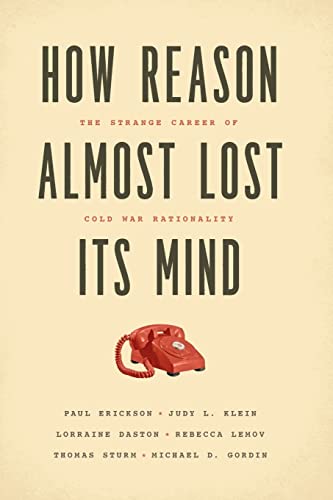
In the United States at the height of the Cold War, roughly between the end of World War II and the early 1980s, a new project of redefining rationality commanded the attention of sharp minds, powerful politicians, wealthy foundations, and top military brass. Its home was the human sciences—psychology, sociology, political science, and economics, among others—and its participants enlisted in an intellectual campaign to figure out what rationality should mean and how it could be deployed.
How Reason Almost Lost Its Mind brings to life the people—Herbert Simon, Oskar Morgenstern, Herman Kahn, Anatol Rapoport, Thomas Schelling, and many others—and places, including the RAND Corporation, the Center for Advanced Study in the Behavioral Sciences, the Cowles Commission for Research and Economics, and the Council on Foreign Relations, that played a key role in putting forth a “Cold War rationality.” Decision makers harnessed this picture of rationality—optimizing, formal, algorithmic, and mechanical—in their quest to understand phenomena as diverse as economic transactions, biological evolution, political elections, international relations, and military strategy. The authors chronicle and illuminate what it meant to be rational in the age of nuclear brinkmanship.
Les informations fournies dans la section « Synopsis » peuvent faire référence à une autre édition de ce titre.
À propos de l'auteur
Paul Erickson is assistant professor of history and science in society at Wesleyan University.
Les informations fournies dans la section « A propos du livre » peuvent faire référence à une autre édition de ce titre.
Résultats de recherche pour How Reason Almost Lost Its Mind: The Strange Career...

Image d'archives
How Reason Almost Lost Its Mind : The Strange Career of Cold War Rationality
Edité par
University of Chicago Press, 2015
ISBN 10 : 022632415X
ISBN 13 : 9780226324159
Ancien ou d'occasion
Couverture souple
Vendeur : Better World Books, Mishawaka, IN, Etats-Unis
Évaluation du vendeur 5 sur 5 étoiles

Etat : Good. Pages intact with minimal writing/highlighting. The binding may be loose and creased. Dust jackets/supplements are not included. Stock photo provided. Product includes identifying sticker. Better World Books: Buy Books. Do Good. N° de réf. du vendeur 68363833-6
Acheter D'occasion
EUR 22,04
Livraison gratuite
Expédition nationale : Etats-Unis
Expédition nationale : Etats-Unis
Quantité disponible : 1 disponible(s)
Image d'archives
How Reason Almost Lost Its Mind
Vendeur : PBShop.store US, Wood Dale, IL, Etats-Unis
Évaluation du vendeur 5 sur 5 étoiles
PAP. Etat : New. New Book. Shipped from UK. Established seller since 2000. N° de réf. du vendeur GB-9780226324159
Acheter neuf
EUR 31,02
Livraison gratuite
Expédition nationale : Etats-Unis
Expédition nationale : Etats-Unis
Quantité disponible : 1 disponible(s)
Image d'archives
How Reason Almost Lost Its Mind ? The Strange Career of Cold War Rationality (eng)
Edité par
University of Chicago Press, 2015
ISBN 10 : 022632415X
ISBN 13 : 9780226324159
Neuf
Couverture souple
Vendeur : Brook Bookstore On Demand, Napoli, NA, Italie
Évaluation du vendeur 5 sur 5 étoiles
Etat : new. N° de réf. du vendeur 675e7db6551bc10be1e561de11d00456
Acheter neuf
EUR 26,82
Expédition à EUR 5,50
Expédition depuis Italie vers Etats-Unis
Expédition depuis Italie vers Etats-Unis
Quantité disponible : Plus de 20 disponibles
Image fournie par le vendeur
How Reason Almost Lost Its Mind: The Strange Career of Cold War Rationality (Paperback or Softback)
Edité par
University of Chicago Press 11/17/2015, 2015
ISBN 10 : 022632415X
ISBN 13 : 9780226324159
Neuf
Paperback or Softback
Vendeur : BargainBookStores, Grand Rapids, MI, Etats-Unis
Évaluation du vendeur 5 sur 5 étoiles
Paperback or Softback. Etat : New. How Reason Almost Lost Its Mind: The Strange Career of Cold War Rationality. Book. N° de réf. du vendeur BBS-9780226324159
Acheter neuf
EUR 33,10
Livraison gratuite
Expédition nationale : Etats-Unis
Expédition nationale : Etats-Unis
Quantité disponible : 5 disponible(s)
Image d'archives
How Reason Almost Lost Its Mind: The Strange Career of Cold War Rationality
Edité par
University of Chicago Press, 2015
ISBN 10 : 022632415X
ISBN 13 : 9780226324159
Neuf
paperback
Vendeur : Chiron Media, Wallingford, Royaume-Uni
Évaluation du vendeur 5 sur 5 étoiles
paperback. Etat : New. Brand new book, sourced directly from publisher. Dispatch time is 24-48 hours from our warehouse. Book will be sent in robust, secure packaging to ensure it reaches you securely. N° de réf. du vendeur 6666-GRD-9780226324159
Acheter neuf
EUR 27,89
Expédition à EUR 5,89
Expédition depuis Royaume-Uni vers Etats-Unis
Expédition depuis Royaume-Uni vers Etats-Unis
Quantité disponible : 2 disponible(s)
Image d'archives
How Reason Almost Lost its Mind
Edité par
The University of Chicago Press, 2015
ISBN 10 : 022632415X
ISBN 13 : 9780226324159
Neuf
Couverture souple
Vendeur : Kennys Bookshop and Art Galleries Ltd., Galway, GY, Irlande
Évaluation du vendeur 5 sur 5 étoiles
Etat : New. Num Pages: 272 pages, black & white illustrations. BIC Classification: 1KBB; 3JJP; HBJK; HBLW3; HBTW; HPS; JFCX. Category: (G) General (US: Trade). Dimension: 229 x 152 x 15. Weight in Grams: 398. . 2015. Paperback. . . . . N° de réf. du vendeur V9780226324159
Acheter neuf
EUR 25,41
Expédition à EUR 9,50
Expédition depuis Irlande vers Etats-Unis
Expédition depuis Irlande vers Etats-Unis
Quantité disponible : Plus de 20 disponibles
Image d'archives
How Reason Almost Lost Its Mind - The Strange Career of Cold War Rationality
Edité par
The University of Chicago Press, 2015
ISBN 10 : 022632415X
ISBN 13 : 9780226324159
Neuf
PAP
Vendeur : PBShop.store UK, Fairford, GLOS, Royaume-Uni
Évaluation du vendeur 5 sur 5 étoiles
PAP. Etat : New. New Book. Shipped from UK. Established seller since 2000. N° de réf. du vendeur GB-9780226324159
Acheter neuf
EUR 30,10
Expédition à EUR 4,91
Expédition depuis Royaume-Uni vers Etats-Unis
Expédition depuis Royaume-Uni vers Etats-Unis
Quantité disponible : 2 disponible(s)
Image fournie par le vendeur
How Reason Almost Lost Its Mind - The Strange Career of Cold War Rationality
Edité par
The University of Chicago Press, US, 2015
ISBN 10 : 022632415X
ISBN 13 : 9780226324159
Neuf
Paperback
Vendeur : Rarewaves.com USA, London, LONDO, Royaume-Uni
Évaluation du vendeur 5 sur 5 étoiles
Paperback. Etat : New. In the United States at the height of the Cold War, roughly between the end of World War II and the early 1980s, a new project of redefining rationality commanded the attention of sharp minds, powerful politicians, wealthy foundations, and top military brass. Its home was the human sciences-psychology, sociology, political science, and economics, among others-and its participants enlisted in an intellectual campaign to figure out what rationality should mean and how it could be deployed. How Reason Almost Lost Its Mind brings to life the people-Herbert Simon, Oskar Morgenstern, Herman Kahn, Anatol Rapoport, Thomas Schelling, and many others-and places, including the RAND Corporation, the Center for Advanced Study in the Behavioral Sciences, the Cowles Commission for Research and Economics, and the Council on Foreign Relations, that played a key role in putting forth a \u201cCold War rationality.\u201d Decision makers harnessed this picture of rationality-optimizing, formal, algorithmic, and mechanical-in their quest to understand phenomena as diverse as economic transactions, biological evolution, political elections, international relations, and military strategy.The authors chronicle and illuminate what it meant to be rational in the age of nuclear brinkmanship. N° de réf. du vendeur LU-9780226324159
Acheter neuf
EUR 36,20
Livraison gratuite
Expédition depuis Royaume-Uni vers Etats-Unis
Expédition depuis Royaume-Uni vers Etats-Unis
Quantité disponible : 1 disponible(s)
Image fournie par le vendeur
How Reason Almost Lost Its Mind - The Strange Career of Cold War Rationality
Edité par
The University of Chicago Press, US, 2015
ISBN 10 : 022632415X
ISBN 13 : 9780226324159
Neuf
Paperback
Vendeur : Rarewaves USA, HEBRON, KY, Etats-Unis
Évaluation du vendeur 5 sur 5 étoiles
Paperback. Etat : New. In the United States at the height of the Cold War, roughly between the end of World War II and the early 1980s, a new project of redefining rationality commanded the attention of sharp minds, powerful politicians, wealthy foundations, and top military brass. Its home was the human sciences-psychology, sociology, political science, and economics, among others-and its participants enlisted in an intellectual campaign to figure out what rationality should mean and how it could be deployed. How Reason Almost Lost Its Mind brings to life the people-Herbert Simon, Oskar Morgenstern, Herman Kahn, Anatol Rapoport, Thomas Schelling, and many others-and places, including the RAND Corporation, the Center for Advanced Study in the Behavioral Sciences, the Cowles Commission for Research and Economics, and the Council on Foreign Relations, that played a key role in putting forth a \u201cCold War rationality.\u201d Decision makers harnessed this picture of rationality-optimizing, formal, algorithmic, and mechanical-in their quest to understand phenomena as diverse as economic transactions, biological evolution, political elections, international relations, and military strategy.The authors chronicle and illuminate what it meant to be rational in the age of nuclear brinkmanship. N° de réf. du vendeur LU-9780226324159
Acheter neuf
EUR 37,27
Livraison gratuite
Expédition nationale : Etats-Unis
Expédition nationale : Etats-Unis
Quantité disponible : 1 disponible(s)
Image fournie par le vendeur
How Reason Almost Lost Its Mind The Strange Career of Cold War Rationality (Paperback)
Edité par
The University of Chicago Press, Chicago, IL, 2015
ISBN 10 : 022632415X
ISBN 13 : 9780226324159
Neuf
Paperback
Vendeur : Grand Eagle Retail, Bensenville, IL, Etats-Unis
Évaluation du vendeur 5 sur 5 étoiles
Paperback. Etat : new. Paperback. In the United States at the height of the Cold War, roughly between the end of World War II and the early 1980s, a new project of redefining rationality commanded the attention of sharp minds, powerful politicians, wealthy foundations, and top military brass. Its home was the human sciencespsychology, sociology, political science, and economics, among othersand its participants enlisted in an intellectual campaign to figure out what rationality should mean and how it could be deployed. How Reason Almost Lost Its Mind brings to life the peopleHerbert Simon, Oskar Morgenstern, Herman Kahn, Anatol Rapoport, Thomas Schelling, and many othersand places, including the RAND Corporation, the Center for Advanced Study in the Behavioral Sciences, the Cowles Commission for Research and Economics, and the Council on Foreign Relations, that played a key role in putting forth a Cold War rationality. Decision makers harnessed this picture of rationalityoptimizing, formal, algorithmic, and mechanicalin their quest to understand phenomena as diverse as economic transactions, biological evolution, political elections, international relations, and military strategy. The authors chronicle and illuminate what it meant to be rational in the age of nuclear brinkmanship. Shipping may be from multiple locations in the US or from the UK, depending on stock availability. N° de réf. du vendeur 9780226324159
Acheter neuf
EUR 39,12
Livraison gratuite
Expédition nationale : Etats-Unis
Expédition nationale : Etats-Unis
Quantité disponible : 1 disponible(s)