
Articles liés à Novelties in the Heavens: Rhetoric and Science in the...
Synopsis
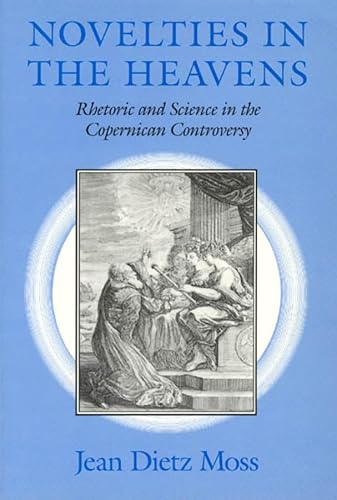
In this fascinating work, Jean Dietz Moss shows how the scientific revolution begun by Copernicus brought about another revolution as well--one in which rhetoric, previously used simply to explain scientific thought, became a tool for persuading a skeptical public of the superiority of the Copernican system.
Moss describes the nature of dialectical and rhetorical discourse in the period of the Copernican debate to shed new light on the argumentative strategies used by the participants. Against the background of Ptolemy's Almagest, she analyzes the gradual increase of rhetoric beginning with Copernicus's De Revolutionibus and Galileo's Siderius nuncius, through Galileo's debates with the Jesuits Scheiner and Grassi, to the most persuasive work of all, Galileo's Dialogue. The arguments of the Dominicans Bruno and Campanella, the testimony of Johannes Kepler, and the pleas of Scriptural exegetes and the speculations of John Wilkins furnish a counterpoint to the writings of Galileo, the centerpiece of this study. The author places the controversy within its historical frame, creating a coherent narrative movement. She illuminates the reactions of key ecclesiastical and academic figures figures and the general public to the issues. Blending history and rhetorical analysis, this first study to look at rhetoric as defined by sixteenth- and seventeenth-century participants is an original contribution to our understanding of the use of persuasion as an instrument of scientific debate.Les informations fournies dans la section « Synopsis » peuvent faire référence à une autre édition de ce titre.
Résultats de recherche pour Novelties in the Heavens: Rhetoric and Science in the...

Image d'archives
Novelties in the Heavens: Rhetoric and Science in the Copernican Controversy
Edité par
The University of Chicago Press, Chicago, Illinois, 1993
ISBN 10 : 0226542351
ISBN 13 : 9780226542355
Ancien ou d'occasion
Trade Paperback
Vendeur : Dan's Books, Arlington, MA, Etats-Unis
Évaluation du vendeur 5 sur 5 étoiles

Trade Paperback. Etat : Very Good +. First Paperback Edition, First Printing. 353pp. N° de réf. du vendeur 002374
Acheter D'occasion
EUR 9,96
Expédition à EUR 4,39
Expédition nationale : Etats-Unis
Expédition nationale : Etats-Unis
Quantité disponible : 1 disponible(s)
Image d'archives
Novelties in the Heavens: Rhetoric and Science in the Copernican Controversy
Edité par
University of Chicago Press, 1993
ISBN 10 : 0226542351
ISBN 13 : 9780226542355
Ancien ou d'occasion
Paperback
Vendeur : ThriftBooks-Dallas, Dallas, TX, Etats-Unis
Évaluation du vendeur 5 sur 5 étoiles
Paperback. Etat : Good. No Jacket. Pages can have notes/highlighting. Spine may show signs of wear. ~ ThriftBooks: Read More, Spend Less. N° de réf. du vendeur G0226542351I3N00
Acheter D'occasion
EUR 14,42
Livraison gratuite
Expédition nationale : Etats-Unis
Expédition nationale : Etats-Unis
Quantité disponible : 1 disponible(s)
Image d'archives
Novelties in the Heavens: Rhetoric and Science in the Copernican Controversy (Chicago Lectures in Mathematics (Paperback))
Edité par
University of Chicago Press, 1993
ISBN 10 : 0226542351
ISBN 13 : 9780226542355
Ancien ou d'occasion
Paperback
Edition originale
Vendeur : Powell's Bookstores Chicago, ABAA, Chicago, IL, Etats-Unis
Évaluation du vendeur 5 sur 5 étoiles
Paperback. Etat : Used-Very Good. 1st Edition. Pbk. Some shelf-wear. Else clean copy. N° de réf. du vendeur 1824651
Acheter D'occasion
EUR 10,86
Expédition à EUR 4,39
Expédition nationale : Etats-Unis
Expédition nationale : Etats-Unis
Quantité disponible : 1 disponible(s)
Image d'archives
Novelties in the Heavens: Rhetoric and Science in the Copernican Controversy
Edité par
University Of Chicago Press, 1993
ISBN 10 : 0226542351
ISBN 13 : 9780226542355
Ancien ou d'occasion
Couverture souple
Vendeur : Anybook.com, Lincoln, Royaume-Uni
Évaluation du vendeur 5 sur 5 étoiles
Etat : Fair. This is an ex-library book and may have the usual library/used-book markings inside.This book has soft covers. In fair condition, suitable as a study copy. Please note the Image in this listing is a stock photo and may not match the covers of the actual item,550grams, ISBN:9780226542355. N° de réf. du vendeur 9215030
Acheter D'occasion
EUR 3,59
Expédition à EUR 15,81
Expédition depuis Royaume-Uni vers Etats-Unis
Expédition depuis Royaume-Uni vers Etats-Unis
Quantité disponible : 1 disponible(s)
Image d'archives
Novelties in the Heavens: Rhetoric and Science in the Copernican Controversy (Chicago Lectures in Mathematics (Paperback))
Edité par
University of Chicago Press, 1993
ISBN 10 : 0226542351
ISBN 13 : 9780226542355
Ancien ou d'occasion
Paperback
Vendeur : Midtown Scholar Bookstore, Harrisburg, PA, Etats-Unis
Évaluation du vendeur 5 sur 5 étoiles
Paperback. Etat : Acceptable. This is a damaged book. May be ex-library, water-damaged, or spine creased/broken. Acceptable, Reading copy only, with writing/markings and heavy wear. Standard-sized. N° de réf. du vendeur mon0000350962
Acheter D'occasion
EUR 14,48
Expédition à EUR 5,27
Expédition nationale : Etats-Unis
Expédition nationale : Etats-Unis
Quantité disponible : 1 disponible(s)
Image d'archives
Novelties in the Heavens: Rhetoric and Science in the Copernican Controversy
Edité par
University of Chicago Press, 1993, 1993
ISBN 10 : 0226542351
ISBN 13 : 9780226542355
Ancien ou d'occasion
Soft cover
Vendeur : Sutton Books, Norwich, VT, Etats-Unis
Évaluation du vendeur 4 sur 5 étoiles

Soft cover. Etat : Near Fine. Pbk 353pp slight shelfwear to covers with a faint corner crease otherwise an excellent clean tight unmarked text. N° de réf. du vendeur HPS150-B
Acheter D'occasion
EUR 18,10
Expédition à EUR 4,83
Expédition nationale : Etats-Unis
Expédition nationale : Etats-Unis
Quantité disponible : 1 disponible(s)
Image d'archives
Novelties in the Heavens: Rhetoric and Science in the Copernican Controversy (Chicago Lectures in Mathematics (Paperback))
Edité par
University of Chicago Press, Chicago/London, 1993
ISBN 10 : 0226542351
ISBN 13 : 9780226542355
Ancien ou d'occasion
Couverture rigide
Vendeur : Antiquariat Stefan Krüger, Essen, NRW, Allemagne
Évaluation du vendeur 3 sur 5 étoiles

Pappband. New. XIV, 353 S. Opp. 498 Gramm. Buch. N° de réf. du vendeur 54193
Acheter D'occasion
EUR 24
Expédition à EUR 19
Expédition depuis Allemagne vers Etats-Unis
Expédition depuis Allemagne vers Etats-Unis
Quantité disponible : 1 disponible(s)
Image fournie par le vendeur
NOVELTIES IN THE HEAVENS; Rhetoric and Science in the Copernican Controversy
Edité par
University of Chicago Press, Chicago, 1993
ISBN 10 : 0226542351
ISBN 13 : 9780226542355
Ancien ou d'occasion
Softcover
Edition originale
Vendeur : Rare Book Cellar, Pomona, NY, Etats-Unis
Évaluation du vendeur 5 sur 5 étoiles
Softcover. First Edition; First Printing. Very Good+ in wraps. Foxing on text block edges.; Chicago Lectures in Mathematics; 368 pages. N° de réf. du vendeur 334734
Acheter D'occasion
EUR 61,51
Expédition à EUR 9,62
Expédition nationale : Etats-Unis
Expédition nationale : Etats-Unis
Quantité disponible : 1 disponible(s)
Image d'archives
Novelties in the Heavens: Rhetoric and Science in the Copernican Controversy (Chicago Lectures in Mathematics (Paperback))
Edité par
University of Chicago Press, 1993
ISBN 10 : 0226542351
ISBN 13 : 9780226542355
Ancien ou d'occasion
Softcover
Vendeur : Kalligramm, Berlin, Allemagne
Évaluation du vendeur 4 sur 5 étoiles
Softcover. Etat : Sehr gut. N° de réf. du vendeur 003683
Acheter D'occasion
EUR 10
Expédition à EUR 90,85
Expédition depuis Allemagne vers Etats-Unis
Expédition depuis Allemagne vers Etats-Unis
Quantité disponible : 1 disponible(s)