
Globalization: The Human Consequences - Couverture rigide
Livre 67 sur 102: European Perspectives: A Series in Social Thought and Cultural Criticism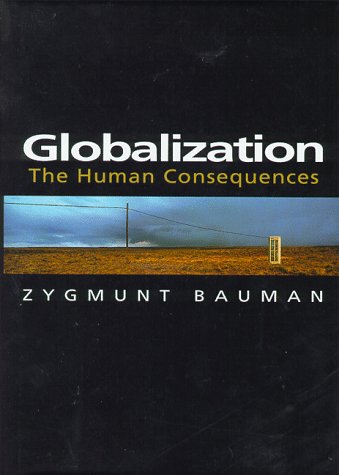
Synopsis
An academic examination of globalization and its consequences. Bauman (sociology emeritus, U. of Leeds and U. of Warsaw) dissects globalization in all its manifestations: its effects on the economy; politics; social structures; and even perceptions of tim
Les informations fournies dans la section « Synopsis » peuvent faire référence à une autre édition de ce titre.
Quatrième de couverture
′Globalization′ is a word that is currently much in use. This book is an attempt to show that there is far more to globalization than its surface manifestations. Unpacking the social roots and social consequences of globalizing processes, this book disperses some of the mist that surrounds the term.
Alongside the emerging planetary dimensions of business, finance, trade and information flow, a ′localizing′, space–fixing process is set in motion. What appears as globalization for some, means localization for many others; signalling new freedom for some, globalizing processes appear as uninvited and cruel fate for many others. Freedom to move, a scarce and unequally distributed commodity, quickly becomes the main stratifying factor of our times.
Neo–tribal and fundamentalist tendencies are as legitimate offspring of globalization as the widely acclaimed ′hybridization′ of top culture – the culture at the globalized top. A particular reason to worry is the progressive breakdown in communication between the increasingly global and extra– territorial elites and ever more ′localized′ majority. The bulk of the population, the ′new middle class′, bears the brunt of these problems, and suffers uncertainty, anxiety and fear as a result.
This book is a major contribution to the unfolding debate about globalization, and as such will be of interest to students and professionals in sociology, human geography and cultural issues.
Présentation de l'éditeur
Bauman shows in this detailed history of globalization that while human affairs now take place on a global scale, we are not able to direct events; we can only watch as boundaries, institutions, and loyalties shift in rapid and unpredictable ways. From the way the global economy creates a class of absentee landlords to current prison designs for the criminalized underclass, Bauman dissects globalization in all its manifestations: its effects on the economy, politics, social structures, and even our perceptions of time and space.
Drawing on the works of philosophers, social historians, architects, and theoreticians such as Michel Foucault, Claude Lévi-Strauss, Alfred J. Dunlap, and Le Corbusier, Globalization presents a historical overview of the methods employed to create and define human spaces and institutions, from rural villages to sprawling urban centers.
Les informations fournies dans la section « A propos du livre » peuvent faire référence à une autre édition de ce titre.
Autres éditions populaires du même titre

Résultats de recherche pour Globalization: The Human Consequences

Image d'archives
Globalization: The Human Consequences
Edité par
Columbia Univ Pr, 1998
ISBN 10 : 0231114281
ISBN 13 : 9780231114288
Ancien ou d'occasion
Couverture rigide
Vendeur : Midtown Scholar Bookstore, Harrisburg, PA, Etats-Unis
Évaluation du vendeur 5 sur 5 étoiles

hardcover. Etat : Good. Torn/worn dj. Good hardcover with some shelfwear; may have previous owner's name inside. Standard-sized. N° de réf. du vendeur mon0000192877
Acheter D'occasion
EUR 8,16
Expédition à EUR 5,25
Expédition nationale : Etats-Unis
Expédition nationale : Etats-Unis
Quantité disponible : 1 disponible(s)
Image d'archives
Globalization : The Human Consequences
Edité par
Columbia University Press, 1998
ISBN 10 : 0231114281
ISBN 13 : 9780231114288
Ancien ou d'occasion
Couverture rigide
Vendeur : Better World Books, Mishawaka, IN, Etats-Unis
Évaluation du vendeur 5 sur 5 étoiles
Etat : Good. 0th Edition. Pages intact with minimal writing/highlighting. The binding may be loose and creased. Dust jackets/supplements are not included. Stock photo provided. Product includes identifying sticker. Better World Books: Buy Books. Do Good. N° de réf. du vendeur 11212884-6
Acheter D'occasion
EUR 15,86
Livraison gratuite
Expédition nationale : Etats-Unis
Expédition nationale : Etats-Unis
Quantité disponible : 2 disponible(s)