
Articles liés à History at the Limit of World-History
Synopsis
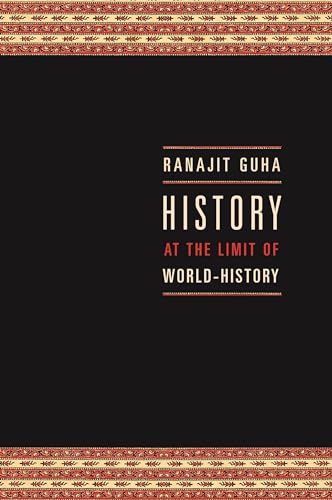
The past is not just, as has been famously said, another country with foreign customs: it is a contested and colonized terrain. Indigenous histories have been expropriated, eclipsed, sometimes even wholly eradicated, in the service of imperialist aims buttressed by a distinctly Western philosophy of history. Ranajit Guha, perhaps the most influential figure in postcolonial and subaltern studies at work today, offers a critique of such historiography by taking issue with the Hegelian concept of World-history. That concept, he contends, reduces the course of human history to the amoral record of states and empires, great men and clashing civilizations. It renders invisible the quotidian experience of ordinary people and casts off all that came before it into the nether-existence known as "Prehistory."
On the Indian subcontinent, Guha believes, this Western way of looking at the past was so successfully insinuated by British colonization that few today can see clearly its ongoing and pernicious influence. He argues that to break out of this habit of mind and go beyond the Eurocentric and statist limit of World-history historians should learn from literature to make their narratives doubly inclusive: to extend them in scope not only to make room for the pasts of the so-called peoples without history but to address the historicality of everyday life as well. Only then, as Guha demonstrates through an examination of Rabindranath Tagore's critique of historiography, can we recapture a more fully human past of "experience and wonder."Les informations fournies dans la section « Synopsis » peuvent faire référence à une autre édition de ce titre.
À propos de l'auteur
Ranajit Guha is founding editor of Subaltern Studies and author of a number of celebrated books, including Dominance Without Hegemony: History and Power in Colonial India. He has held various research and teaching positions in India, England, the United States, and Australia. He currently lives in Austria.
Les informations fournies dans la section « A propos du livre » peuvent faire référence à une autre édition de ce titre.
Résultats de recherche pour History at the Limit of World-History

Image d'archives
History at the Limit of World-History (Italian Academy Lectures)
Edité par
Columbia University Press, 2003
ISBN 10 : 0231124198
ISBN 13 : 9780231124195
Ancien ou d'occasion
paperback
Vendeur : HPB-Red, Dallas, TX, Etats-Unis
Évaluation du vendeur 5 sur 5 étoiles

paperback. Etat : Good. Connecting readers with great books since 1972! Used textbooks may not include companion materials such as access codes, etc. May have some wear or writing/highlighting. We ship orders daily and Customer Service is our top priority! N° de réf. du vendeur S_476008604
Acheter D'occasion
EUR 17,39
Expédition à EUR 3,33
Expédition nationale : Etats-Unis
Expédition nationale : Etats-Unis
Quantité disponible : 1 disponible(s)
Image fournie par le vendeur
History at the Limit of World-History
Edité par
Columbia University Press, 2003
ISBN 10 : 0231124198
ISBN 13 : 9780231124195
Neuf
Couverture souple
Vendeur : GreatBookPrices, Columbia, MD, Etats-Unis
Évaluation du vendeur 5 sur 5 étoiles
Etat : New. N° de réf. du vendeur 1632221-n
Acheter neuf
EUR 21,26
Expédition à EUR 2,35
Expédition nationale : Etats-Unis
Expédition nationale : Etats-Unis
Quantité disponible : Plus de 20 disponibles
Image fournie par le vendeur
History at the Limit of World-History (Paperback)
Edité par
Columbia University Press, New York, 2003
ISBN 10 : 0231124198
ISBN 13 : 9780231124195
Neuf
Paperback
Vendeur : Grand Eagle Retail, Bensenville, IL, Etats-Unis
Évaluation du vendeur 5 sur 5 étoiles
Paperback. Etat : new. Paperback. The past is not just, as has been famously said, another country with foreign customs: it is a contested and colonized terrain. Indigenous histories have been expropriated, eclipsed, sometimes even wholly eradicated, in the service of imperialist aims buttressed by a distinctly Western philosophy of history. Ranajit Guha, perhaps the most influential figure in postcolonial and subaltern studies at work today, offers a critique of such historiography by taking issue with the Hegelian concept of World-history. That concept, he contends, reduces the course of human history to the amoral record of states and empires, great men and clashing civilizations. It renders invisible the quotidian experience of ordinary people and casts off all that came before it into the nether-existence known as "Prehistory."On the Indian subcontinent, Guha believes, this Western way of looking at the past was so successfully insinuated by British colonization that few today can see clearly its ongoing and pernicious influence. He argues that to break out of this habit of mind and go beyond the Eurocentric and statist limit of World-history historians should learn from literature to make their narratives doubly inclusive: to extend them in scope not only to make room for the pasts of the so-called peoples without history but to address the historicality of everyday life as well. Only then, as Guha demonstrates through an examination of Rabindranath Tagore's critique of historiography, can we recapture a more fully human past of "experience and wonder." The past is not just, as has been famously said, another country with foreign customs: it is a contested and colonized terrain. This title offers a critique of such historiography by taking issue with the Hegelian concept of World-history. Shipping may be from multiple locations in the US or from the UK, depending on stock availability. N° de réf. du vendeur 9780231124195
Acheter neuf
EUR 23,67
Livraison gratuite
Expédition nationale : Etats-Unis
Expédition nationale : Etats-Unis
Quantité disponible : 1 disponible(s)
Image d'archives
History at the Limit of World-History (Italian Academy Lectures)
Edité par
Columbia University Press, 2003
ISBN 10 : 0231124198
ISBN 13 : 9780231124195
Neuf
Paperback
Vendeur : Textbooks_Source, Columbia, MO, Etats-Unis
Évaluation du vendeur 5 sur 5 étoiles
Paperback. Etat : New. 1st US - 1st Printing. Ships in a BOX from Central Missouri! UPS shipping for most packages, (Priority Mail for AK/HI/APO/PO Boxes). N° de réf. du vendeur 000664201N
Acheter neuf
EUR 20,15
Expédition à EUR 3,55
Expédition nationale : Etats-Unis
Expédition nationale : Etats-Unis
Quantité disponible : 4 disponible(s)
Image fournie par le vendeur
History at the Limit of World-History
Edité par
Columbia University Press, 2003
ISBN 10 : 0231124198
ISBN 13 : 9780231124195
Ancien ou d'occasion
Couverture souple
Vendeur : GreatBookPrices, Columbia, MD, Etats-Unis
Évaluation du vendeur 5 sur 5 étoiles
Etat : As New. Unread book in perfect condition. N° de réf. du vendeur 1632221
Acheter D'occasion
EUR 23,84
Expédition à EUR 2,35
Expédition nationale : Etats-Unis
Expédition nationale : Etats-Unis
Quantité disponible : Plus de 20 disponibles
Image fournie par le vendeur
History at the Limit of World-History
Edité par
Columbia University Press, US, 2003
ISBN 10 : 0231124198
ISBN 13 : 9780231124195
Neuf
Paperback
Vendeur : Rarewaves USA, HEBRON, KY, Etats-Unis
Évaluation du vendeur 5 sur 5 étoiles
Paperback. Etat : New. The past is not just, as has been famously said, another country with foreign customs: it is a contested and colonized terrain. Indigenous histories have been expropriated, eclipsed, sometimes even wholly eradicated, in the service of imperialist aims buttressed by a distinctly Western philosophy of history. Ranajit Guha, perhaps the most influential figure in postcolonial and subaltern studies at work today, offers a critique of such historiography by taking issue with the Hegelian concept of World-history. That concept, he contends, reduces the course of human history to the amoral record of states and empires, great men and clashing civilizations. It renders invisible the quotidian experience of ordinary people and casts off all that came before it into the nether-existence known as "Prehistory." On the Indian subcontinent, Guha believes, this Western way of looking at the past was so successfully insinuated by British colonization that few today can see clearly its ongoing and pernicious influence.He argues that to break out of this habit of mind and go beyond the Eurocentric and statist limit of World-history historians should learn from literature to make their narratives doubly inclusive: to extend them in scope not only to make room for the pasts of the so-called peoples without history but to address the historicality of everyday life as well. Only then, as Guha demonstrates through an examination of Rabindranath Tagore's critique of historiography, can we recapture a more fully human past of "experience and wonder.". N° de réf. du vendeur LU-9780231124195
Acheter neuf
EUR 31,15
Livraison gratuite
Expédition nationale : Etats-Unis
Expédition nationale : Etats-Unis
Quantité disponible : Plus de 20 disponibles
Image fournie par le vendeur
History at the Limit of World-History (Paperback or Softback)
Edité par
Columbia University Press 8/27/2003, 2003
ISBN 10 : 0231124198
ISBN 13 : 9780231124195
Neuf
Paperback or Softback
Vendeur : BargainBookStores, Grand Rapids, MI, Etats-Unis
Évaluation du vendeur 5 sur 5 étoiles
Paperback or Softback. Etat : New. History at the Limit of World-History. Book. N° de réf. du vendeur BBS-9780231124195
Acheter neuf
EUR 33,34
Livraison gratuite
Expédition nationale : Etats-Unis
Expédition nationale : Etats-Unis
Quantité disponible : 5 disponible(s)
Image d'archives
History at the Limit of World-History (Italian Academy Lectures)
Edité par
Columbia University Press, 2003
ISBN 10 : 0231124198
ISBN 13 : 9780231124195
Neuf
Couverture souple
Vendeur : Books Puddle, Woodside, NY, Etats-Unis
Évaluation du vendeur 4 sur 5 étoiles

Etat : New. pp. 128 1st US - 1st Printing edition. N° de réf. du vendeur 264478594
Acheter neuf
EUR 33,30
Expédition à EUR 3,55
Expédition nationale : Etats-Unis
Expédition nationale : Etats-Unis
Quantité disponible : 1 disponible(s)
Image d'archives
History at the Limit of World-History (Italian Academy Lectures)
Edité par
Columbia University Press, 2003
ISBN 10 : 0231124198
ISBN 13 : 9780231124195
Neuf
Couverture souple
Vendeur : Majestic Books, Hounslow, Royaume-Uni
Évaluation du vendeur 4 sur 5 étoiles
Etat : New. pp. 128. N° de réf. du vendeur 3402077
Acheter neuf
EUR 29,75
Expédition à EUR 7,66
Expédition depuis Royaume-Uni vers Etats-Unis
Expédition depuis Royaume-Uni vers Etats-Unis
Quantité disponible : 1 disponible(s)
Image d'archives
History at the Limit of World-History (Italian Academy Lectures)
impression à la demandeVendeur : Revaluation Books, Exeter, Royaume-Uni
Évaluation du vendeur 5 sur 5 étoiles
Paperback. Etat : Brand New. 128 pages. 8.75x6.00x0.50 inches. In Stock. This item is printed on demand. N° de réf. du vendeur __0231124198
Acheter neuf
EUR 27,01
Expédition à EUR 11,79
Expédition depuis Royaume-Uni vers Etats-Unis
Expédition depuis Royaume-Uni vers Etats-Unis
Quantité disponible : 1 disponible(s)