
Articles liés à The Pariah Problem: Caste, Religion, and the Social...
The Pariah Problem: Caste, Religion, and the Social in Modern India - Couverture rigide
Livre 11 sur 12: Cultures of History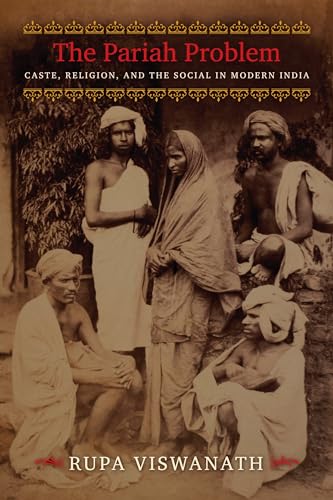
Synopsis
Once known as "Pariahs," Dalits are primarily descendants of unfree agrarian laborers. They belong to India's most subordinated castes, face overwhelming poverty and discrimination, and provoke public anxiety. Drawing on a wealth of previously untapped sources, this book follows the conception and evolution of the "Pariah Problem" in public consciousness in the 1890s. It shows how high-caste landlords, state officials, and well-intentioned missionaries conceived of Dalit oppression, and effectively foreclosed the emergence of substantive solutions to the "Problem"--with consequences that continue to be felt today.
Rupa Viswanath begins with a description of the everyday lives of Dalit laborers in the 1890s and highlights the systematic efforts made by the state and Indian elites to protect Indian slavery from public scrutiny. Protestant missionaries were the first non-Dalits to draw attention to their plight. The missionaries' vision of the Pariahs' suffering as being a result of Hindu religious prejudice, however, obscured the fact that the entire agrarian political-economic system depended on unfree Pariah labor. Both the Indian public and colonial officials came to share a view compatible with missionary explanations, which meant all subsequent welfare efforts directed at Dalits focused on religious and social transformation rather than on structural reform. Methodologically, theoretically, and empirically, this book breaks new ground to demonstrate how events in the early decades of state-sponsored welfare directed at Dalits laid the groundwork for the present day, where the postcolonial state and well-meaning social and religious reformers continue to downplay Dalits' landlessness, violent suppression, and political subordination.Les informations fournies dans la section « Synopsis » peuvent faire référence à une autre édition de ce titre.
À propos de l'auteur
Rupa Viswanath is professor of Indian religions at the Centre for Modern Indian Studies at the University of Göttingen. She has held positions at the University of Pennsylvania and the University of Cambridge. Her interests include national minorities and practices of minoritization, comparative secularisms, slavery and race, transnational religious movements, religions and representative democracy, and political theory and the global south.
Les informations fournies dans la section « A propos du livre » peuvent faire référence à une autre édition de ce titre.
Résultats de recherche pour The Pariah Problem: Caste, Religion, and the Social...

Image d'archives
The Pariah Problem: Caste, Religion, and the Social in Modern India
Edité par
Columbia University Press, 2014
ISBN 10 : 0231163061
ISBN 13 : 9780231163064
Ancien ou d'occasion
Couverture rigide
Vendeur : World of Books (was SecondSale), Montgomery, IL, Etats-Unis
Évaluation du vendeur 5 sur 5 étoiles

Hardback. Etat : Good. Once known as "Pariahs," Dalits are primarily descendants of unfree agrarian laborers. They belong to India's most subordinated castes, face overwhelming poverty and discrimination, and provoke public anxiety. Drawing on a wealth of previously untapped sources, this book follows the conception and evolution of the "Pariah Problem" in public consciousness in the 1890s. It shows how high-caste landlords, state officials, and well-intentioned missionaries conceived of Dalit oppression, and effectively foreclosed the emergence of substantive solutions to the "Problem"-with consequences that continue to be felt today. Rupa Viswanath begins with a description of the everyday lives of Dalit laborers in the 1890s and highlights the systematic efforts made by the state and Indian elites to protect Indian slavery from public scrutiny. Protestant missionaries were the first non-Dalits to draw attention to their plight. The missionaries' vision of the Pariahs' suffering as being a result of Hindu religious prejudice, however, obscured the fact that the entire agrarian political-economic system depended on unfree Pariah labor. Both the Indian public and colonial officials came to share a view compatible with missionary explanations, which meant all subsequent welfare efforts directed at Dalits focused on religious and social transformation rather than on structural reform. Methodologically, theoretically, and empirically, this book breaks new ground to demonstrate how events in the early decades of state-sponsored welfare directed at Dalits laid the groundwork for the present day, where the postcolonial state and well-meaning social and religious reformers continue to downplay Dalits' landlessness, violent suppression, and political subordination. N° de réf. du vendeur 00106129280
Acheter D'occasion
EUR 9,49
Livraison gratuite
Expédition nationale : Etats-Unis
Expédition nationale : Etats-Unis
Quantité disponible : 1 disponible(s)
Image d'archives
The Pariah Problem: Caste, Religion, and the Social in Modern India
Edité par
Columbia University Press, 2014
ISBN 10 : 0231163061
ISBN 13 : 9780231163064
Ancien ou d'occasion
Couverture rigide
Vendeur : World of Books Inc, Montgomery, IL, Etats-Unis
Évaluation du vendeur 4 sur 5 étoiles

Hardback. Etat : Good. Once known as "Pariahs," Dalits are primarily descendants of unfree agrarian laborers. They belong to India's most subordinated castes, face overwhelming poverty and discrimination, and provoke public anxiety. Drawing on a wealth of previously untapped sources, this book follows the conception and evolution of the "Pariah Problem" in public consciousness in the 1890s. It shows how high-caste landlords, state officials, and well-intentioned missionaries conceived of Dalit oppression, and effectively foreclosed the emergence of substantive solutions to the "Problem"-with consequences that continue to be felt today. Rupa Viswanath begins with a description of the everyday lives of Dalit laborers in the 1890s and highlights the systematic efforts made by the state and Indian elites to protect Indian slavery from public scrutiny. Protestant missionaries were the first non-Dalits to draw attention to their plight. The missionaries' vision of the Pariahs' suffering as being a result of Hindu religious prejudice, however, obscured the fact that the entire agrarian political-economic system depended on unfree Pariah labor. Both the Indian public and colonial officials came to share a view compatible with missionary explanations, which meant all subsequent welfare efforts directed at Dalits focused on religious and social transformation rather than on structural reform. Methodologically, theoretically, and empirically, this book breaks new ground to demonstrate how events in the early decades of state-sponsored welfare directed at Dalits laid the groundwork for the present day, where the postcolonial state and well-meaning social and religious reformers continue to downplay Dalits' landlessness, violent suppression, and political subordination. N° de réf. du vendeur CIN0231163061G
Acheter D'occasion
EUR 11,33
Livraison gratuite
Expédition nationale : Etats-Unis
Expédition nationale : Etats-Unis
Quantité disponible : 1 disponible(s)
Image d'archives
The Pariah Problem : Caste, Religion, and the Social in Modern India
Edité par
Columbia University Press, 2014
ISBN 10 : 0231163061
ISBN 13 : 9780231163064
Ancien ou d'occasion
Couverture rigide
Vendeur : Better World Books, Mishawaka, IN, Etats-Unis
Évaluation du vendeur 5 sur 5 étoiles
Etat : Good. Former library copy. Pages intact with minimal writing/highlighting. The binding may be loose and creased. Dust jackets/supplements are not included. Includes library markings. Stock photo provided. Product includes identifying sticker. Better World Books: Buy Books. Do Good. N° de réf. du vendeur 40050701-75
Acheter D'occasion
EUR 11,61
Livraison gratuite
Expédition nationale : Etats-Unis
Expédition nationale : Etats-Unis
Quantité disponible : 1 disponible(s)
Image d'archives
The Pariah Problem: Caste, Religion, and the Social in Modern India
Edité par
Columbia University Press, 2014
ISBN 10 : 0231163061
ISBN 13 : 9780231163064
Ancien ou d'occasion
Couverture rigide
Vendeur : ThriftBooks-Atlanta, AUSTELL, GA, Etats-Unis
Évaluation du vendeur 5 sur 5 étoiles
Hardcover. Etat : As New. No Jacket. Pages are clean and are not marred by notes or folds of any kind. ~ ThriftBooks: Read More, Spend Less. N° de réf. du vendeur G0231163061I2N00
Acheter D'occasion
EUR 13,21
Livraison gratuite
Expédition nationale : Etats-Unis
Expédition nationale : Etats-Unis
Quantité disponible : 1 disponible(s)
Image d'archives
The Pariah Problem: Caste, Religion, and the Social in Modern India (Cultures of History)
Edité par
Columbia University Press, 2014
ISBN 10 : 0231163061
ISBN 13 : 9780231163064
Ancien ou d'occasion
Couverture rigide
Vendeur : Midtown Scholar Bookstore, Harrisburg, PA, Etats-Unis
Évaluation du vendeur 5 sur 5 étoiles
Hardcover. Etat : Good. Good - Bumped and creased book with tears to the extremities, but not affecting the text block, may have remainder mark or previous owner's name - GOOD Standard-sized. N° de réf. du vendeur M0231163061Z3
Acheter D'occasion
EUR 8,65
Expédition à EUR 5,37
Expédition nationale : Etats-Unis
Expédition nationale : Etats-Unis
Quantité disponible : 6 disponible(s)
Image d'archives
The Pariah Problem: Caste, Religion, and the Social in Modern India (Cultures of History)
Edité par
Columbia University Press, 2014
ISBN 10 : 0231163061
ISBN 13 : 9780231163064
Ancien ou d'occasion
Couverture rigide
Vendeur : Midtown Scholar Bookstore, Harrisburg, PA, Etats-Unis
Évaluation du vendeur 5 sur 5 étoiles
Hardcover. Etat : Very Good. Very Good - Crisp, clean, unread book with some shelfwear/edgewear, may have a remainder mark - NICE Standard-sized. N° de réf. du vendeur M0231163061Z2
Acheter D'occasion
EUR 9,20
Expédition à EUR 5,37
Expédition nationale : Etats-Unis
Expédition nationale : Etats-Unis
Quantité disponible : 10 disponible(s)
Image fournie par le vendeur
Pariah Problem : Caste, Religion, and the Social in Modern India
Edité par
Columbia University Press, 2014
ISBN 10 : 0231163061
ISBN 13 : 9780231163064
Neuf
Couverture rigide
Vendeur : GreatBookPrices, Columbia, MD, Etats-Unis
Évaluation du vendeur 5 sur 5 étoiles
Etat : New. N° de réf. du vendeur 20584798-n
Acheter neuf
EUR 61,08
Expédition à EUR 2,36
Expédition nationale : Etats-Unis
Expédition nationale : Etats-Unis
Quantité disponible : 4 disponible(s)
Image d'archives
The Pariah Problem
Edité par
Columbia University Press, 2014
ISBN 10 : 0231163061
ISBN 13 : 9780231163064
Neuf
Couverture rigide
Vendeur : PBShop.store US, Wood Dale, IL, Etats-Unis
Évaluation du vendeur 5 sur 5 étoiles
HRD. Etat : New. New Book. Shipped from UK. Established seller since 2000. N° de réf. du vendeur WI-9780231163064
Acheter neuf
EUR 63,52
Livraison gratuite
Expédition nationale : Etats-Unis
Expédition nationale : Etats-Unis
Quantité disponible : 1 disponible(s)
Image fournie par le vendeur
Pariah Problem : Caste, Religion, and the Social in Modern India
Edité par
Columbia University Press, 2014
ISBN 10 : 0231163061
ISBN 13 : 9780231163064
Ancien ou d'occasion
Couverture rigide
Vendeur : GreatBookPrices, Columbia, MD, Etats-Unis
Évaluation du vendeur 5 sur 5 étoiles
Etat : As New. Unread book in perfect condition. N° de réf. du vendeur 20584798
Acheter D'occasion
EUR 68,16
Expédition à EUR 2,36
Expédition nationale : Etats-Unis
Expédition nationale : Etats-Unis
Quantité disponible : 4 disponible(s)
Image d'archives
The Pariah Problem
Edité par
Columbia University Press, 2014
ISBN 10 : 0231163061
ISBN 13 : 9780231163064
Neuf
Couverture rigide
Vendeur : PBShop.store UK, Fairford, GLOS, Royaume-Uni
Évaluation du vendeur 5 sur 5 étoiles
HRD. Etat : New. New Book. Shipped from UK. Established seller since 2000. N° de réf. du vendeur WI-9780231163064
Acheter neuf
EUR 63,56
Expédition à EUR 7,01
Expédition depuis Royaume-Uni vers Etats-Unis
Expédition depuis Royaume-Uni vers Etats-Unis
Quantité disponible : 1 disponible(s)