
Articles liés à The Boundless Sea: A Human History of the Oceans
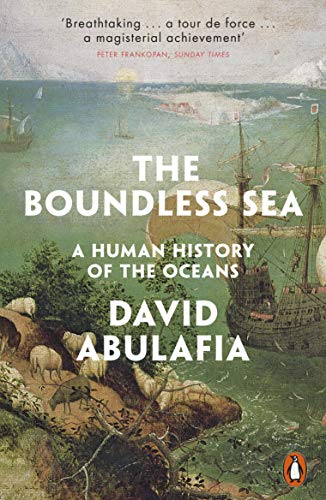
Synopsis
WINNER OF THE WOLFSON HISTORY PRIZE 2020
A SUNDAY TIMES, FINANCIAL TIMES, THE TIMES AND BBC HISTORY MAGAZINE BOOK OF THE YEAR
For most of human history, the seas and oceans have been the main means of long-distance trade and communication between peoples - for the spread of ideas and religion as well as commerce. This book traces the history of human movement and interaction around and across the world's greatest bodies of water, charting our relationship with the oceans from the time of the first voyagers. David Abulafia begins with the earliest of seafaring societies - the Polynesians of the Pacific, the possessors of intuitive navigational skills long before the invention of the compass, who by the first century were trading between their far-flung islands. By the seventh century, trading routes stretched from the coasts of Arabia and Africa to southern China and Japan, bringing together the Indian Ocean and the western Pacific and linking half the world through the international spice trade. In the Atlantic, centuries before the little kingdom of Portugal carved out its powerful, seaborne empire, many peoples sought new lands across the sea - the Bretons, the Frisians and, most notably, the Vikings, now known to be the first Europeans to reach North America. As Portuguese supremacy dwindled in the late sixteenth century, the Spanish, the Dutch and then the British each successively ruled the waves.
Following merchants, explorers, pirates, cartographers and travellers in their quests for spices, gold, ivory, slaves, lands for settlement and knowledge of what lay beyond, Abulafia has created an extraordinary narrative of humanity and the oceans. From the earliest forays of peoples in hand-hewn canoes through uncharted waters to the routes now taken daily by supertankers in their thousands, The Boundless Sea shows how maritime networks came to form a continuum of interaction and interconnection across the globe: 90 per cent of global trade is still conducted by sea. This is history of the grandest scale and scope, and from a bracingly different perspective - not, as in most global histories, from the land, but from the boundless seas.
Les informations fournies dans la section « Synopsis » peuvent faire référence à une autre édition de ce titre.
À propos de l'auteur
David Abulafia is Emeritus Professor of Mediterranean History at the University of Cambridge, a Fellow of Gonville and Caius College and a former Chairman of the Cambridge History Faculty. His previous books include Frederick II, The Western Mediterranean Kingdoms and The Great Sea, which has been translated into a dozen languages. He is a member of the Academia Europaea, and in 2003 was made Commendatore dell'Ordine della Stella della Solidarietà Italiana in recognition of his work on Italian and Mediterranean history.
Les informations fournies dans la section « A propos du livre » peuvent faire référence à une autre édition de ce titre.
Résultats de recherche pour The Boundless Sea: A Human History of the Oceans

Image d'archives
The Boundless Sea: A Human History of the Oceans
Edité par
Penguin Books Ltd, United Kingdom, London, 2020
ISBN 10 : 0241956277
ISBN 13 : 9780241956274
Ancien ou d'occasion
Paperback
Vendeur : WorldofBooks, Goring-By-Sea, WS, Royaume-Uni
Évaluation du vendeur 5 sur 5 étoiles

Paperback. Etat : Very Good. WINNER OF THE WOLFSON HISTORY PRIZE 2020A SUNDAY TIMES, FINANCIAL TIMES, THE TIMES AND BBC HISTORY MAGAZINE BOOK OF THE YEARFor most of human history, the seas and oceans have been the main means of long-distance trade and communication between peoples - for the spread of ideas and religion as well as commerce. This book traces the history of human movement and interaction around and across the world's greatest bodies of water, charting our relationship with the oceans from the time of the first voyagers. David Abulafia begins with the earliest of seafaring societies - the Polynesians of the Pacific, the possessors of intuitive navigational skills long before the invention of the compass, who by the first century were trading between their far-flung islands. By the seventh century, trading routes stretched from the coasts of Arabia and Africa to southern China and Japan, bringing together the Indian Ocean and the western Pacific and linking half the world through the international spice trade. In the Atlantic, centuries before the little kingdom of Portugal carved out its powerful, seaborne empire, many peoples sought new lands across the sea - the Bretons, the Frisians and, most notably, the Vikings, now known to be the first Europeans to reach North America. As Portuguese supremacy dwindled in the late sixteenth century, the Spanish, the Dutch and then the British each successively ruled the waves.Following merchants, explorers, pirates, cartographers and travellers in their quests for spices, gold, ivory, slaves, lands for settlement and knowledge of what lay beyond, Abulafia has created an extraordinary narrative of humanity and the oceans. From the earliest forays of peoples in hand-hewn canoes through uncharted waters to the routes now taken daily by supertankers in their thousands, The Boundless Sea shows how maritime networks came to form a continuum of interaction and interconnection across the globe: 90 per cent of global trade is still conducted by sea. This is history of the grandest scale and scope, and from a bracingly different perspective - not, as in most global histories, from the land, but from the boundless seas. The book has been read, but is in excellent condition. Pages are intact and not marred by notes or highlighting. The spine remains undamaged. N° de réf. du vendeur GOR010868173
Acheter D'occasion
EUR 11,91
Expédition à EUR 6,69
Expédition depuis Royaume-Uni vers Etats-Unis
Expédition depuis Royaume-Uni vers Etats-Unis
Quantité disponible : 1 disponible(s)
Image d'archives
The Boundless Sea: A Human History of the Oceans
Vendeur : Chaparral Books, Portland, OR, Etats-Unis
Évaluation du vendeur 5 sur 5 étoiles
Paperback. Etat : Very Good. A clean copy in standard used condition, free of damage with minimal handling and shelf wear. No writing, highlighting, or remainder marks. Slight corner bumps to ends of spine. 1050pp. N° de réf. du vendeur CHAPabuBS
Acheter D'occasion
EUR 16,62
Expédition à EUR 6,72
Expédition nationale : Etats-Unis
Expédition nationale : Etats-Unis
Quantité disponible : 1 disponible(s)
Image d'archives
The Boundless Sea: A Human History of the Oceans
Edité par
Penguin Books Ltd, 2020
ISBN 10 : 0241956277
ISBN 13 : 9780241956274
Ancien ou d'occasion
Paperback
Vendeur : World of Books (was SecondSale), Montgomery, IL, Etats-Unis
Évaluation du vendeur 5 sur 5 étoiles
Paperback. Etat : Good. WINNER OF THE WOLFSON HISTORY PRIZE 2020A SUNDAY TIMES, FINANCIAL TIMES, THE TIMES AND BBC HISTORY MAGAZINE BOOK OF THE YEARFor most of human history, the seas and oceans have been the main means of long-distance trade and communication between peoples - for the spread of ideas and religion as well as commerce. This book traces the history of human movement and interaction around and across the world's greatest bodies of water, charting our relationship with the oceans from the time of the first voyagers. David Abulafia begins with the earliest of seafaring societies - the Polynesians of the Pacific, the possessors of intuitive navigational skills long before the invention of the compass, who by the first century were trading between their far-flung islands. By the seventh century, trading routes stretched from the coasts of Arabia and Africa to southern China and Japan, bringing together the Indian Ocean and the western Pacific and linking half the world through the international spice trade. In the Atlantic, centuries before the little kingdom of Portugal carved out its powerful, seaborne empire, many peoples sought new lands across the sea - the Bretons, the Frisians and, most notably, the Vikings, now known to be the first Europeans to reach North America. As Portuguese supremacy dwindled in the late sixteenth century, the Spanish, the Dutch and then the British each successively ruled the waves.Following merchants, explorers, pirates, cartographers and travellers in their quests for spices, gold, ivory, slaves, lands for settlement and knowledge of what lay beyond, Abulafia has created an extraordinary narrative of humanity and the oceans. From the earliest forays of peoples in hand-hewn canoes through uncharted waters to the routes now taken daily by supertankers in their thousands, The Boundless Sea shows how maritime networks came to form a continuum of interaction and interconnection across the globe: 90 per cent of global trade is still conducted by sea. This is history of the grandest scale and scope, and from a bracingly different perspective - not, as in most global histories, from the land, but from the boundless seas. N° de réf. du vendeur 00102733487
Acheter D'occasion
EUR 23,53
Livraison gratuite
Expédition nationale : Etats-Unis
Expédition nationale : Etats-Unis
Quantité disponible : 1 disponible(s)
Image d'archives
The Boundless Sea: A Human History of the Oceans
Edité par
Penguin Books Ltd, 2020
ISBN 10 : 0241956277
ISBN 13 : 9780241956274
Ancien ou d'occasion
Paperback
Vendeur : World of Books Inc, Montgomery, IL, Etats-Unis
Évaluation du vendeur 4 sur 5 étoiles

Paperback. Etat : Good. WINNER OF THE WOLFSON HISTORY PRIZE 2020A SUNDAY TIMES, FINANCIAL TIMES, THE TIMES AND BBC HISTORY MAGAZINE BOOK OF THE YEARFor most of human history, the seas and oceans have been the main means of long-distance trade and communication between peoples - for the spread of ideas and religion as well as commerce. This book traces the history of human movement and interaction around and across the world's greatest bodies of water, charting our relationship with the oceans from the time of the first voyagers. David Abulafia begins with the earliest of seafaring societies - the Polynesians of the Pacific, the possessors of intuitive navigational skills long before the invention of the compass, who by the first century were trading between their far-flung islands. By the seventh century, trading routes stretched from the coasts of Arabia and Africa to southern China and Japan, bringing together the Indian Ocean and the western Pacific and linking half the world through the international spice trade. In the Atlantic, centuries before the little kingdom of Portugal carved out its powerful, seaborne empire, many peoples sought new lands across the sea - the Bretons, the Frisians and, most notably, the Vikings, now known to be the first Europeans to reach North America. As Portuguese supremacy dwindled in the late sixteenth century, the Spanish, the Dutch and then the British each successively ruled the waves.Following merchants, explorers, pirates, cartographers and travellers in their quests for spices, gold, ivory, slaves, lands for settlement and knowledge of what lay beyond, Abulafia has created an extraordinary narrative of humanity and the oceans. From the earliest forays of peoples in hand-hewn canoes through uncharted waters to the routes now taken daily by supertankers in their thousands, The Boundless Sea shows how maritime networks came to form a continuum of interaction and interconnection across the globe: 90 per cent of global trade is still conducted by sea. This is history of the grandest scale and scope, and from a bracingly different perspective - not, as in most global histories, from the land, but from the boundless seas. N° de réf. du vendeur CIN0241956277G
Acheter D'occasion
EUR 25,38
Livraison gratuite
Expédition nationale : Etats-Unis
Expédition nationale : Etats-Unis
Quantité disponible : 1 disponible(s)
Image fournie par le vendeur
The Boundless Sea
Edité par
Penguin, 2020
ISBN 10 : 0241956277
ISBN 13 : 9780241956274
Ancien ou d'occasion
Couverture souple
Vendeur : GreatBookPrices, Columbia, MD, Etats-Unis
Évaluation du vendeur 5 sur 5 étoiles
Etat : As New. Unread book in perfect condition. N° de réf. du vendeur 40407874
Acheter D'occasion
EUR 23,49
Expédition à EUR 2,37
Expédition nationale : Etats-Unis
Expédition nationale : Etats-Unis
Quantité disponible : Plus de 20 disponibles
Image d'archives
The Boundless Sea: A Human History of the Oceans
Vendeur : Chiron Media, Wallingford, Royaume-Uni
Évaluation du vendeur 5 sur 5 étoiles
paperback. Etat : New. Brand new book, sourced directly from publisher. Dispatch time is 24-48 hours from our warehouse. Book will be sent in robust, secure packaging to ensure it reaches you securely. N° de réf. du vendeur 6666-GRD-9780241956274
Acheter neuf
EUR 18,37
Expédition à EUR 7,75
Expédition depuis Royaume-Uni vers Etats-Unis
Expédition depuis Royaume-Uni vers Etats-Unis
Quantité disponible : Plus de 20 disponibles
Image fournie par le vendeur
The Boundless Sea
Vendeur : GreatBookPrices, Columbia, MD, Etats-Unis
Évaluation du vendeur 5 sur 5 étoiles
Etat : New. N° de réf. du vendeur 40407874-n
Acheter neuf
EUR 24,47
Expédition à EUR 2,37
Expédition nationale : Etats-Unis
Expédition nationale : Etats-Unis
Quantité disponible : Plus de 20 disponibles
Image d'archives
The Boundless Sea
Vendeur : PBShop.store UK, Fairford, GLOS, Royaume-Uni
Évaluation du vendeur 5 sur 5 étoiles
PAP. Etat : New. New Book. Shipped from UK. Established seller since 2000. N° de réf. du vendeur DB-9780241956274
Acheter neuf
EUR 21,78
Expédition à EUR 7,01
Expédition depuis Royaume-Uni vers Etats-Unis
Expédition depuis Royaume-Uni vers Etats-Unis
Quantité disponible : 11 disponible(s)
Image fournie par le vendeur
The Boundless Sea
Vendeur : Rarewaves.com USA, London, LONDO, Royaume-Uni
Évaluation du vendeur 5 sur 5 étoiles
Paperback. Etat : New. WINNER OF THE WOLFSON HISTORY PRIZE 2020A SUNDAY TIMES, FINANCIAL TIMES, THE TIMES AND BBC HISTORY MAGAZINE BOOK OF THE YEARFor most of human history, the seas and oceans have been the main means of long-distance trade and communication between peoples - for the spread of ideas and religion as well as commerce. This book traces the history of human movement and interaction around and across the world's greatest bodies of water, charting our relationship with the oceans from the time of the first voyagers. David Abulafia begins with the earliest of seafaring societies - the Polynesians of the Pacific, the possessors of intuitive navigational skills long before the invention of the compass, who by the first century were trading between their far-flung islands. By the seventh century, trading routes stretched from the coasts of Arabia and Africa to southern China and Japan, bringing together the Indian Ocean and the western Pacific and linking half the world through the international spice trade. In the Atlantic, centuries before the little kingdom of Portugal carved out its powerful, seaborne empire, many peoples sought new lands across the sea - the Bretons, the Frisians and, most notably, the Vikings, now known to be the first Europeans to reach North America. As Portuguese supremacy dwindled in the late sixteenth century, the Spanish, the Dutch and then the British each successively ruled the waves.Following merchants, explorers, pirates, cartographers and travellers in their quests for spices, gold, ivory, slaves, lands for settlement and knowledge of what lay beyond, Abulafia has created an extraordinary narrative of humanity and the oceans. From the earliest forays of peoples in hand-hewn canoes through uncharted waters to the routes now taken daily by supertankers in their thousands, The Boundless Sea shows how maritime networks came to form a continuum of interaction and interconnection across the globe: 90 per cent of global trade is still conducted by sea. This is history of the grandest scale and scope, and from a bracingly different perspective - not, as in most global histories, from the land, but from the boundless seas. N° de réf. du vendeur LU-9780241956274
Acheter neuf
EUR 29,16
Livraison gratuite
Expédition depuis Royaume-Uni vers Etats-Unis
Expédition depuis Royaume-Uni vers Etats-Unis
Quantité disponible : 13 disponible(s)
Image d'archives
The Boundless Sea: A Human History of the Oceans
Edité par
Penguin, 2020
ISBN 10 : 0241956277
ISBN 13 : 9780241956274
Neuf
Couverture souple
Edition originale
Vendeur : Kennys Bookshop and Art Galleries Ltd., Galway, GY, Irlande
Évaluation du vendeur 5 sur 5 étoiles
Etat : New. 2020. 1st Edition. paperback. . . . . . N° de réf. du vendeur V9780241956274
Acheter neuf
EUR 20,37
Expédition à EUR 9,50
Expédition depuis Irlande vers Etats-Unis
Expédition depuis Irlande vers Etats-Unis
Quantité disponible : Plus de 20 disponibles