
Articles liés à Acting in an Uncertain World: An Essay on Technical...
Acting in an Uncertain World: An Essay on Technical Democracy - Couverture rigide
Livre 13 sur 63: Inside Technology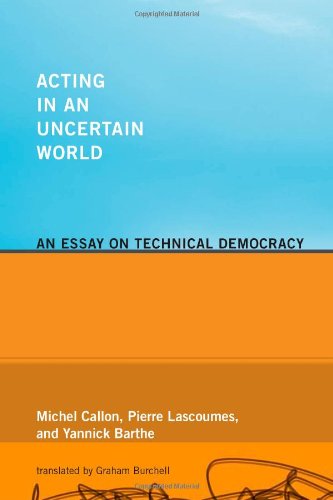
Synopsis
A call for a new form of democracy in which “hybrid forums” composed of experts and laypeople address such sociotechnical controversies as hazardous waste, genetically modified organisms, and nanotechnology.
Controversies over such issues as nuclear waste, genetically modified organisms, asbestos, tobacco, gene therapy, avian flu, and cell phone towers arise almost daily as rapid scientific and technological advances create uncertainty and bring about unforeseen concerns. The authors of Acting in an Uncertain World argue that political institutions must be expanded and improved to manage these controversies, to transform them into productive conversations, and to bring about “technical democracy.” They show how “hybrid forums”—in which experts, non-experts, ordinary citizens, and politicians come together—reveal the limits of traditional delegative democracies, in which decisions are made by quasi-professional politicians and techno-scientific information is the domain of specialists in laboratories. The division between professionals and laypeople, the authors claim, is simply outmoded. The authors argue that laboratory research should be complemented by everyday experimentation pursued in the real world, and they describe various modes of cooperation between the two. They explore a range of concrete examples of hybrid forums that have dealt with sociotechnical controversies including nuclear waste disposal in France, industrial waste and birth defects in Japan, a childhood leukemia cluster in Woburn, Massachusetts, and mad cow disease in the United Kingdom. The authors discuss the implications for political decision making in general and describe a “dialogic” democracy that enriches traditional representative democracy. To invent new procedures for consultation and representation, they suggest, is to contribute to an endless process that is necessary for the ongoing democratization of democracy.
Les informations fournies dans la section « Synopsis » peuvent faire référence à une autre édition de ce titre.
À propos de l'auteur
Michel Callon, developer (with Bruno Latour and others) of Actor Network Theory, is Professor at the École des mines de Paris and a Researcher at the Centre de Sociologie de l'innovation there.
Pierre Lascoumes is Director of Research at CNRS (Centre national de la recherche scientfique).
Yannick Barthe is a Researcher at CNRS (Centre national de la recherche scientifique) and a member of the Centre de sociologie de l'innovation.
Les informations fournies dans la section « A propos du livre » peuvent faire référence à une autre édition de ce titre.
Résultats de recherche pour Acting in an Uncertain World: An Essay on Technical...

Image d'archives
Acting in an Uncertain World : An Essay on Technical Democracy
Edité par
MIT Press, 2009
ISBN 10 : 0262033828
ISBN 13 : 9780262033824
Ancien ou d'occasion
Couverture rigide
Vendeur : Better World Books: West, Reno, NV, Etats-Unis
Évaluation du vendeur 5 sur 5 étoiles

Etat : Very Good. Former library copy. Pages intact with possible writing/highlighting. Binding strong with minor wear. Dust jackets/supplements may not be included. Includes library markings. Stock photo provided. Product includes identifying sticker. Better World Books: Buy Books. Do Good. N° de réf. du vendeur 15100547-6
Acheter D'occasion
EUR 10,38
Livraison gratuite
Expédition nationale : Etats-Unis
Expédition nationale : Etats-Unis
Quantité disponible : 2 disponible(s)
Image d'archives
Acting in an Uncertain World â" An Essay on Technical Democracy Translated by Graham Burchell from French (Inside Technology)
Edité par
Mit Pr, 2009
ISBN 10 : 0262033828
ISBN 13 : 9780262033824
Ancien ou d'occasion
Couverture rigide
Vendeur : WorldofBooks, Goring-By-Sea, WS, Royaume-Uni
Évaluation du vendeur 5 sur 5 étoiles
Hardback. Etat : Good. The book has been read but remains in clean condition. All pages are intact and the cover is intact. Some minor wear to the spine. N° de réf. du vendeur GOR015130986
Acheter D'occasion
EUR 9,88
Expédition à EUR 6,62
Expédition depuis Royaume-Uni vers Etats-Unis
Expédition depuis Royaume-Uni vers Etats-Unis
Quantité disponible : 1 disponible(s)
Image d'archives
Acting in an Uncertain World: An Essay on Technical Democracy (Inside Technology)
Edité par
Mit Pr (edition ), 2009
ISBN 10 : 0262033828
ISBN 13 : 9780262033824
Ancien ou d'occasion
Couverture rigide
Vendeur : BooksRun, Philadelphia, PA, Etats-Unis
Évaluation du vendeur 5 sur 5 étoiles
Hardcover. Etat : Fair. The item might be beaten up but readable. May contain markings or highlighting, as well as stains, bent corners, or any other major defect, but the text is not obscured in any way. N° de réf. du vendeur 0262033828-7-1-13
Acheter D'occasion
EUR 17,92
Livraison gratuite
Expédition nationale : Etats-Unis
Expédition nationale : Etats-Unis
Quantité disponible : 1 disponible(s)
Image d'archives
Acting in an Uncertain World: An Essay on Technical Democracy (Inside Technology)
Edité par
Mit Pr (edition ), 2009
ISBN 10 : 0262033828
ISBN 13 : 9780262033824
Ancien ou d'occasion
Couverture rigide
Vendeur : BooksRun, Philadelphia, PA, Etats-Unis
Évaluation du vendeur 5 sur 5 étoiles
Hardcover. Etat : Very Good. With dust jacket. It's a well-cared-for item that has seen limited use. The item may show minor signs of wear. All the text is legible, with all pages included. It may have slight markings and/or highlighting. N° de réf. du vendeur 0262033828-11-1-29
Acheter D'occasion
EUR 17,92
Livraison gratuite
Expédition nationale : Etats-Unis
Expédition nationale : Etats-Unis
Quantité disponible : 1 disponible(s)
Image d'archives
Acting in an Uncertain World - An Essay on Technical Democracy Translated by Graham Burchell from French
Edité par
MIT Press, Cambridge, MA, (2009), 2009
ISBN 10 : 0262033828
ISBN 13 : 9780262033824
Ancien ou d'occasion
Couverture rigide
Edition originale
Vendeur : Heartwood Books, A.B.A.A., Charlottesville, VA, Etats-Unis
Évaluation du vendeur 5 sur 5 étoiles
Cloth. Etat : Very Good Plus. Etat de la jaquette : Very Good Plus. 1st Edition. Very Good Plus, internally clean, solid hard cover First Printing in a complete Very Good Plus dust jacket. N° de réf. du vendeur 023778
Acheter D'occasion
EUR 36,78
Expédition à EUR 4,45
Expédition nationale : Etats-Unis
Expédition nationale : Etats-Unis
Quantité disponible : 1 disponible(s)
Image fournie par le vendeur
Acting in an Uncertain World: An Essay on Technical Democracy (Inside Technology Series)
Edité par
MIT Press, 2009
ISBN 10 : 0262033828
ISBN 13 : 9780262033824
Ancien ou d'occasion
Couverture rigide
Edition originale
Vendeur : Cambridge Recycled Books, Cambridge, Royaume-Uni
Évaluation du vendeur 5 sur 5 étoiles
Hardcover. Etat : Very Good. Etat de la jaquette : Very Good. First Edition. Appears to have hardly been read. Same day dispatch (Mon- Fri) from the UK if ordered by 1pm. N° de réf. du vendeur SS16220919008
Acheter D'occasion
EUR 36,51
Expédition à EUR 26,58
Expédition depuis Royaume-Uni vers Etats-Unis
Expédition depuis Royaume-Uni vers Etats-Unis
Quantité disponible : 1 disponible(s)