
Articles liés à Becoming MIT: Moments of Decision
Synopsis
The evolution of MIT, as seen in a series of crucial decisions over the years.
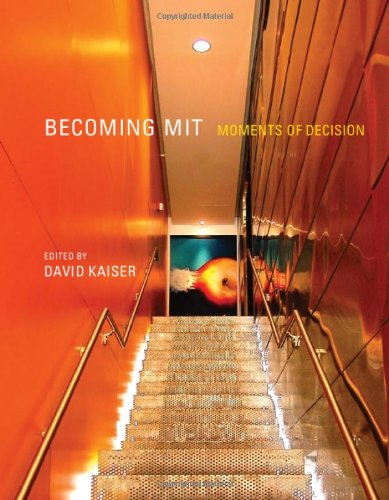
How did MIT become MIT? The Massachusetts Institute of Technology marks the 150th anniversary of its founding in 2011. Over the years, MIT has lived by its motto, “Mens et Manus” (“Mind and Hand”), dedicating itself to the pursuit of knowledge and its application to real-world problems. MIT has produced leading scholars in fields ranging from aeronautics to economics, invented entire academic disciplines, and transformed ideas into market-ready devices. This book examines a series of turning points, crucial decisions that helped define MIT. Many of these issues have relevance today: the moral implications of defense contracts, the optimal balance between government funding and private investment, and the right combination of basic science, engineering, and humanistic scholarship in the curriculum.
Chapters describe the educational vison and fund-raising acumen of founder William Barton Rogers (MIT was among the earliest recipients of land grant funding); MIT's relationship with Harvard—its rival, doppelgänger, and, for a brief moment, degree-conferring partner; the battle between pure science and industrial sponsorship in the early twentieth century; MIT's rapid expansion during World War II because of defense work and military training courses; the conflict between Cold War gadgetry and the humanities; protests over defense contracts at the height of the Vietnam War; the uproar in the local community over the perceived riskiness of recombinant DNA research; and the measures taken to reverse years of institutionalized discrimination against women scientists.
Les informations fournies dans la section « Synopsis » peuvent faire référence à une autre édition de ce titre.
À propos de l'auteur
David Kaiser is Germeshausen Professor of the History of Science, Department Head of the Program in Science, Technology, and Society, and Senior Lecturer in the Department of Physics at MIT. He is the author of Drawing Theories Apart: The Dispersion of the Feynman Diagrams in Postwar Physics, and editor of Pedagogy and the Practice of Science: Historical and Contemporary Perspectives (MIT Press).
Merritt Roe Smith is Cutten Professor of the History of Technology at MIT and the author or editor of six books, most recently Inventing America: A History of the United States.
Bruce Sinclair, formerly Melvin Kranzberg Professor of the History of Technology at the Georgia Institute of Technology, is a Senior Fellow at the Dibner Institute at MIT. He has served as president of the Society for the History of Technology and received its Da Vinci Medal.
Christophe Lécuyer is Professor of the History of Science and Technology at Université Pierre et Marie Curie and the author of Making Silicon Valley: Innovation and the Growth of High Tech, 1930-1970 (MIT Press, 2005).
Deborah G. Douglas is Curator of Science and Technology at the MIT Museum. She was the curator and project director for the MIT 150 Exhibition.
David Kaiser is Germeshausen Professor of the History of Science, Department Head of the Program in Science, Technology, and Society, and Senior Lecturer in the Department of Physics at MIT. He is the author of Drawing Theories Apart: The Dispersion of the Feynman Diagrams in Postwar Physics, and editor of Pedagogy and the Practice of Science: Historical and Contemporary Perspectives (MIT Press).
Les informations fournies dans la section « A propos du livre » peuvent faire référence à une autre édition de ce titre.
Résultats de recherche pour Becoming MIT: Moments of Decision

Image fournie par le vendeur
Becoming Mit: Moments of Decision
Edité par
Mit Pr, 2010
ISBN 10 : 0262113236
ISBN 13 : 9780262113236
Ancien ou d'occasion
Couverture rigide
Vendeur : Bay State Book Company, North Smithfield, RI, Etats-Unis
Évaluation du vendeur 5 sur 5 étoiles

Etat : very_good. N° de réf. du vendeur BSM.1EJ39
Acheter D'occasion
EUR 12,91
Livraison gratuite
Expédition nationale : Etats-Unis
Expédition nationale : Etats-Unis
Quantité disponible : 1 disponible(s)
Image d'archives
Becoming Mit: Moments of Decision
Edité par
Mit Pr, 2010
ISBN 10 : 0262113236
ISBN 13 : 9780262113236
Ancien ou d'occasion
Couverture rigide
Vendeur : Roundabout Books, Greenfield, MA, Etats-Unis
Évaluation du vendeur 4 sur 5 étoiles

hardcover. Etat : Near Fine. Condition Notes: Excellent, unmarked copy with little wear and tight binding. We ship in recyclable American-made mailers. 100% money-back guarantee on all orders. N° de réf. du vendeur 1783070
Acheter D'occasion
EUR 13,97
Livraison gratuite
Expédition nationale : Etats-Unis
Expédition nationale : Etats-Unis
Quantité disponible : 1 disponible(s)
Image fournie par le vendeur
Becoming Mit: Moments of Decision
Edité par
Mit Pr, 2010
ISBN 10 : 0262113236
ISBN 13 : 9780262113236
Ancien ou d'occasion
Couverture rigide
Vendeur : Shakespeare Book House, Rockford, IL, Etats-Unis
Évaluation du vendeur 5 sur 5 étoiles
Etat : very_good. The book is clean and shows minor shelf ware, N° de réf. du vendeur EBBV.0262113236.VG
Acheter D'occasion
EUR 10,90
Expédition à EUR 3,56
Expédition nationale : Etats-Unis
Expédition nationale : Etats-Unis
Quantité disponible : 1 disponible(s)
Image d'archives
Becoming Mit: Moments of Decision
Edité par
Mit Pr, 2010
ISBN 10 : 0262113236
ISBN 13 : 9780262113236
Ancien ou d'occasion
Couverture rigide
Vendeur : ThriftBooks-Phoenix, Phoenix, AZ, Etats-Unis
Évaluation du vendeur 5 sur 5 étoiles
Hardcover. Etat : Very Good. No Jacket. May have limited writing in cover pages. Pages are unmarked. ~ ThriftBooks: Read More, Spend Less. N° de réf. du vendeur G0262113236I4N00
Acheter D'occasion
EUR 14,56
Livraison gratuite
Expédition nationale : Etats-Unis
Expédition nationale : Etats-Unis
Quantité disponible : 1 disponible(s)
Image d'archives
Becoming Mit: Moments of Decision
Edité par
Mit Pr, 2010
ISBN 10 : 0262113236
ISBN 13 : 9780262113236
Ancien ou d'occasion
Couverture rigide
Vendeur : ThriftBooks-Atlanta, AUSTELL, GA, Etats-Unis
Évaluation du vendeur 5 sur 5 étoiles
Hardcover. Etat : Very Good. No Jacket. May have limited writing in cover pages. Pages are unmarked. ~ ThriftBooks: Read More, Spend Less. N° de réf. du vendeur G0262113236I4N00
Acheter D'occasion
EUR 14,56
Livraison gratuite
Expédition nationale : Etats-Unis
Expédition nationale : Etats-Unis
Quantité disponible : 1 disponible(s)
Image d'archives
Becoming MIT : Moments of Decision
Edité par
MIT Press, 2010
ISBN 10 : 0262113236
ISBN 13 : 9780262113236
Ancien ou d'occasion
Couverture rigide
Vendeur : Better World Books: West, Reno, NV, Etats-Unis
Évaluation du vendeur 5 sur 5 étoiles
Etat : Fine. Used book that is in almost brand-new condition. May contain a remainder mark. Better World Books: Buy Books. Do Good. N° de réf. du vendeur 68101137-75
Acheter D'occasion
EUR 15,30
Livraison gratuite
Expédition nationale : Etats-Unis
Expédition nationale : Etats-Unis
Quantité disponible : 1 disponible(s)
Image d'archives
Becoming MIT: Moments of Decision
Edité par
The M.I.T Press, 2010
ISBN 10 : 0262113236
ISBN 13 : 9780262113236
Ancien ou d'occasion
Couverture rigide
Vendeur : Anybook.com, Lincoln, Royaume-Uni
Évaluation du vendeur 5 sur 5 étoiles
Etat : Good. This is an ex-library book and may have the usual library/used-book markings inside.This book has hardback covers. In good all round condition. No dust jacket. Please note the Image in this listing is a stock photo and may not match the covers of the actual item,600grams, ISBN:9780262113236. N° de réf. du vendeur 5788026
Acheter D'occasion
EUR 12,56
Expédition à EUR 15,41
Expédition depuis Royaume-Uni vers Etats-Unis
Expédition depuis Royaume-Uni vers Etats-Unis
Quantité disponible : 1 disponible(s)
Image d'archives
Becoming Mit: Moments of Decision
Edité par
Mit Pr, 2010
ISBN 10 : 0262113236
ISBN 13 : 9780262113236
Ancien ou d'occasion
Couverture rigide
Vendeur : Boswell's Books, Shelburne Falls, MA, Etats-Unis
Évaluation du vendeur 4 sur 5 étoiles
hardcover. Etat : Near Fine. Condition Notes: Excellent, unmarked copy with little wear and tight binding. We ship in recyclable American-made mailers. 100% money-back guarantee on all orders. N° de réf. du vendeur 1783070
Acheter D'occasion
EUR 32,31
Livraison gratuite
Expédition nationale : Etats-Unis
Expédition nationale : Etats-Unis
Quantité disponible : 1 disponible(s)
Image d'archives
Becoming Mit: Moments of Decision
Vendeur : GoldBooks, Denver, CO, Etats-Unis
Évaluation du vendeur 5 sur 5 étoiles
Hardcover. Etat : new. New Copy. Customer Service Guaranteed. N° de réf. du vendeur 6T70_90_0262113236
Acheter neuf
EUR 35,30
Expédition à EUR 4,91
Expédition nationale : Etats-Unis
Expédition nationale : Etats-Unis
Quantité disponible : 1 disponible(s)
Image d'archives
Becoming MIT Moments of Decision
Vendeur : Revaluation Books, Exeter, Royaume-Uni
Évaluation du vendeur 5 sur 5 étoiles
Hardcover. Etat : Brand New. 224 pages. 9.25x7.25x1.00 inches. In Stock. N° de réf. du vendeur 0262113236
Acheter neuf
EUR 80,04
Expédition à EUR 14,77
Expédition depuis Royaume-Uni vers Etats-Unis
Expédition depuis Royaume-Uni vers Etats-Unis
Quantité disponible : 1 disponible(s)