
Articles liés à Do the Right Thing: Studies in Limited Rationality
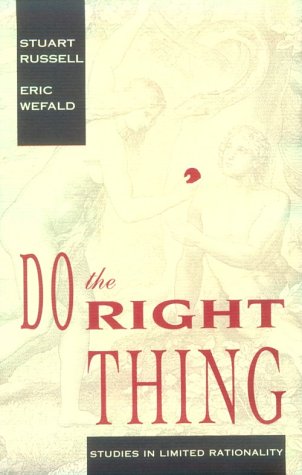
Synopsis
The authors argue that a new theoretical foundation for artificial intelligence can be constructed in which rationality is a property of "programs" within a finite architecture, and their behavior over time in the task environment, rather than a property of individual decisions.
Like Mooki, the hero of Spike Lee's film "Do the Right Thing," artificially intelligent systems have a hard time knowing what to do in all circumstances. Classical theories of perfect rationality prescribe the "right thing" for any occasion, but no finite agent can compute their prescriptions fast enough. In Do the Right Thing, the authors argue that a new theoretical foundation for artificial intelligence can be constructed in which rationality is a property of "programs" within a finite architecture, and their behavior over time in the task environment, rather than a property of individual decisions. Do the Right Thing suggests that the rich structure that seems to be exhibited by humans, and ought to be exhibited by AI systems, is a necessary result of the pressure for optimal behavior operating within a system of strictly limited resources. It provides an outline for the design of new intelligent systems and describes theoretical and practical tools for bringing about intelligent behavior in finite machines. The tools are applied to game planning and realtime problem solving, with surprising results.
This book builds on important philosophical and technical work by his coauthor, the late Eric Wefald.
Les informations fournies dans la section « Synopsis » peuvent faire référence à une autre édition de ce titre.
À propos de l'auteur
Stuart Russell is Associate Professor of Computer Science at the University of California, Berkeley. This book builds on important philosophical and technical work by his coauthor, the late Eric Wefald.
Les informations fournies dans la section « A propos du livre » peuvent faire référence à une autre édition de ce titre.
Résultats de recherche pour Do the Right Thing: Studies in Limited Rationality

Image d'archives
Do the right thing : studies in limited rationality.
Edité par
Mit Pr, 1991
ISBN 10 : 0262181444
ISBN 13 : 9780262181440
Ancien ou d'occasion
Couverture rigide
Vendeur : Kloof Booksellers & Scientia Verlag, Amsterdam, Pays-Bas
Évaluation du vendeur 4 sur 5 étoiles

Etat : as new. Cambridge, MA : M.I.T. Press, 1991. Hardcover. Dustjacket. xx,200 pp. - Like Mooki, the hero of Spike Lee's film "Do the Right Thing," artificially intelligent systems have a hard time knowing what to do in all circumstances. Classical theories of perfect rationality prescribe the "right thing" for any occasion, but no finite agent can compute their prescriptions fast enough. In Do the Right Thing, the authors argue that a new theoretical foundation for artificial intelligence can be constructed in which rationality is a property of "programs" within a finite architecture, and their behavior over time in the task environment, rather than a property of individual decisions. Do the Right Thing suggests that the rich structure that seems to be exhibited by humans, and ought to be exhibited by AI systems, is a necessary result of the pressure for optimal behavior operating within a system of strictly limited resources. It provides an outline for the design of new intelligent systems and describes theoretical and practical tools for bringing about intelligent behavior in finite machines. The tools are applied to game planning and real-time problem solving, with surprising results. Condition : as new copy. ISBN 9780262181440. Keywords : PHILOSOPHY, *2018-20 philosophy. N° de réf. du vendeur 268128
Acheter D'occasion
EUR 16,95
Expédition à EUR 30
Expédition depuis Pays-Bas vers Etats-Unis
Expédition depuis Pays-Bas vers Etats-Unis
Quantité disponible : 1 disponible(s)
Image fournie par le vendeur
Do the Right Thing: Studies in Limited Rationality (Artificial Intelligence)
Edité par
Mit Pr, 1991
ISBN 10 : 0262181444
ISBN 13 : 9780262181440
Ancien ou d'occasion
Couverture rigide
Vendeur : -OnTimeBooks-, Phoenix, AZ, Etats-Unis
Évaluation du vendeur 5 sur 5 étoiles

Etat : good. A copy that has been read, remains in good condition. All pages are intact, and the cover is intact. The spine and cover show signs of wear. Pages can include notes and highlighting and show signs of wear, and the copy can include "From the library of" labels or previous owner inscriptions. 100% GUARANTEE! Shipped with delivery confirmation, if you're not satisfied with purchase please return item! Ships via media mail. N° de réf. du vendeur OTV.0262181444.G
Acheter D'occasion
EUR 90,08
Livraison gratuite
Expédition nationale : Etats-Unis
Expédition nationale : Etats-Unis
Quantité disponible : 1 disponible(s)
Image d'archives
Do the Right Thing: Studies in Limited Rationality (Artificial Intelligence)
Vendeur : SHIMEDIA, Brooklyn, NY, Etats-Unis
Évaluation du vendeur 4 sur 5 étoiles
Etat : New. Satisfaction Guaranteed or your money back. N° de réf. du vendeur 0262181444
Acheter neuf
EUR 90,55
Livraison gratuite
Expédition nationale : Etats-Unis
Expédition nationale : Etats-Unis
Quantité disponible : 1 disponible(s)