
Articles liés à Free Will
Synopsis
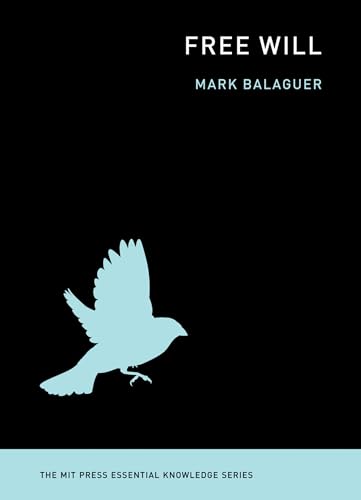
A philosopher considers whether the scientific and philosophical arguments against free will are reason enough to give up our belief in it.
Les informations fournies dans la section « Synopsis » peuvent faire référence à une autre édition de ce titre.
À propos de l'auteur
Mark Balaguer is Professor in the Department of Philosophy at California State University, Los Angeles. He is the author of Platonism and Anti-Platonism in Mathematics and Free Will as an Open Scientific Question (MIT Press).
Les informations fournies dans la section « A propos du livre » peuvent faire référence à une autre édition de ce titre.
Résultats de recherche pour Free Will

Image d'archives
Free Will
Edité par
MIT Press, 2014
ISBN 10 : 0262525798
ISBN 13 : 9780262525794
Ancien ou d'occasion
Couverture souple
Vendeur : Better World Books, Mishawaka, IN, Etats-Unis
Évaluation du vendeur 5 sur 5 étoiles

Etat : Good. Former library copy. Pages intact with minimal writing/highlighting. The binding may be loose and creased. Dust jackets/supplements are not included. Includes library markings. Stock photo provided. Product includes identifying sticker. Better World Books: Buy Books. Do Good. N° de réf. du vendeur 51314698-6
Acheter D'occasion
EUR 7,79
Livraison gratuite
Expédition nationale : Etats-Unis
Expédition nationale : Etats-Unis
Quantité disponible : 1 disponible(s)
Image d'archives
Free Will (The MIT Press Essential Knowledge series)
Edité par
The MIT Press, 2014
ISBN 10 : 0262525798
ISBN 13 : 9780262525794
Ancien ou d'occasion
paperback
Vendeur : HPB Inc., Dallas, TX, Etats-Unis
Évaluation du vendeur 5 sur 5 étoiles
paperback. Etat : Very Good. Connecting readers with great books since 1972! Used books may not include companion materials, and may have some shelf wear or limited writing. We ship orders daily and Customer Service is our top priority! N° de réf. du vendeur S_483100565
Acheter D'occasion
EUR 7,09
Expédition à EUR 3,23
Expédition nationale : Etats-Unis
Expédition nationale : Etats-Unis
Quantité disponible : 1 disponible(s)
Image d'archives
Free Will (MIT Press Essential Knowledge series)
Edité par
The MIT Press, 2014
ISBN 10 : 0262525798
ISBN 13 : 9780262525794
Ancien ou d'occasion
Paperback
Vendeur : Midtown Scholar Bookstore, Harrisburg, PA, Etats-Unis
Évaluation du vendeur 5 sur 5 étoiles
Paperback. Etat : Very Good. Very Good - Crisp, clean, unread book with some shelfwear/edgewear, may have a remainder mark - NICE Standard-sized. N° de réf. du vendeur M0262525798Z2
Acheter D'occasion
EUR 6,93
Expédition à EUR 5,17
Expédition nationale : Etats-Unis
Expédition nationale : Etats-Unis
Quantité disponible : Plus de 20 disponibles
Image d'archives
Free Will (MIT Press Essential Knowledge series)
Edité par
The MIT Press, 2014
ISBN 10 : 0262525798
ISBN 13 : 9780262525794
Ancien ou d'occasion
Paperback
Vendeur : Midtown Scholar Bookstore, Harrisburg, PA, Etats-Unis
Évaluation du vendeur 5 sur 5 étoiles
Paperback. Etat : Good. Good paperback, bumped/creased with shelfwear; may have previous owner's name inside. Standard-sized. N° de réf. du vendeur mon0000345621
Acheter D'occasion
EUR 7,16
Expédition à EUR 5,17
Expédition nationale : Etats-Unis
Expédition nationale : Etats-Unis
Quantité disponible : 1 disponible(s)
Image d'archives
Free Will (The MIT Press Essential Knowledge series)
Edité par
The MIT Press, 2014
ISBN 10 : 0262525798
ISBN 13 : 9780262525794
Ancien ou d'occasion
paperback
Vendeur : Books From California, Simi Valley, CA, Etats-Unis
Évaluation du vendeur 4 sur 5 étoiles

paperback. Etat : Fine. N° de réf. du vendeur mon0003715672
Acheter D'occasion
EUR 9,60
Expédition à EUR 4,30
Expédition nationale : Etats-Unis
Expédition nationale : Etats-Unis
Quantité disponible : 19 disponible(s)
Image fournie par le vendeur
Free Will
Vendeur : GreatBookPrices, Columbia, MD, Etats-Unis
Évaluation du vendeur 5 sur 5 étoiles
Etat : New. N° de réf. du vendeur 20281905-n
Acheter neuf
EUR 12,43
Expédition à EUR 2,27
Expédition nationale : Etats-Unis
Expédition nationale : Etats-Unis
Quantité disponible : Plus de 20 disponibles
Image fournie par le vendeur
Free Will
Vendeur : Rarewaves USA, HEBRON, KY, Etats-Unis
Évaluation du vendeur 5 sur 5 étoiles
Paperback. Etat : New. A philosopher considers whether the scientific and philosophical arguments against free will are reason enough to give up our belief in it.In our daily life, it really seems as though we have free will, that what we do from moment to moment is determined by conscious decisions that we freely make. You get up from the couch, you go for a walk, you eat chocolate ice cream. It seems that we're in control of actions like these; if we are, then we have free will. But in recent years, some have argued that free will is an illusion. The neuroscientist (and best-selling author) Sam Harris and the late Harvard psychologist Daniel Wegner, for example, claim that certain scientific findings disprove free will. In this engaging and accessible volume in the Essential Knowledge series, the philosopher Mark Balaguer examines the various arguments and experiments that have been cited to support the claim that human beings don't have free will. He finds them to be overstated and misguided.Balaguer discusses determinism, the view that every physical event is predetermined, or completely caused by prior events. He describes several philosophical and scientific arguments against free will, including one based on Benjamin Libet's famous neuroscientific experiments, which allegedly show that our conscious decisions are caused by neural events that occur before we choose. He considers various religious and philosophical views, including the philosophical pro-free-will view known as compatibilism. Balaguer concludes that the anti-free-will arguments put forward by philosophers, psychologists, and neuroscientists simply don't work. They don't provide any good reason to doubt the existence of free will. But, he cautions, this doesn't necessarily mean that we have free will. The question of whether we have free will remains an open one; we simply don't know enough about the brain to answer it definitively. N° de réf. du vendeur LU-9780262525794
Acheter neuf
EUR 14,78
Livraison gratuite
Expédition nationale : Etats-Unis
Expédition nationale : Etats-Unis
Quantité disponible : Plus de 20 disponibles
Image d'archives
Free Will (Paperback)
Edité par
MIT Press Ltd, Cambridge, Mass., 2014
ISBN 10 : 0262525798
ISBN 13 : 9780262525794
Neuf
Paperback
Vendeur : Grand Eagle Retail, Bensenville, IL, Etats-Unis
Évaluation du vendeur 5 sur 5 étoiles
Paperback. Etat : new. Paperback. A philosopher considers whether the scientific and philosophical arguments against free will are reason enough to give up our belief in it.In our daily life, it really seems as though we have free will, that what we do from moment to moment is determined by conscious decisions that we freely make. You get up from the couch, you go for a walk, you eat chocolate ice cream. It seems that we're in control of actions like these; if we are, then we have free will. But in recent years, some have argued that free will is an illusion. The neuroscientist (and best-selling author) Sam Harris and the late Harvard psychologist Daniel Wegner, for example, claim that certain scientific findings disprove free will. In this engaging and accessible volume in the Essential Knowledge series, the philosopher Mark Balaguer examines the various arguments and experiments that have been cited to support the claim that human beings don't have free will. He finds them to be overstated and misguided.Balaguer discusses determinism, the view that every physical event is predetermined, or completely caused by prior events. He describes several philosophical and scientific arguments against free will, including one based on Benjamin Libet's famous neuroscientific experiments, which allegedly show that our conscious decisions are caused by neural events that occur before we choose. He considers various religious and philosophical views, including the philosophical pro-free-will view known as compatibilism. Balaguer concludes that the anti-free-will arguments put forward by philosophers, psychologists, and neuroscientists simply don't work. They don't provide any good reason to doubt the existence of free will. But, he cautions, this doesn't necessarily mean that we have free will. The question of whether we have free will remains an open one; we simply don't know enough about the brain to answer it definitively.A philosopher considers whether the scientific and philosophical arguments against free will are reason enough to give up our belief in it.In our daily life, it really seems as though we have free will, that what we do from moment to moment is determined by conscious decisions that we freely make. You get up from the couch, you go for a walk, you eat chocolate ice cream. It seems that we're in control of actions like these; if we are, then we have free will. But in recent years, some have argued that free will is an illusion. The neuroscientist (and best-selling author) Sam Harris and the late Harvard psychologist Daniel Wegner, for example, claim that certain scientific findings disprove free will. In this engaging and accessible volume in the Essential Knowledge series, the philosopher Mark Balaguer examines the various arguments and experiments that have been cited to support the claim that human beings don't have free will. He finds them to be overstated and misguided.Balaguer discusses determinism, the view that every physical event is predetermined, or completely caused by prior events. He describes several philosophical and scientific arguments against free will, including one based on Benjamin Libet's famous neuroscientific experiments, which allegedly show that our conscious decisions are caused by neural events that occur before we choose. He considers various religious and philosophical views, including the philosophical pro-free-will view known as compatibilism. Balaguer concludes that the anti-free-will arguments put forward by philosophers, psychologists, and neuroscientists simply don't work. They don't provide any good reason to doubt the existence of free will. But, he cautions, this doesn't necessarily mean that we have free will. The question of whether we have free will remains an open one; we simply don't know enough about the brain to answer it definitively. A philosopher considers whether the scientific and philosophical a Shipping may be from multiple locations in the US or from the UK, depending on stock availability. N° de réf. du vendeur 9780262525794
Acheter neuf
EUR 16,84
Livraison gratuite
Expédition nationale : Etats-Unis
Expédition nationale : Etats-Unis
Quantité disponible : 1 disponible(s)
Image d'archives
Free Will (MIT Press Essential Knowledge series)
Vendeur : Chiron Media, Wallingford, Royaume-Uni
Évaluation du vendeur 5 sur 5 étoiles
paperback. Etat : New. Brand new book, sourced directly from publisher. Dispatch time is 24-48 hours from our warehouse. Book will be sent in robust, secure packaging to ensure it reaches you securely. N° de réf. du vendeur 6666-GRD-9780262525794
Acheter neuf
EUR 14,77
Expédition à EUR 2,32
Expédition depuis Royaume-Uni vers Etats-Unis
Expédition depuis Royaume-Uni vers Etats-Unis
Quantité disponible : 1 disponible(s)
Image d'archives
Free Will
Vendeur : Massive Bookshop, Erving, MA, Etats-Unis
Évaluation du vendeur 4 sur 5 étoiles
Paperback. Etat : New. N° de réf. du vendeur 9780262525794
Acheter neuf
EUR 16,81
Expédition à EUR 4,09
Expédition nationale : Etats-Unis
Expédition nationale : Etats-Unis
Quantité disponible : 10 disponible(s)