
Articles liés à The Fourth Dimension and Non-Euclidean Geometry in...
Synopsis
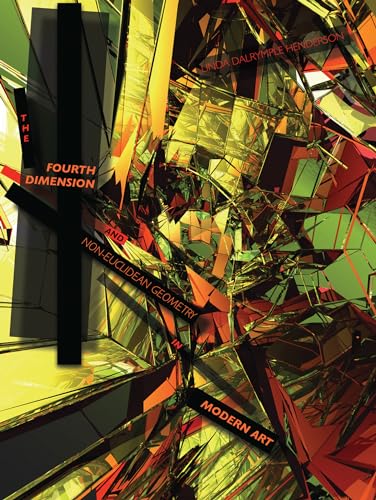
The long-awaited new edition of a groundbreaking work on the impact of alternative concepts of space on modern art.
In this groundbreaking study, first published in 1983 and unavailable for over a decade, Linda Dalrymple Henderson demonstrates that two concepts of space beyond immediate perception—the curved spaces of non-Euclidean geometry and, most important, a higher, fourth dimension of space—were central to the development of modern art. The possibility of a spatial fourth dimension suggested that our world might be merely a shadow or section of a higher dimensional existence. That iconoclastic idea encouraged radical innovation by a variety of early twentieth-century artists, ranging from French Cubists, Italian Futurists, and Marcel Duchamp, to Max Weber, Kazimir Malevich, and the artists of De Stijl and Surrealism.
In an extensive new Reintroduction, Henderson surveys the impact of interest in higher dimensions of space in art and culture from the 1950s to 2000. Although largely eclipsed by relativity theory beginning in the 1920s, the spatial fourth dimension experienced a resurgence during the later 1950s and 1960s. In a remarkable turn of events, it has returned as an important theme in contemporary culture in the wake of the emergence in the 1980s of both string theory in physics (with its ten- or eleven-dimensional universes) and computer graphics. Henderson demonstrates the importance of this new conception of space for figures ranging from Buckminster Fuller, Robert Smithson, and the Park Place Gallery group in the 1960s to Tony Robbin and digital architect Marcos Novak.
Les informations fournies dans la section « Synopsis » peuvent faire référence à une autre édition de ce titre.
À propos de l'auteur
Linda Dalrymple Henderson is David Bruton, Jr., Centennial Professor in Art History and Regents Outstanding Teaching Professor at the University of Texas at Austin. She is the author of Duchamp in Context: Science and Technology in the Large Glass and Related Works and Reimagining Space: The Park Place Gallery Group in 1960s New York and coeditor of From Energy to Information: Representation in Science and Technology, Art, and Literature.
Les informations fournies dans la section « A propos du livre » peuvent faire référence à une autre édition de ce titre.
Résultats de recherche pour The Fourth Dimension and Non-Euclidean Geometry in...

Image d'archives
The Fourth Dimension and Non-Euclidean Geometry in Modern Art, revised edition (Leonardo)
Edité par
The MIT Press, 2018
ISBN 10 : 0262536552
ISBN 13 : 9780262536554
Ancien ou d'occasion
paperback
Vendeur : Bellwetherbooks, McKeesport, PA, Etats-Unis
Évaluation du vendeur 4 sur 5 étoiles

paperback. Etat : Good. Bruise/tear to cover. N° de réf. du vendeur mon0000056407
Acheter D'occasion
EUR 34,95
Expédition à EUR 3,48
Expédition nationale : Etats-Unis
Expédition nationale : Etats-Unis
Quantité disponible : 1 disponible(s)
Image d'archives
The Fourth Dimension and Non-Euclidean Geometry in Modern Art, revised edition (Leonardo)
Edité par
The MIT Press, 2018
ISBN 10 : 0262536552
ISBN 13 : 9780262536554
Ancien ou d'occasion
Paperback
Vendeur : GCCebooks, Salinas, CA, Etats-Unis
Évaluation du vendeur 4 sur 5 étoiles
Paperback. Etat : Acceptable. 2nd Revised ed. The cover and pages show excessive wear and/or damage. Book edges have stains. Book edges have marks or writing. The cover is damaged. N° de réf. du vendeur 3UAP3I002L9N
Acheter D'occasion
EUR 38,57
Expédition à EUR 3,52
Expédition nationale : Etats-Unis
Expédition nationale : Etats-Unis
Quantité disponible : 1 disponible(s)
Image d'archives
The Fourth Dimension and Non-Euclidean Geometry in Modern Art, revised edition (Leonardo)
Vendeur : Books Puddle, Woodside, NY, Etats-Unis
Évaluation du vendeur 4 sur 5 étoiles
Etat : New. pp. 760. N° de réf. du vendeur 26379490493
Acheter neuf
EUR 43,81
Expédition à EUR 3,52
Expédition nationale : Etats-Unis
Expédition nationale : Etats-Unis
Quantité disponible : 3 disponible(s)
Image d'archives
TheFourthDimensionandNon-EuclideanGeometryinModern Format: TradePaperback
Vendeur : INDOO, Avenel, NJ, Etats-Unis
Évaluation du vendeur 5 sur 5 étoiles

Etat : As New. Unread copy in mint condition. N° de réf. du vendeur RH9780262536554
Acheter D'occasion
EUR 50,32
Livraison gratuite
Expédition nationale : Etats-Unis
Expédition nationale : Etats-Unis
Quantité disponible : Plus de 20 disponibles
Image d'archives
TheFourthDimensionandNon-EuclideanGeometryinModern Format: TradePaperback
Vendeur : INDOO, Avenel, NJ, Etats-Unis
Évaluation du vendeur 5 sur 5 étoiles
Etat : New. Brand New. N° de réf. du vendeur 9780262536554
Acheter neuf
EUR 50,41
Livraison gratuite
Expédition nationale : Etats-Unis
Expédition nationale : Etats-Unis
Quantité disponible : Plus de 20 disponibles
Image d'archives
The Fourth Dimension and Non-Euclidean Geometry in Modern Art (Paperback)
Edité par
MIT Press Ltd, Cambridge, Mass., 2018
ISBN 10 : 0262536552
ISBN 13 : 9780262536554
Neuf
Paperback
Vendeur : Grand Eagle Retail, Bensenville, IL, Etats-Unis
Évaluation du vendeur 5 sur 5 étoiles
Paperback. Etat : new. Paperback. The long-awaited new edition of a groundbreaking work on the impact of alternative concepts of space on modern art.In this groundbreaking study, first published in 1983 and unavailable for over a decade, Linda Dalrymple Henderson demonstrates that two concepts of space beyond immediate perception-the curved spaces of non-Euclidean geometry and, most important, a higher, fourth dimension of space-were central to the development of modern art. The possibility of a spatial fourth dimension suggested that our world might be merely a shadow or section of a higher dimensional existence. That iconoclastic idea encouraged radical innovation by a variety of early twentieth-century artists, ranging from French Cubists, Italian Futurists, and Marcel Duchamp, to Max Weber, Kazimir Malevich, and the artists of De Stijl and Surrealism.In an extensive new Reintroduction, Henderson surveys the impact of interest in higher dimensions of space in art and culture from the 1950s to 2000. Although largely eclipsed by relativity theory beginning in the 1920s, the spatial fourth dimension experienced a resurgence during the later 1950s and 1960s. In a remarkable turn of events, it has returned as an important theme in contemporary culture in the wake of the emergence in the 1980s of both string theory in physics (with its ten- or eleven-dimensional universes) and computer graphics. Henderson demonstrates the importance of this new conception of space for figures ranging from Buckminster Fuller, Robert Smithson, and the Park Place Gallery group in the 1960s to Tony Robbin and digital architect Marcos Novak. The long-awaited new edition of a groundbreaking work on the impact of alternative concepts of space on modern art. Shipping may be from multiple locations in the US or from the UK, depending on stock availability. N° de réf. du vendeur 9780262536554
Acheter neuf
EUR 55,85
Livraison gratuite
Expédition nationale : Etats-Unis
Expédition nationale : Etats-Unis
Quantité disponible : 1 disponible(s)
Image d'archives
Fourth Dimension and Non-Euclidean Geometry in Modern Art
Vendeur : GreatBookPrices, Columbia, MD, Etats-Unis
Évaluation du vendeur 5 sur 5 étoiles
Etat : New. N° de réf. du vendeur 33332673-n
Acheter neuf
EUR 53,87
Expédition à EUR 2,33
Expédition nationale : Etats-Unis
Expédition nationale : Etats-Unis
Quantité disponible : Plus de 20 disponibles
Image fournie par le vendeur
The Fourth Dimension and Non-Euclidean Geometry in Modern Art
Vendeur : Rarewaves USA, HEBRON, KY, Etats-Unis
Évaluation du vendeur 5 sur 5 étoiles
Paperback. Etat : New. revised edition. N° de réf. du vendeur LU-9780262536554
Acheter neuf
EUR 60,49
Livraison gratuite
Expédition nationale : Etats-Unis
Expédition nationale : Etats-Unis
Quantité disponible : Plus de 20 disponibles
Image d'archives
Fourth Dimension and Non-Euclidean Geometry in Modern Art
Edité par
The MIT Press, 2018
ISBN 10 : 0262536552
ISBN 13 : 9780262536554
Ancien ou d'occasion
Couverture souple
Vendeur : GreatBookPrices, Columbia, MD, Etats-Unis
Évaluation du vendeur 5 sur 5 étoiles
Etat : As New. Unread book in perfect condition. N° de réf. du vendeur 33332673
Acheter D'occasion
EUR 64,65
Expédition à EUR 2,33
Expédition nationale : Etats-Unis
Expédition nationale : Etats-Unis
Quantité disponible : Plus de 20 disponibles
Image d'archives
The Fourth Dimension and Non-Euclidean Geometry in Modern Art, Revised Edition
Edité par
MIT Press, Cambridge, 2018
ISBN 10 : 0262536552
ISBN 13 : 9780262536554
Ancien ou d'occasion
Trade paperback
Vendeur : Lost Books, AUSTIN, TX, Etats-Unis
Évaluation du vendeur 5 sur 5 étoiles
Trade paperback. Etat : Very good. 2nd Revised ed. Trade paperback (US). 760 p. Leonardo. Audience: General/trade. N° de réf. du vendeur Alibris.0018485
Acheter D'occasion
EUR 68,12
Expédition à EUR 4,40
Expédition nationale : Etats-Unis
Expédition nationale : Etats-Unis
Quantité disponible : 1 disponible(s)