
An Engine, Not a Camera: How Financial Models Shape Markets - Couverture souple
Livre 11 sur 63: Inside Technology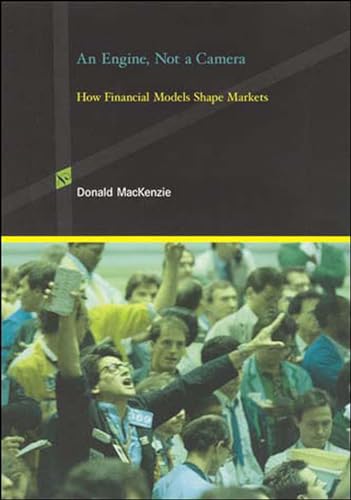
Synopsis
In An Engine, Not a Camera, Donald MacKenzie argues that the emergence of modern economic theories of finance affected financial markets in fundamental ways. These new, Nobel Prize-winning theories, based on elegant mathematical models of markets, were not simply external analyses but intrinsic parts of economic processes.
Paraphrasing Milton Friedman, MacKenzie says that economic models are an engine of inquiry rather than a camera to reproduce empirical facts. More than that, the emergence of an authoritative theory of financial markets altered those markets fundamentally. For example, in 1970, there was almost no trading in financial derivatives such as "futures." By June of 2004, derivatives contracts totaling $273 trillion were outstanding worldwide. MacKenzie suggests that this growth could never have happened without the development of theories that gave derivatives legitimacy and explained their complexities.
MacKenzie examines the role played by finance theory in the two most serious crises to hit the world's financial markets in recent years: the stock market crash of 1987 and the market turmoil that engulfed the hedge fund Long-Term Capital Management in 1998. He also looks at finance theory that is somewhat beyond the mainstream—chaos theorist Benoit Mandelbrot's model of "wild" randomness. MacKenzie's pioneering work in the social studies of finance will interest anyone who wants to understand how America's financial markets have grown into their current form.
Les informations fournies dans la section « Synopsis » peuvent faire référence à une autre édition de ce titre.
À propos de l?auteur
Donald MacKenzie is Professor of Sociology (Personal Chair) at the University of Edinburgh. His books include Inventing Accuracy (1990), Knowing Machines (1996), and Mechanizing Proof (2001), all published by the MIT Press. Portions of An Engine, not a Camera won the Viviana A. Zelizer Prize in economic sociology from the American Sociological Association.
Les informations fournies dans la section « A propos du livre » peuvent faire référence à une autre édition de ce titre.
Autres éditions populaires du même titre

Résultats de recherche pour An Engine, Not a Camera: How Financial Models Shape...

Image d'archives
An Engine, Not a Camera: How Financial Models Shape Markets (Inside Technology)
Edité par
The MIT Press (edition First Edition), 2008
ISBN 10 : 0262633671
ISBN 13 : 9780262633673
Ancien ou d'occasion
Paperback
Edition originale
Vendeur : BooksRun, Philadelphia, PA, Etats-Unis
Évaluation du vendeur 5 sur 5 étoiles

Paperback. Etat : Very Good. First Edition. It's a well-cared-for item that has seen limited use. The item may show minor signs of wear. All the text is legible, with all pages included. It may have slight markings and/or highlighting. N° de réf. du vendeur 0262633671-11-1
Acheter D'occasion
EUR 25,93
Livraison gratuite
Expédition nationale : Etats-Unis
Expédition nationale : Etats-Unis
Quantité disponible : 1 disponible(s)
Image fournie par le vendeur
An Engine, Not a Camera: How Financial Models Shape Markets (Inside Technology)
Edité par
The MIT Press, 2008
ISBN 10 : 0262633671
ISBN 13 : 9780262633673
Ancien ou d'occasion
Couverture souple
Vendeur : clickgoodwillbooks, Indianapolis, IN, Etats-Unis
Évaluation du vendeur 5 sur 5 étoiles
Etat : acceptable. Used - Acceptable: All pages and the cover are intact, but shrink wrap, dust covers, or boxed set case may be missing. Pages may include limited notes, highlighting, or minor water damage but the text is readable. Item may be missing bundled media. N° de réf. du vendeur CSIV.0262633671.A
Acheter D'occasion
EUR 24,55
Expédition à EUR 3,48
Expédition nationale : Etats-Unis
Expédition nationale : Etats-Unis
Quantité disponible : 1 disponible(s)
Image d'archives
An Engine, Not a Camera
Edité par
The MIT Press Bookstore, 2008
ISBN 10 : 0262633671
ISBN 13 : 9780262633673
Neuf
Couverture souple
Vendeur : Books Puddle, New York, NY, Etats-Unis
Évaluation du vendeur 4 sur 5 étoiles

Etat : New. pp. 392. N° de réf. du vendeur 26696062
Acheter neuf
EUR 34,50
Expédition à EUR 3,48
Expédition nationale : Etats-Unis
Expédition nationale : Etats-Unis
Quantité disponible : 3 disponible(s)
Image d'archives
An Engine, Not a Camera: How Financial Models Shape Markets (Inside Technology) Format: Paperback
Edité par
Penguin Random House, 2008
ISBN 10 : 0262633671
ISBN 13 : 9780262633673
Ancien ou d'occasion
Couverture souple
Vendeur : INDOO, Avenel, NJ, Etats-Unis
Évaluation du vendeur 5 sur 5 étoiles
Etat : As New. Unread copy in mint condition. N° de réf. du vendeur RH9780262633673
Acheter D'occasion
EUR 41,12
Livraison gratuite
Expédition nationale : Etats-Unis
Expédition nationale : Etats-Unis
Quantité disponible : Plus de 20 disponibles
Image d'archives
An Engine, Not a Camera: How Financial Models Shape Markets (Inside Technology) Format: Paperback
Edité par
Penguin Random House, 2008
ISBN 10 : 0262633671
ISBN 13 : 9780262633673
Neuf
Couverture souple
Vendeur : INDOO, Avenel, NJ, Etats-Unis
Évaluation du vendeur 5 sur 5 étoiles
Etat : New. Brand New. N° de réf. du vendeur 9780262633673
Acheter neuf
EUR 41,21
Livraison gratuite
Expédition nationale : Etats-Unis
Expédition nationale : Etats-Unis
Quantité disponible : Plus de 20 disponibles
Image d'archives
An Engine, Not a Camera (Paperback)
Edité par
MIT Press Ltd, Cambridge, Mass., 2008
ISBN 10 : 0262633671
ISBN 13 : 9780262633673
Neuf
Paperback
Vendeur : Grand Eagle Retail, Bensenville, IL, Etats-Unis
Évaluation du vendeur 5 sur 5 étoiles
Paperback. Etat : new. Paperback. In An Engine, Not a Camera, Donald MacKenzie argues that the emergence of modern economic theories of finance affected financial markets in fundamental ways. These new, Nobel Prize-winning theories, based on elegant mathematical models of markets, were not simply external analyses but intrinsic parts of economic processes.Paraphrasing Milton Friedman, MacKenzie says that economic models are an engine of inquiry rather than a camera to reproduce empirical facts. More than that, the emergence of an authoritative theory of financial markets altered those markets fundamentally. For example, in 1970, there was almost no trading in financial derivatives such as "futures." By June of 2004, derivatives contracts totaling $273 trillion were outstanding worldwide. MacKenzie suggests that this growth could never have happened without the development of theories that gave derivatives legitimacy and explained their complexities.MacKenzie examines the role played by finance theory in the two most serious crises to hit the world's financial markets in recent years- the stock market crash of 1987 and the market turmoil that engulfed the hedge fund Long-Term Capital Management in 1998. He also looks at finance theory that is somewhat beyond the mainstream-chaos theorist Benoit Mandelbrot's model of "wild" randomness. MacKenzie's pioneering work in the social studies of finance will interest anyone who wants to understand how America's financial markets have grown into their current form. A pioneering work in the social studies of finance describes how the emergence of modern finance theory has affected financial markets in fundamental ways--as an engine that shapes them rather than a camera that reproduces their every detail. Shipping may be from multiple locations in the US or from the UK, depending on stock availability. N° de réf. du vendeur 9780262633673
Acheter neuf
EUR 44,92
Livraison gratuite
Expédition nationale : Etats-Unis
Expédition nationale : Etats-Unis
Quantité disponible : 1 disponible(s)
Image fournie par le vendeur
An Engine, Not a Camera
Vendeur : Rarewaves USA, OSWEGO, IL, Etats-Unis
Évaluation du vendeur 5 sur 5 étoiles
Paperback. Etat : New. N° de réf. du vendeur LU-9780262633673
Acheter neuf
EUR 45,67
Livraison gratuite
Expédition nationale : Etats-Unis
Expédition nationale : Etats-Unis
Quantité disponible : Plus de 20 disponibles
Image d'archives
An Engine, Not a Camera: How Financial Models Shape Markets (Inside Technology)
Edité par
The MIT Press, 2008
ISBN 10 : 0262633671
ISBN 13 : 9780262633673
Ancien ou d'occasion
Couverture souple
Vendeur : Phatpocket Limited, Waltham Abbey, HERTS, Royaume-Uni
Évaluation du vendeur 5 sur 5 étoiles
Etat : Good. Your purchase helps support Sri Lankan Children's Charity 'The Rainbow Centre'. Ex-library, so some stamps and wear, but in good overall condition. Our donations to The Rainbow Centre have helped provide an education and a safe haven to hundreds of children who live in appalling conditions. N° de réf. du vendeur Z1-C-073-01645
Acheter D'occasion
EUR 35,95
Expédition à EUR 12,26
Expédition depuis Royaume-Uni vers Etats-Unis
Expédition depuis Royaume-Uni vers Etats-Unis
Quantité disponible : 1 disponible(s)
Image d'archives
An Engine, Not a Camera
Edité par
The MIT Press Bookstore, 2008
ISBN 10 : 0262633671
ISBN 13 : 9780262633673
Neuf
Couverture souple
Vendeur : Biblios, Frankfurt am main, HESSE, Allemagne
Évaluation du vendeur 4 sur 5 étoiles
Etat : New. pp. 392. N° de réf. du vendeur 18696052
Acheter neuf
EUR 43,13
Expédition à EUR 9,95
Expédition depuis Allemagne vers Etats-Unis
Expédition depuis Allemagne vers Etats-Unis
Quantité disponible : 3 disponible(s)
Image fournie par le vendeur
Engine, Not a Camera : How Financial Models Shape Markets
Edité par
The MIT Press, 2008
ISBN 10 : 0262633671
ISBN 13 : 9780262633673
Ancien ou d'occasion
Couverture souple
Vendeur : GreatBookPrices, Columbia, MD, Etats-Unis
Évaluation du vendeur 5 sur 5 étoiles
Etat : As New. Unread book in perfect condition. N° de réf. du vendeur 5636414
Acheter D'occasion
EUR 52,90
Expédition à EUR 2,30
Expédition nationale : Etats-Unis
Expédition nationale : Etats-Unis
Quantité disponible : Plus de 20 disponibles