
Articles liés à Erec and Enide
Synopsis
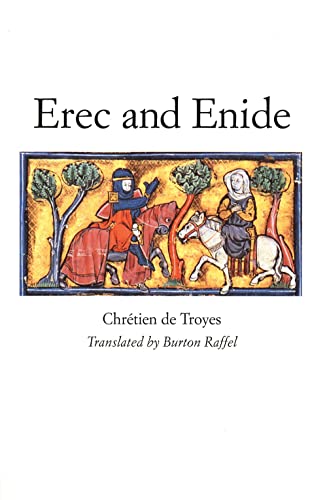
Erec and Enide, the first of five surviving Arthurian romantic poems by twelfth-century French poet Chrétien de Troyes, narrates a vivid chapter from the legend of King Arthur. Chrétien's romances became the source for Arthurian tradition and influenced countless other poets in England and on the Continent. Yet his swift-moving style is difficult to capture in translation, and today's English-speaking audiences remain largely unfamiliar with the pleasures of reading his poems.
Now an experienced translator of medieval verse who is himself a poet has translated Eric and Enide in an original three-stress metric verse form that fully captures the movement, the sense, and the spirit of the Old French original. Burton Raffel's rendition preserves the subtlety and charm of a poem that is in turn serious, dramatic, bawdy, merry, and satiric. Erec and Enide tells the story of Erec, a knight at King Arthur's court, whose retirement to domestic bliss with his beautiful new wife Enide takes him away from his chivalric duties. To regain his knightly honor, Erec sets out with Enide on a series of amazing adventures. Eric dispatches thieves and giants with prodigious strength and valor but treats his wife rather harshly for doubting his abilities. When Enide is kidnapped by a robber baron, Erec revives from near-death to perform a courageous rescue, and at length the two are reconciled.Les informations fournies dans la section « Synopsis » peuvent faire référence à une autre édition de ce titre.
Biographie de l'auteur
Chrétien de Troyes was a French poet and trouvère who flourished in the late 12th century. Little is known of his life, but he seems to have been from Troyes, or at least intimately connected with it, and between 1160 and 1172 he served at the court of his patroness Marie of France, Countess of Champagne, daughter of Eleanor of Aquitaine, perhaps as herald-at-arms (as Gaston Paris speculated). His work on Arthurian subjects represents some of the best regarded of medieval literature. His use of structure, particular in Yvain, the Knight of the Lion, has been seen as a step towards the modern novel. Chrétien's writing was very popular, as evidenced by the high number of surviving copies of his romances and their many adaptations into other languages. Three of Middle High German literature's finest examples, Wolfram von Eschenbach's Parzival and Hartmann von Aue's Erec and Iwein, were based on Perceval, Erec, and Yvain; the Three Welsh Romances associated with the Mabinogion, Peredur, son of Efrawg, Geraint and Enid, and Owain, or the Lady of the Fountain are derived from the same trio. Especially in the case of Peredur, however, the connection between the Welsh romances and their source is probably not direct, and has never been satisfactorily delineated. Chrétien also has the distinction of being the first writer to mention the Holy Grail (Perceval) and the love affair between Queen Guinevere and Lancelot (Lancelot), subjects of household recognition even today.
Présentation de l'éditeur
Erec and Enede was the first Arthurian romance (composed around A.D. 1170), also the first of five extant works by French court poet Chretien de Troyes. Erec and Enide, newly married and lost in erotic, conjugal bliss, are brought back to reality when gossip suggests that Erec, son of a king, prefers life at home to the existence of a fearless, heroic knight. Celtic legend, classical motifs, and ecclesiastical elements are masterfully interwoven in this tale, whose colloquial translation brings to life the clashing sounds of battle, de Troyes's multiple poetic tones and colorful expressions, and the rhyme and meter of the original. Both scholars and general readers will surely enjoy this story of the Erec’s quest for honor, glory, and the Arthurian way.
Les informations fournies dans la section « A propos du livre » peuvent faire référence à une autre édition de ce titre.
Résultats de recherche pour Erec and Enide

Image d'archives
Erec and Enide (Chretien de Troyes Romances S)
Edité par
Yale University Press, 1997
ISBN 10 : 0300067712
ISBN 13 : 9780300067712
Ancien ou d'occasion
Paperback
Vendeur : Midtown Scholar Bookstore, Harrisburg, PA, Etats-Unis
Évaluation du vendeur 5 sur 5 étoiles

Paperback. Etat : Very Good. Very Good - Crisp, clean, unread book with some shelfwear/edgewear, may have a remainder mark - NICE Standard-sized. N° de réf. du vendeur M0300067712Z2
Acheter D'occasion
EUR 2,12
Expédition à EUR 5,16
Expédition nationale : Etats-Unis
Expédition nationale : Etats-Unis
Quantité disponible : 10 disponible(s)
Image d'archives
Erec and Enide (Chretien de Troyes Romances S)
Edité par
Yale University Press, 1997
ISBN 10 : 0300067712
ISBN 13 : 9780300067712
Ancien ou d'occasion
Paperback
Vendeur : Midtown Scholar Bookstore, Harrisburg, PA, Etats-Unis
Évaluation du vendeur 5 sur 5 étoiles
Paperback. Etat : Good. Good - Bumped and creased book with tears to the extremities, but not affecting the text block, may have remainder mark or previous owner's name - GOOD Standard-sized. N° de réf. du vendeur M0300067712Z3
Acheter D'occasion
EUR 2,14
Expédition à EUR 5,16
Expédition nationale : Etats-Unis
Expédition nationale : Etats-Unis
Quantité disponible : 2 disponible(s)
Image d'archives
Erec and Enide (Chretien de Troyes Romances S)
Edité par
Yale University Press, 1997
ISBN 10 : 0300067712
ISBN 13 : 9780300067712
Ancien ou d'occasion
Paperback
Vendeur : Books From California, Simi Valley, CA, Etats-Unis
Évaluation du vendeur 4 sur 5 étoiles

Paperback. Etat : Good. Ex owner markings on prelim pages. N° de réf. du vendeur mon0003907607
Acheter D'occasion
EUR 3,11
Expédition à EUR 4,29
Expédition nationale : Etats-Unis
Expédition nationale : Etats-Unis
Quantité disponible : 1 disponible(s)
Image d'archives
Erec and Enide (Chretien de Troyes Romances S)
Edité par
Yale University Press, 1997
ISBN 10 : 0300067712
ISBN 13 : 9780300067712
Ancien ou d'occasion
Paperback
Vendeur : Half Price Books Inc., Dallas, TX, Etats-Unis
Évaluation du vendeur 5 sur 5 étoiles
Paperback. Etat : Very Good. Connecting readers with great books since 1972! Used books may not include companion materials, and may have some shelf wear or limited writing. We ship orders daily and Customer Service is our top priority! N° de réf. du vendeur S_466069725
Acheter D'occasion
EUR 4,19
Expédition à EUR 3,22
Expédition nationale : Etats-Unis
Expédition nationale : Etats-Unis
Quantité disponible : 1 disponible(s)
Image fournie par le vendeur
Erec and Enide
Edité par
YALE UNIVERSITY PRESS, 1997
ISBN 10 : 0300067712
ISBN 13 : 9780300067712
Ancien ou d'occasion
Couverture souple
Vendeur : eCampus, Lexington, KY, Etats-Unis
Évaluation du vendeur 4 sur 5 étoiles
Etat : Very Good. N° de réf. du vendeur U:9780300067712:ONHAND
Acheter D'occasion
EUR 4,87
Expédition à EUR 3,43
Expédition nationale : Etats-Unis
Expédition nationale : Etats-Unis
Quantité disponible : 1 disponible(s)
Image d'archives
Erec and Enide (Chretien de Troyes Romances S)
Edité par
Yale University Press, 1997
ISBN 10 : 0300067712
ISBN 13 : 9780300067712
Ancien ou d'occasion
Paperback
Vendeur : HPB-Ruby, Dallas, TX, Etats-Unis
Évaluation du vendeur 5 sur 5 étoiles
Paperback. Etat : Very Good. Connecting readers with great books since 1972! Used books may not include companion materials, and may have some shelf wear or limited writing. We ship orders daily and Customer Service is our top priority! N° de réf. du vendeur S_480358865
Acheter D'occasion
EUR 6,72
Expédition à EUR 3,22
Expédition nationale : Etats-Unis
Expédition nationale : Etats-Unis
Quantité disponible : 1 disponible(s)
Image d'archives
Erec and Enide
Edité par
Yale University Press, 1997
ISBN 10 : 0300067712
ISBN 13 : 9780300067712
Ancien ou d'occasion
Couverture souple
Vendeur : Better World Books, Mishawaka, IN, Etats-Unis
Évaluation du vendeur 5 sur 5 étoiles
Etat : Very Good. Pages intact with possible writing/highlighting. Binding strong with minor wear. Dust jackets/supplements may not be included. Stock photo provided. Product includes identifying sticker. Better World Books: Buy Books. Do Good. N° de réf. du vendeur 3168906-6
Acheter D'occasion
EUR 11,02
Livraison gratuite
Expédition nationale : Etats-Unis
Expédition nationale : Etats-Unis
Quantité disponible : 1 disponible(s)
Image d'archives
Erec and Enide (Chretien de Troyes Romances S)
Edité par
Yale University Press, 1997
ISBN 10 : 0300067712
ISBN 13 : 9780300067712
Ancien ou d'occasion
paperback
Vendeur : Textbooks_Source, Columbia, MO, Etats-Unis
Évaluation du vendeur 5 sur 5 étoiles
paperback. Etat : Good. New edition. Ships in a BOX from Central Missouri! May not include working access code. Will not include dust jacket. Has used sticker(s) and some writing or highlighting. UPS shipping for most packages, (Priority Mail for AK/HI/APO/PO Boxes). N° de réf. du vendeur 000348040U
Acheter D'occasion
EUR 10,37
Expédition à EUR 3,43
Expédition nationale : Etats-Unis
Expédition nationale : Etats-Unis
Quantité disponible : Plus de 20 disponibles
Image d'archives
Erec and Enide (Chretien de Troyes Romances S)
Edité par
Yale University Press, 1997
ISBN 10 : 0300067712
ISBN 13 : 9780300067712
Ancien ou d'occasion
paperback
Vendeur : One Planet Books, Columbia, MO, Etats-Unis
Évaluation du vendeur 5 sur 5 étoiles
paperback. Etat : Good. New edition. Ships in a BOX from Central Missouri! May not include working access code. Will not include dust jacket. Has used sticker(s) and some writing and/or highlighting. UPS shipping for most packages, (Priority Mail for AK/HI/APO/PO Boxes). N° de réf. du vendeur 000348040U
Acheter D'occasion
EUR 10,37
Expédition à EUR 3,43
Expédition nationale : Etats-Unis
Expédition nationale : Etats-Unis
Quantité disponible : Plus de 20 disponibles
Image d'archives
Erec and Enide (Chretien de Troyes Romances S)
Edité par
Yale University Press, 1997
ISBN 10 : 0300067712
ISBN 13 : 9780300067712
Ancien ou d'occasion
Paperback
Vendeur : Chaparral Books, Portland, OR, Etats-Unis
Évaluation du vendeur 5 sur 5 étoiles
Paperback. Etat : Very Good. First Paperback Edition First Pr. Minor wear to wraps. Light wear and soiling to edges of text block. Small Discoloration near foredge of half title page. Text and images unmarked. N° de réf. du vendeur SELtroERE
Acheter D'occasion
EUR 10,62
Expédition à EUR 6,45
Expédition nationale : Etats-Unis
Expédition nationale : Etats-Unis
Quantité disponible : 1 disponible(s)