
Articles liés à Rebuilding the Unity of Health And the Environment...
Rebuilding the Unity of Health And the Environment in Rural America: Workshop Summary - Couverture souple
Synopsis
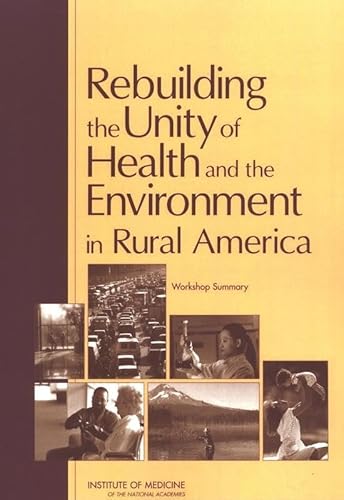
Throughout much of its history, the United States was predominantly a rural society. The need to provide sustenance resulted in many people settling in areas where food could be raised for their families. Over the past century, however, a quiet shift from a rural to an urban society occurred, such that by 1920, for the first time, more members of our society lived in urban regions than in rural ones. This was made possible by changing agricultural practices. No longer must individuals raise their own food, and the number of person-hours and acreage required to produce food has steadily been decreasing because of technological advances, according to Roundtable member James Merchant of the University of Iowa.
The Institute of Medicine's Roundtable on Environmental Health Science, Research, and Medicine held a regional workshop at the University of Iowa on November 29 and 30, 2004, to look at rural environmental health issues. Iowa, with its expanse of rural land area, growing agribusiness, aging population, and increasing immigrant population, provided an opportunity to explore environmental health in a region of the country that is not as densely populated. As many workshop participants agreed, the shifting agricultural practices as the country progresses from family operations to large-scale corporate farms will have impacts on environmental health.
This report describes and summarizes the participants' presentations to the Roundtable members and the discussions that the members had with the presenters and participants at the workshop.
Les informations fournies dans la section « Synopsis » peuvent faire référence à une autre édition de ce titre.
À propos de l'auteur
James Merchant, Christine Coussens, and Dalia Gilbert, Editors, Roundtable on Environmental Health Sciences, Research, and Medicine
Les informations fournies dans la section « A propos du livre » peuvent faire référence à une autre édition de ce titre.
Résultats de recherche pour Rebuilding the Unity of Health And the Environment...

Image fournie par le vendeur
Rebuilding the Unity of Health And the Environment in Rural America : Workshop Summary
Edité par
National Academies Press, 2006
ISBN 10 : 030910047X
ISBN 13 : 9780309100472
Neuf
Couverture souple
Vendeur : GreatBookPrices, Columbia, MD, Etats-Unis
Évaluation du vendeur 5 sur 5 étoiles

Etat : New. N° de réf. du vendeur 6525918-n
Acheter neuf
EUR 52,40
Expédition à EUR 2,36
Expédition nationale : Etats-Unis
Expédition nationale : Etats-Unis
Quantité disponible : 3 disponible(s)
Image d'archives
Rebuilding the Unity of Health and the Environment in Rural America
Vendeur : PBShop.store US, Wood Dale, IL, Etats-Unis
Évaluation du vendeur 5 sur 5 étoiles
PAP. Etat : New. New Book. Shipped from UK. Established seller since 2000. N° de réf. du vendeur GB-9780309100472
Acheter neuf
EUR 54,84
Livraison gratuite
Expédition nationale : Etats-Unis
Expédition nationale : Etats-Unis
Quantité disponible : 3 disponible(s)
Image fournie par le vendeur
Rebuilding the Unity of Health And the Environment in Rural America : Workshop Summary
Edité par
National Academies Press, 2006
ISBN 10 : 030910047X
ISBN 13 : 9780309100472
Ancien ou d'occasion
Couverture souple
Vendeur : GreatBookPrices, Columbia, MD, Etats-Unis
Évaluation du vendeur 5 sur 5 étoiles
Etat : As New. Unread book in perfect condition. N° de réf. du vendeur 6525918
Acheter D'occasion
EUR 54,24
Expédition à EUR 2,36
Expédition nationale : Etats-Unis
Expédition nationale : Etats-Unis
Quantité disponible : 3 disponible(s)
Image d'archives
Rebuilding the Unity of Health and the Environment in Rural America
Vendeur : PBShop.store UK, Fairford, GLOS, Royaume-Uni
Évaluation du vendeur 5 sur 5 étoiles
PAP. Etat : New. New Book. Shipped from UK. Established seller since 2000. N° de réf. du vendeur GB-9780309100472
Acheter neuf
EUR 52,53
Expédition à EUR 4,91
Expédition depuis Royaume-Uni vers Etats-Unis
Expédition depuis Royaume-Uni vers Etats-Unis
Quantité disponible : 2 disponible(s)
Image fournie par le vendeur
Rebuilding the Unity of Health and the Environment in Rural America
Edité par
National Academies Press, US, 2006
ISBN 10 : 030910047X
ISBN 13 : 9780309100472
Neuf
Paperback
Vendeur : Rarewaves.com USA, London, LONDO, Royaume-Uni
Évaluation du vendeur 5 sur 5 étoiles
Paperback. Etat : New. Throughout much of its history, the United States was predominantly a rural society. The need to provide sustenance resulted in many people settling in areas where food could be raised for their families. Over the past century, however, a quiet shift from a rural to an urban society occurred, such that by 1920, for the first time, more members of our society lived in urban regions than in rural ones. This was made possible by changing agricultural practices. No longer must individuals raise their own food, and the number of person-hours and acreage required to produce food has steadily been decreasing because of technological advances, according to Roundtable member James Merchant of the University of Iowa. The Institute of Medicine's Roundtable on Environmental Health Science, Research, and Medicine held a regional workshop at the University of Iowa on November 29 and 30, 2004, to look at rural environmental health issues. Iowa, with its expanse of rural land area, growing agribusiness, aging population, and increasing immigrant population, provided an opportunity to explore environmental health in a region of the country that is not as densely populated.As many workshop participants agreed, the shifting agricultural practices as the country progresses from family operations to large-scale corporate farms will have impacts on environmental health. This report describes and summarizes the participants' presentations to the Roundtable members and the discussions that the members had with the presenters and participants at the workshop. N° de réf. du vendeur LU-9780309100472
Acheter neuf
EUR 59,76
Livraison gratuite
Expédition depuis Royaume-Uni vers Etats-Unis
Expédition depuis Royaume-Uni vers Etats-Unis
Quantité disponible : 1 disponible(s)
Image d'archives
Rebuilding the Unity of Health and the Environment in Rural America
Edité par
National Academies Press, 2006
ISBN 10 : 030910047X
ISBN 13 : 9780309100472
Neuf
Couverture souple
Vendeur : Kennys Bookshop and Art Galleries Ltd., Galway, GY, Irlande
Évaluation du vendeur 5 sur 5 étoiles
Etat : New. Rebuilding the Unity of Health and the Environment in Rural America: Workshop Summary (2006) Editor(s): Merchant, James; Coussens, Christine M.; Gilbert, Dalia. Num Pages: 116 pages, illustrations. BIC Classification: 1KBB; MBP. Category: (P) Professional & Vocational. Dimension: 229 x 152. . . 2006. Paperback. . . . . N° de réf. du vendeur V9780309100472
Acheter neuf
EUR 50,39
Expédition à EUR 9,50
Expédition depuis Irlande vers Etats-Unis
Expédition depuis Irlande vers Etats-Unis
Quantité disponible : 2 disponible(s)
Image fournie par le vendeur
Rebuilding the Unity of Health and the Environment in Rural America
Edité par
National Academies Press, US, 2006
ISBN 10 : 030910047X
ISBN 13 : 9780309100472
Neuf
Paperback
Vendeur : Rarewaves USA, HEBRON, KY, Etats-Unis
Évaluation du vendeur 5 sur 5 étoiles
Paperback. Etat : New. Throughout much of its history, the United States was predominantly a rural society. The need to provide sustenance resulted in many people settling in areas where food could be raised for their families. Over the past century, however, a quiet shift from a rural to an urban society occurred, such that by 1920, for the first time, more members of our society lived in urban regions than in rural ones. This was made possible by changing agricultural practices. No longer must individuals raise their own food, and the number of person-hours and acreage required to produce food has steadily been decreasing because of technological advances, according to Roundtable member James Merchant of the University of Iowa. The Institute of Medicine's Roundtable on Environmental Health Science, Research, and Medicine held a regional workshop at the University of Iowa on November 29 and 30, 2004, to look at rural environmental health issues. Iowa, with its expanse of rural land area, growing agribusiness, aging population, and increasing immigrant population, provided an opportunity to explore environmental health in a region of the country that is not as densely populated.As many workshop participants agreed, the shifting agricultural practices as the country progresses from family operations to large-scale corporate farms will have impacts on environmental health. This report describes and summarizes the participants' presentations to the Roundtable members and the discussions that the members had with the presenters and participants at the workshop. N° de réf. du vendeur LU-9780309100472
Acheter neuf
EUR 62,53
Livraison gratuite
Expédition nationale : Etats-Unis
Expédition nationale : Etats-Unis
Quantité disponible : 1 disponible(s)
Image d'archives
Rebuilding the Unity of Health and the Environment in Rural America (Paperback)
Edité par
National Academies Press, Washington, 2006
ISBN 10 : 030910047X
ISBN 13 : 9780309100472
Neuf
Paperback
Edition originale
Vendeur : Grand Eagle Retail, Bensenville, IL, Etats-Unis
Évaluation du vendeur 5 sur 5 étoiles
Paperback. Etat : new. Paperback. Throughout much of its history, the United States was predominantly a rural society. The need to provide sustenance resulted in many people settling in areas where food could be raised for their families. Over the past century, however, a quiet shift from a rural to an urban society occurred, such that by 1920, for the first time, more members of our society lived in urban regions than in rural ones. This was made possible by changing agricultural practices. No longer must individuals raise their own food, and the number of person-hours and acreage required to produce food has steadily been decreasing because of technological advances, according to Roundtable member James Merchant of the University of Iowa. The Institute of Medicine's Roundtable on Environmental Health Science, Research, and Medicine held a regional workshop at the University of Iowa on November 29 and 30, 2004, to look at rural environmental health issues. Iowa, with its expanse of rural land area, growing agribusiness, aging population, and increasing immigrant population, provided an opportunity to explore environmental health in a region of the country that is not as densely populated.As many workshop participants agreed, the shifting agricultural practices as the country progresses from family operations to large-scale corporate farms will have impacts on environmental health. This report describes and summarizes the participants' presentations to the Roundtable members and the discussions that the members had with the presenters and participants at the workshop. Rebuilding the Unity of Health and the Environment in Rural America: Workshop Summary (2006) Shipping may be from multiple locations in the US or from the UK, depending on stock availability. N° de réf. du vendeur 9780309100472
Acheter neuf
EUR 67,13
Livraison gratuite
Expédition nationale : Etats-Unis
Expédition nationale : Etats-Unis
Quantité disponible : 1 disponible(s)
Image fournie par le vendeur
Rebuilding the Unity of Health And the Environment in Rural America : Workshop Summary
Edité par
National Academies Press, 2006
ISBN 10 : 030910047X
ISBN 13 : 9780309100472
Neuf
Couverture souple
Vendeur : GreatBookPricesUK, Woodford Green, Royaume-Uni
Évaluation du vendeur 5 sur 5 étoiles
Etat : New. N° de réf. du vendeur 6525918-n
Acheter neuf
EUR 52,52
Expédition à EUR 17,70
Expédition depuis Royaume-Uni vers Etats-Unis
Expédition depuis Royaume-Uni vers Etats-Unis
Quantité disponible : 3 disponible(s)
Image d'archives
Rebuilding the Unity of Health and the Environment in Rural America: Workshop Summary
Edité par
National Academies Press, 2006
ISBN 10 : 030910047X
ISBN 13 : 9780309100472
Neuf
Couverture souple
Vendeur : Ria Christie Collections, Uxbridge, Royaume-Uni
Évaluation du vendeur 5 sur 5 étoiles
Etat : New. In English. N° de réf. du vendeur ria9780309100472_new
Acheter neuf
EUR 60,06
Expédition à EUR 11,05
Expédition depuis Royaume-Uni vers Etats-Unis
Expédition depuis Royaume-Uni vers Etats-Unis
Quantité disponible : 2 disponible(s)