
Museums in the Second World War - Couverture souple
Livre 25 sur 113: Routledge Studies in Modern History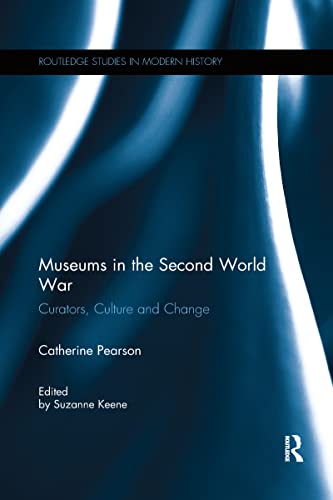
Synopsis
Exploring the role of museums, galleries and curators during the upheaval of the Second World War, this book challenges the accepted view of a hiatus in museum services during the conflict and its immediate aftermath. Instead it argues that new thinking in the 1930s was realised in a number of promising initiatives during the war only to fail during the fragmented post-war recovery. Based on new research including interviews with retired museum staff, letters, diaries, museum archives and government records, this study reveals a complex picture of both innovation and inertia.
At the outbreak of war precious objects were stored away and staff numbers reduced, but although many museums were closed, others successfully campaigned to remain open. By providing innovative modern exhibitions and education initiatives they became popular and valued venues for the public. After the war, however, museums returned to their more traditional, collections-centred approach and failed to negotiate the public funding needed for reconstruction based on this narrower view of their role. Hence, in the longer term, the destruction and economic and social consequences of the conflict served to delay aspirations for reconstruction until the 1960s. Through this lens, the history of the museum in the mid-twentieth century appears as one shaped by the effects of war but equally determined by the input of curators, audiences and the state. The museum thus emerges not as an isolated institution concerned only with presenting the past but as a product of the changing conflicts and cultures within society.
Les informations fournies dans la section « Synopsis » peuvent faire référence à une autre édition de ce titre.
À propos de l'auteur
Catherine Pearson, Author, Independent Historian and Scholar, UK. She is the editor of the journals of museum curator, E.J. Rudsdale, 1920-1951.
Suzanne Keene, Editor, Reader Emeritus at University College London. She has a number of published books on museum collections, most recently co-authoring Museums and Silent Objects: Designing Effective Exhibitions.
Les informations fournies dans la section « A propos du livre » peuvent faire référence à une autre édition de ce titre.
Autres éditions populaires du même titre

Résultats de recherche pour Museums in the Second World War

Image d'archives
Museums in the Second World War
impression à la demandeVendeur : Basi6 International, Irving, TX, Etats-Unis
Évaluation du vendeur 5 sur 5 étoiles

Etat : Brand New. New. US edition. Print on demand title. Delivery takes 20-25 days. N° de réf. du vendeur POD-603334
Acheter neuf
EUR 57,90
Livraison gratuite
Expédition nationale : Etats-Unis
Expédition nationale : Etats-Unis
Quantité disponible : Plus de 20 disponibles
Image d'archives
Museums in the Second World War (Routledge Studies in Modern History)
Vendeur : California Books, Miami, FL, Etats-Unis
Évaluation du vendeur 4 sur 5 étoiles

Etat : New. N° de réf. du vendeur I-9780367595043
Acheter neuf
EUR 68,43
Livraison gratuite
Expédition nationale : Etats-Unis
Expédition nationale : Etats-Unis
Quantité disponible : Plus de 20 disponibles
Image d'archives
Museums in the Second World War: Curators, Culture and Change
Vendeur : Majestic Books, Hounslow, Royaume-Uni
Évaluation du vendeur 4 sur 5 étoiles
Etat : New. pp. 296. N° de réf. du vendeur 385821647
Acheter neuf
EUR 63,66
Expédition à EUR 7,64
Expédition depuis Royaume-Uni vers Etats-Unis
Expédition depuis Royaume-Uni vers Etats-Unis
Quantité disponible : 3 disponible(s)
Image fournie par le vendeur
Museums in the Second World War
Edité par
Taylor & Francis, Routledge, 2020
ISBN 10 : 0367595044
ISBN 13 : 9780367595043
Neuf
Taschenbuch
Vendeur : BuchWeltWeit Ludwig Meier e.K., Bergisch Gladbach, Allemagne
Évaluation du vendeur 5 sur 5 étoiles
Taschenbuch. Etat : Neu. This item is printed on demand - it takes 3-4 days longer - Neuware -Exploring the role of museums, galleries and curators during the upheaval of the Second World War, this book challenges the accepted view of a hiatus in museum services during the conflict and its immediate aftermath. Instead it argues that new thinking in the 1930s was realised in a number of promising initiatives during the war only to fail during the fragmented post-war recovery. Based on new research including interviews with retired museum staff, letters, diaries, museum archives and government records, this study reveals a complex picture of both innovation and inertia. At the outbreak of war precious objects were stored away and staff numbers reduced, but although many museums were closed, others successfully campaigned to remain open. By providing innovative modern exhibitions and education initiatives they became popular and valued venues for the public. After the war, however, museums returned to their more traditional, collections-centred approach and failed to negotiate the public funding needed for reconstruction based on this narrower view of their role. Hence, in the longer term, the destruction and economic and social consequences of the conflict served to delay aspirations for reconstruction until the 1960s. Through this lens, the history of the museum in the mid-twentieth century appears as one shaped by the effects of war but equally determined by the input of curators, audiences and the state. The museum thus emerges not as an isolated institution concerned only with presenting the past but as a product of the changing conflicts and cultures within society. 296 pp. Englisch. N° de réf. du vendeur 9780367595043
Acheter neuf
EUR 53,40
Expédition à EUR 23
Expédition depuis Allemagne vers Etats-Unis
Expédition depuis Allemagne vers Etats-Unis
Quantité disponible : 2 disponible(s)
Image d'archives
Museums in the Second World War
Vendeur : PBShop.store UK, Fairford, GLOS, Royaume-Uni
Évaluation du vendeur 5 sur 5 étoiles
PAP. Etat : New. New Book. Shipped from UK. Established seller since 2000. N° de réf. du vendeur L2-9780367595043
Acheter neuf
EUR 70,77
Expédition à EUR 5,90
Expédition depuis Royaume-Uni vers Etats-Unis
Expédition depuis Royaume-Uni vers Etats-Unis
Quantité disponible : Plus de 20 disponibles
Image d'archives
Museums in the Second World War: Curators, Culture and Change
Vendeur : Books Puddle, New York, NY, Etats-Unis
Évaluation du vendeur 4 sur 5 étoiles
Etat : New. pp. 296. N° de réf. du vendeur 26378049552
Acheter neuf
EUR 77,39
Expédition à EUR 3,49
Expédition nationale : Etats-Unis
Expédition nationale : Etats-Unis
Quantité disponible : 3 disponible(s)
Image d'archives
Museums in the Second World War (Routledge Studies in Modern History)
Vendeur : Ria Christie Collections, Uxbridge, Royaume-Uni
Évaluation du vendeur 5 sur 5 étoiles
Etat : New. In. N° de réf. du vendeur ria9780367595043_new
Acheter neuf
EUR 69,89
Expédition à EUR 14,09
Expédition depuis Royaume-Uni vers Etats-Unis
Expédition depuis Royaume-Uni vers Etats-Unis
Quantité disponible : Plus de 20 disponibles
Image d'archives
Museums in the Second World War: Curators, Culture and Change
Vendeur : Biblios, Frankfurt am main, HESSE, Allemagne
Évaluation du vendeur 4 sur 5 étoiles
Etat : New. pp. 296. N° de réf. du vendeur 18378049562
Acheter neuf
EUR 74,95
Expédition à EUR 9,95
Expédition depuis Allemagne vers Etats-Unis
Expédition depuis Allemagne vers Etats-Unis
Quantité disponible : 3 disponible(s)
Image d'archives
Museums in the Second World War: Curators, Culture and Change
Edité par
Taylor & Francis Ltd, 2020
ISBN 10 : 0367595044
ISBN 13 : 9780367595043
Neuf
Paperback / softback
Vendeur : THE SAINT BOOKSTORE, Southport, Royaume-Uni
Évaluation du vendeur 5 sur 5 étoiles
Paperback / softback. Etat : New. New copy - Usually dispatched within 4 working days. N° de réf. du vendeur B9780367595043
Acheter neuf
EUR 67,26
Expédition à EUR 17,80
Expédition depuis Royaume-Uni vers Etats-Unis
Expédition depuis Royaume-Uni vers Etats-Unis
Quantité disponible : 1 disponible(s)
Image d'archives
Museums in the Second World War: Curators, Culture and Change (Routledge Studies in Modern History)
Edité par
Routledge, 2020
ISBN 10 : 0367595044
ISBN 13 : 9780367595043
Neuf
Couverture souple
Edition originale
Vendeur : Kennys Bookshop and Art Galleries Ltd., Galway, GY, Irlande
Évaluation du vendeur 5 sur 5 étoiles
Etat : New. 2020. 1st Edition. paperback. . . . . . N° de réf. du vendeur V9780367595043
Acheter neuf
EUR 78,82
Expédition à EUR 10,50
Expédition depuis Irlande vers Etats-Unis
Expédition depuis Irlande vers Etats-Unis
Quantité disponible : Plus de 20 disponibles